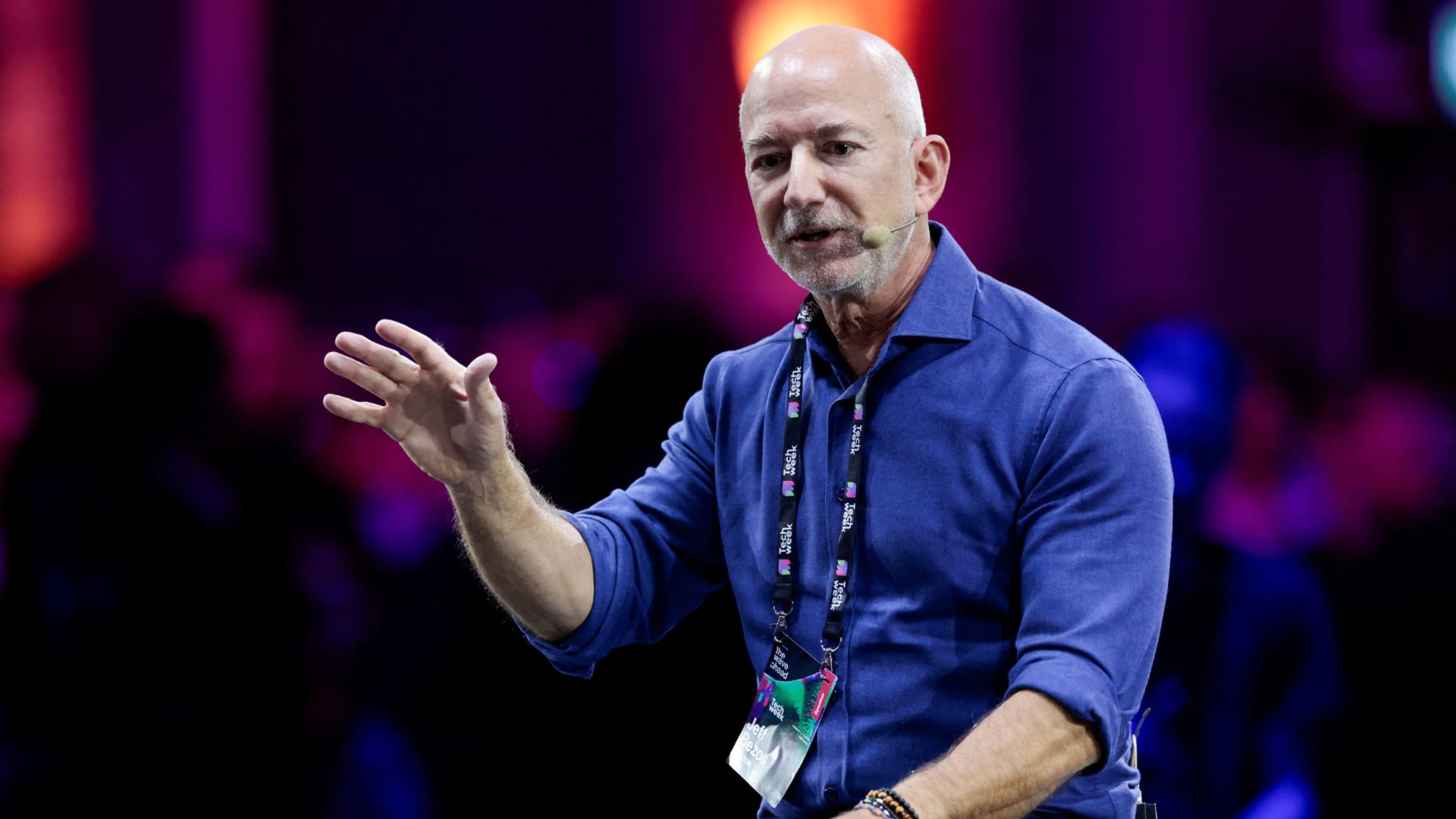
Amazon founder Jeff Bezos told CNBC on Wednesday that investors should not fear an artificial intelligence bubble, even if one exists. The foundation of his argument: the massive capital deployment happening now will push the technology forward regardless of pricing accuracy in individual deals.
“Even if it does turn out to be a bubble, you shouldn't worry about it because the bubble is driving investment and a lot of the investment is going to turn out to be very healthy,” Bezos said during an interview on “Squawk Box.”
The comment comes as hyperscalers – Amazon, Microsoft and Google – are collectively projected to spend over $700 billion on AI infrastructure this year. Record valuations and deal activity have accompanied those outlays, intensifying the AI bubble debate.
Bezos's Capital Allocation Argument
The simple read: a billionaire founder dismisses bubble fears, giving bulls a narrative anchor. The better market read is more precise. Bezos is not arguing that current AI valuations are rational. He is arguing that the allocation mechanism – funding every experiment, including bad ideas – generates compound progress. Some projects will fail. The winners will absorb the learning and scale.
This logic rests on compound optionality. Massive sunk costs in compute, data-center real estate and chip orders create barriers to entry and accelerate the technology frontier. Bezos also implicitly trusts that hyperscaler balance sheets can absorb the waste. The risk is not total capital loss. It is a timing mismatch between upfront spending and revenue generation.
Why Hyperscaler Spending Matters Now
For Microsoft, Amazon Web Services and Google Cloud, that $700 billion capital expenditure is not discretionary. The three are locked in a capacity arms race for NVIDIA GPUs and proprietary silicon. Each company faces a collective-action problem: stop investing and lose market share, keep investing and risk low returns if AI adoption slows.
Bezos’s framing suggests that even a sharp retrenchment in AI hype would not destroy the physical assets built today. Data centers can be repurposed. Cloud capacity is fungible. The real question for stocks like MSFT (Alpha Score 50/100, Mixed, currently $417.42, down 1.44%) is whether revenue from AI services grows fast enough to absorb depreciation and power costs.
The AI Data Center Buildout Drives Convertible Bond Issuance Surge article notes that the sector is increasingly using debt to fund capex. That introduces financial leverage risk, a factor Bezos did not address. If AI revenue disappoints, the servicing burden will become a stock-specific headwind.
The Cash Flow Test for AI Stocks
For traders watching Amazon, Microsoft and Google, the next decision point is not a founder's opinion. It is earnings season. Investors need to see whether hyperscaler AI revenue growth is accelerating faster than the capital costs tied to that $700 billion buildout.
Confirming signals: forward guidance showing AI-driven cloud revenue growing at a premium to total cloud growth, and rising utilization rates for deployed capacity. Weakening signals: management teams that begin to signal capital spending pullbacks or extend time frames for AI monetization.
Bezos’s view is a useful lens on capital allocation. It does not eliminate execution risk. The bubble debate will be settled by cash flow statements, not by billionaire opinions.