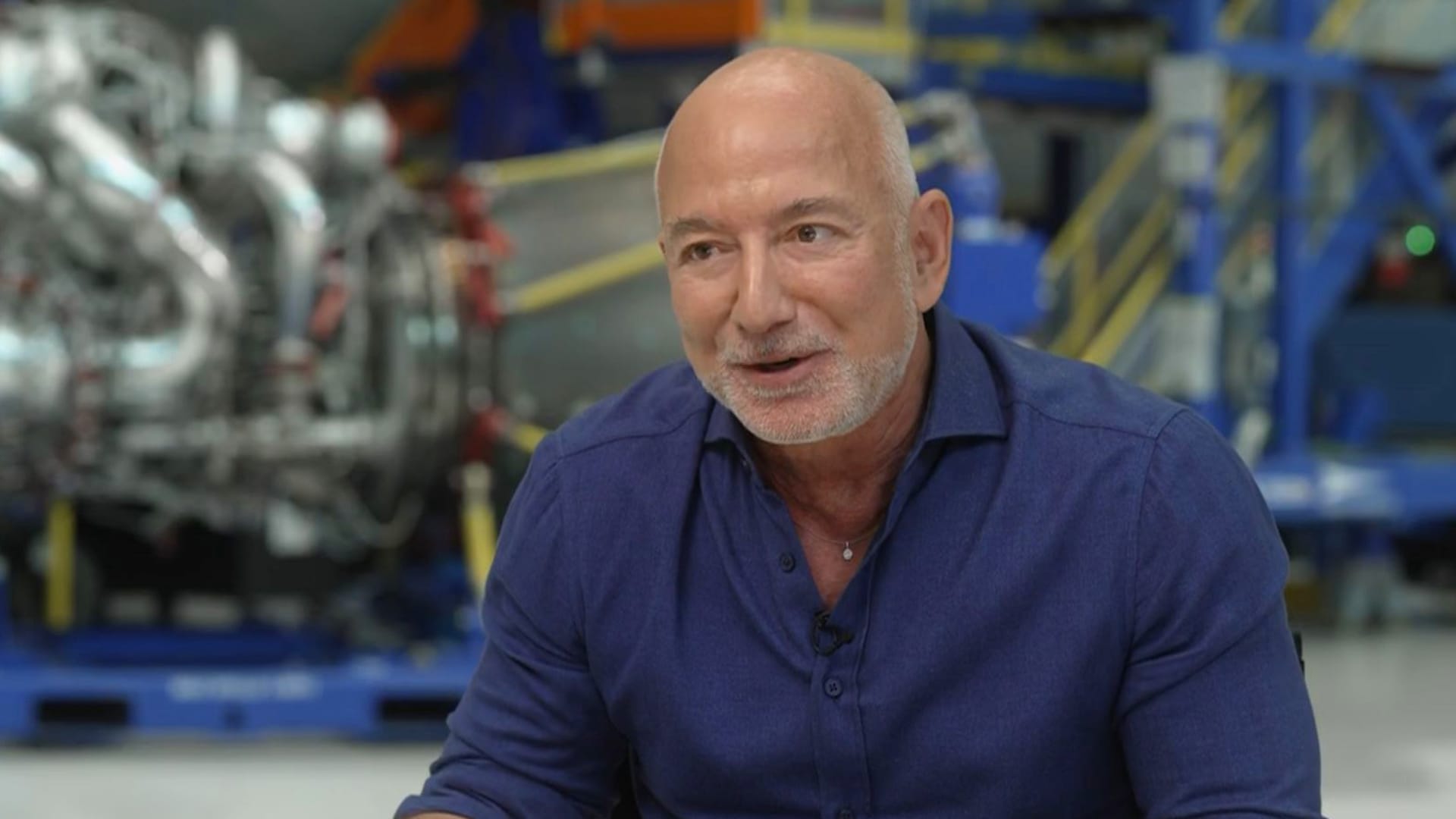
Jeff Bezos used a Wednesday CNBC interview to defend the wealth of billionaires, argue against taxing the rich more, and predict that artificial intelligence will deflate prices across the economy. The Amazon founder also praised President Donald Trump as a "more mature, more disciplined version of himself" and rejected claims that Amazon's Melania Trump documentary was a political favor.
The interview with Andrew Ross Sorkin covered tax policy, AI regulation, housing costs, and the "buy, borrow, die" strategy often attributed to the ultra-wealthy. Bezos struck a populist note early, calling the U.S. "a tale of two economies" and proposing to eliminate income taxes for the bottom half of earners. He quickly pivoted to defending billionaires against what he called "vilification" by politicians.
The Tax Proposal and the Limits of Bezos's Populism
Bezos opened by acknowledging that many Americans are struggling financially. He then proposed a specific tax cut: eliminating income taxes for the bottom half of U.S. earners. "A nurse in Queens who makes $75,000 a year pays more than $12,000 a year in taxes," Bezos said. "Does that really make sense?"
When asked whether that cut should be paired with higher rates for top earners, Bezos called it "a valid debate to have" and immediately criticized the framing. "We already have the most progressive tax system in the world," he said, arguing that overspending, not revenue, is the source of the country's fiscal problems.
The Billionaire Tax Debate
Bezos pushed back on critics like Senator Elizabeth Warren who accuse him of not paying enough. "People sometimes say that, you know, I don't pay taxes. Not true. I pay billions of dollars in taxes," he said. He argued that raising his taxes would not solve broader problems: "You could double the taxes I pay, and it's not going to help that teacher in Queens, I promise you."
New York City Mayor Zohran Mamdani responded on X later Wednesday: "I know a few teachers in Queens who would beg to differ."
The "Buy, Borrow, Die" Denial
Bezos flatly denied the widespread accusation that billionaires use a strategy called "buy, borrow, die" – borrowing against assets to avoid taxes. "There's no truth to this 'buy, borrow, die' thing. I don't even know where this comes from," he said. "I'm selling Amazon stock routinely."
When Sorkin noted that Elon Musk takes out large loans against his stock, Bezos said, "I'm a little skeptical that that's a true loophole, if it is, can we fix it? Then we should." He added that closing such a loophole would not help the nurse in Queens.
AI as a Deflationary Force, Not a Job Killer
Bezos dismissed fears that artificial intelligence will displace workers, arguing instead that the technology will augment employees and improve the economy. "I think those people are dead wrong," he said of AI's naysayers. "What's really going to happen is that it's going to elevate all of these people."
He predicted that AI will boost productivity, resulting in deflation across a range of goods and services – only if regulators do not intervene too early. "We let this technology play out and don't hamstring it with regulation too early," Bezos said.
The Public Perception Gap
Bezos's optimism runs counter to recent polling. A Pew Research Center survey found half of U.S. adults are more concerned than excited about the increased use of AI in daily life. Respondents pointed to potential harms on creativity and relationships and expressed pessimism about its impact on education and jobs.
The rapid development of AI data centers has also sparked backlash from communities concerned about their impact on nearby residents. The rise of AI coding tools from companies like Anthropic and Cursor has spurred fears that they could displace software engineers and programmers.
Bezos argued that AI coding tools are not a threat to software engineers. He said they will help programmers identify and solve problems in their work. "It's just that the work is going to be done at a higher level," Bezos said. "It's going to be done with a bulldozer instead of a shovel, and that's going to be a good thing."
Trump, Politics, and the Melania Documentary
Bezos told Sorkin he believes President Donald Trump is "a more mature, more disciplined version of himself than he was in his first term." He added, "Trump has lots of good ideas, and he has done a lot of – he's been right about a lot of things. You have to give him credit where credit is due."
Bezos did not offer specifics. Trump's second-term administration has repeatedly waded into the free market to boost certain companies, including Intel, Boeing, and U.S. Steel.
The Documentary Controversy
Bezos rejected accusations that Amazon's decision to release a pricey documentary on first lady Melania Trump was an effort to curry favor with the president. "The Melania thing is a falsehood that will not die," he said.
He framed his political engagement as nonpartisan, noting that he has also been in touch with Democratic former Presidents Barack Obama and Joe Biden. "We need our business leaders to provide input into the administration, regardless of who the president is," Bezos said. "I'm on the side of America. And that's where business leaders should be."
The Free-Market Defense of Billionaires
Bezos's belief in free-market principles was clearest in his rebuke of the narrative that billionaires' vast wealth can never be earned fairly. "It's not correct on its face," Bezos said of that view, which has been espoused by politicians including Representative Alexandria Ocasio-Cortez.
He pointed to major fast-food chains In-N-Out Burger and Raising Cane's Chicken Fingers as examples. "The way you make $1 billion, or $100 million or $10 million or anything, is you create a service that people love, if millions of people choose your service, you're going to end up with a billion dollars," he said. "Just try it with a chicken franchise."
Housing and Government Intervention
Bezos blamed high rent prices on government intervention in markets. He acknowledged "way too much influence in politics" from corporations and "in some cases, wealthy people" and also called out unions for political interference.
He criticized New York City Mayor Mamdani over a video calling out Citadel CEO Ken Griffin while unveiling a new pied-à-terre tax. "It isn't right" for the mayor to "stand in front of Ken Griffin's house and act like he is some kind of villain," Bezos said. "Ken Griffin isn't a villain, he hasn't hurt anybody, he's not hurting New York, in fact quite the opposite."
What This Means for Markets
Bezos's interview carries weight for investors in Amazon (AMZN), which remains a bellwether for consumer spending, cloud computing, and AI infrastructure. His defense of AI as deflationary rather than job-destroying aligns with the bull case for large-cap tech companies investing heavily in AI data centers and tools.
His tax proposal – eliminating income taxes for the bottom half of earners – would boost consumer spending power if enacted, benefiting Amazon's retail business directly. Bezos offered no path to implementation, and the political odds of such a proposal passing are low.
For investors tracking regulatory risk, Bezos's call to avoid "hamstringing" AI with regulation too early signals that Amazon will continue to lobby against AI oversight. That stance puts Amazon at odds with European regulators and some U.S. lawmakers who favor stricter rules.
On the political front, Bezos's praise for Trump suggests Amazon may face less antitrust pressure from the current administration than it did during Trump's first term, when Trump frequently criticized Bezos and the Washington Post.
The AlphaScala View
Bezos's interview is a reminder that the world's fourth-richest person sees his interests as aligned with broad economic growth, not zero-sum redistribution. His tax proposal for low earners is notable for its specificity – a rare concrete policy idea from a tech CEO. His defense of billionaires and rejection of higher top-end taxes will keep him at odds with progressive politicians.
For Amazon shareholders, the key takeaway is Bezos's confidence in AI as a deflationary force that will boost productivity across the economy. If he is right, Amazon's AWS business and its retail margins both benefit. If he is wrong – and AI displaces workers faster than it creates new roles – the political backlash could lead to regulation that slows Amazon's AI investments.
On AlphaScala's platform, Amazon carries a Moderate Alpha Score of 59/100, reflecting balanced risk-reward in the current environment. Investors should watch for any concrete policy proposals from the Trump administration that could affect Amazon's tax burden or AI regulation.
Bezos's interview did not move Amazon's stock price significantly. It provided a clear framework for how one of the world's most influential business leaders sees the next decade unfolding: more AI, less regulation, lower taxes for the poor, and no new taxes for the rich.