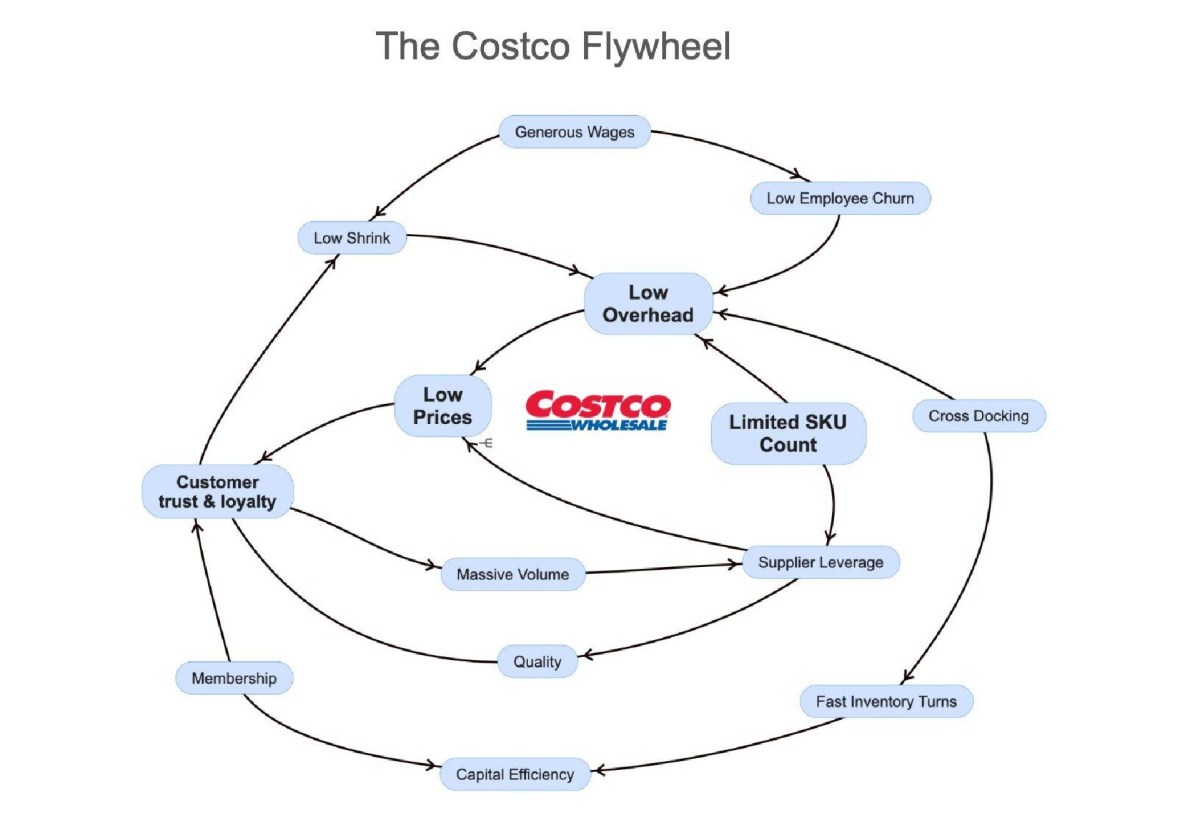
David Shillingford tagged me in his recent LinkedIn post. The tag comes with one major obligation: think critically, respond wisely. Unfortunately, LinkedIn limits the character count of comments, sometimes reducing a needed longer answer into a limited and insufficient soundbite. That is the reason for writing this post.
I love a 'flywheel' graphic. Who doesn't?! They portray some of the most brilliant and sustainable businesses at a glance.
I have been inspired to sketch them out (see Costco and Trader Joe's in the carousel*) but, as you can see, graphics is not my strength.
So you can imagine my excitement when, in a recent Acquired episode, Ben and David described a graphic of the Disney flywheel ('synergy map' or 'profit formula' as Walt called it) that had appeared in a Wall Street Journal article in 1958 and was drawn by a Disney artist. Amazing.
As usual, David, your posts inspire critical thinking.
Looking at the Disney, Costco, and Trader Joe's flywheels, what strikes me is that the value isn't really contained in any individual box. It emerges from the relationships between them. Your point about discipline is therefore important: durable businesses protect and reinforce the relationships that make the flywheel work.
But your post raises another question for me: how did we discover which relationships belonged on the flywheel in the first place?
A flywheel necessarily maps relationships we already know or believe matter. What happens when the relationship determining the outcome isn't on the map?
That is the distinction behind the attached graphic – The Map You Design vs. The Map You Trace. The map on the left starts with what we understand about the system and maps forward toward the intended outcome. The map on the right starts with an outcome that is already failing and traces backward, following the evidence wherever it goes – even outside the organizational boundaries and relationships anyone originally thought relevant.
In the 1998 case shown here, a procurement delivery failure ultimately traced through service behavior, procurement practices, suppliers, customs, and finance. None of those relationships appeared together on the original process map. Yet together they were producing the outcome.
So perhaps there is a second form of discipline sitting underneath the one you identify: not only the discipline to protect the relationships already on the flywheel, but the discipline to keep discovering the relationships that reality tells us should be there.
That becomes especially important as AI turns our maps into executable models. An omitted arrow is no longer simply something management doesn't see. It can become something the technology systematically doesn't see.
I wrote about the distinction here: The Map You Design and the Map You Trace