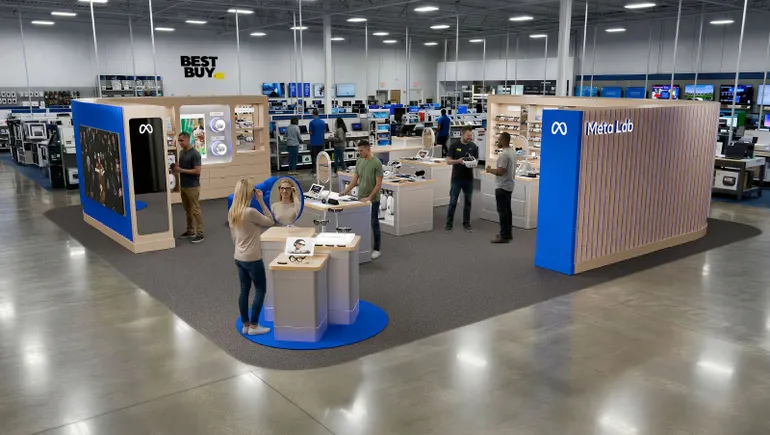
Best Buy is opening Meta Lab @ Best Buy shop-in-shops at 50 locations this summer, a physical retail test for Meta’s AI glasses and VR headsets. The first stores are in San Carlos, California; Woodland Park, New Jersey; Greenville, South Carolina; and Columbus, Ohio. The rollout follows a Q1 earnings report that showed revenue up 2% to $8.9 billion and net earnings up 37% to $276 million, providing the financial capacity to fund new store formats.
“Our customers are passionate about experiencing what’s next and they turn to Best Buy to bring it to life,” Patrick McGinnis, chief merchandising officer at Best Buy, said in a statement. “Meta Lab @ Best Buy is an experience customers can’t find at any other retailer and sets a new standard for how our customers will explore, play with and discover the latest cutting-edge tech.”
Why 50 Stores Now: Q1 Earnings Clear the Path
Revenue and Comps Stabilize the Baseline
Best Buy’s enterprise revenue rose 2% to $8.9 billion in the first quarter, with comparable sales up 2%. The growth is modest after a stretch of consumer electronics weakness. The comp figure matters because it shows foot traffic and basket size are stabilizing, which is the baseline for any new store-within-a-store experiment.
Net Earnings Jump 37%
Net earnings climbed to $276 million from about $201.5 million a year earlier. The 37% increase came from cost controls and a shift toward higher-margin services and membership revenue. That earnings cushion allows Best Buy to fund the Meta Lab rollout, the Ikea shop-in-shops, and the Yardbird outdoor experience without straining the balance sheet.
Cash Flow and Investment Capacity
Best Buy did not disclose free cash flow in the release. However the earnings growth implies stronger operating cash generation. The company uses that capacity to open more medium- and small-format locations while optimizing empty space in larger stores. The Meta Lab concept fits into the latter: converting underused floor space into high-traffic demo zones.
How Meta Lab Works: The Demo Economics
900 Square Feet as a Conversion Zone
Each Meta Lab occupies about 900 square feet – roughly the size of a small apartment. That space is dedicated to interactive demos, smart mirrors, and personalized fittings. For VR headsets and AI glasses, physical try-on is critical. The products are expensive ($300–$3,500), unfamiliar to most consumers, and require precise adjustment. A 900-square-foot zone can handle multiple demo stations, reducing wait times and increasing conversion rates.
Smart Mirrors and Fittings Solve the Fit Problem
Smart mirrors allow shoppers to see how AI glasses look from different angles without removing them. Personalized fittings adjust the nose pads and temple arms for comfort. These features address the two biggest barriers to purchase: fit uncertainty and the inability to visualize the product in use. Best Buy is essentially replicating the eyewear retail model – Warby Parker, LensCrafters – for a category that also includes mixed reality.
Comparison to Ikea and Yardbird Models
Best Buy already operates Ikea shop-in-shops focused on kitchen and storage planning at 10 locations, and it opened consultation spaces inside select Ikea stores in May. Separately, the company plans to open an outdoor experience at 20 locations led by its Yardbird subsidiary. The table below compares the three initiatives:
The Ikea partnership targets home improvement; the Meta Lab targets personal tech. Both follow the same logic: use a partner’s brand pull to drive foot traffic, then convert that traffic with specialized service. The Meta Lab is higher risk because the product category is newer and the price points are higher.
The Store Strategy Shift Behind the Move
From Big-Box to Medium and Small Format
New medium- and small-format stores are cheaper to operate and easier to place in dense urban areas. The Meta Lab shop-in-shops are designed to fit into these smaller footprints without sacrificing demo quality. If the concept works, it could become a standard feature in new store openings.
Optimizing Dead Space in Large Stores
For existing big-box locations, Best Buy uses shop-in-shops to fill dead zones – areas where low-margin appliances or DVDs once sat. The Meta Lab converts that square footage into a high-margin service opportunity. The economics work if the demo-to-purchase conversion rate exceeds the cost of staffing the zone.
Yardbird Outdoor: Another Branded Experience
Beyond Meta Lab, Best Buy’s Yardbird outdoor experience at 20 locations targets the patio and outdoor living category, a growth area post-pandemic. Together, the Meta Lab, Ikea, and Yardbird programs represent a shift from a one-size-fits-all store to a portfolio of branded experiences.
What Meta Lab Means for META’s Hardware Ambition
Physical Retail as a Prerequisite for AI Glasses
AI glasses are a category that needs physical retail. Unlike smartphones, they require fit, style, and comfort assessment. Online reviews cannot replicate the experience of wearing a frame for five minutes. Best Buy’s Meta Lab gives META a national demo network without the capital cost of building its own stores. If the 50-store pilot drives measurable conversion, META could expand the program to hundreds of locations.
META carries an Alpha Score of 57/100 (Moderate) at $590.38, down 0.44% on the session. The score reflects neutral sentiment on the stock, with no strong near-term catalyst. The Meta Lab rollout could serve as a physical retail catalyst for META’s hardware division, which includes the Ray-Ban Meta smart glasses and Quest VR headsets.
The Execution Risk: Showroom or Sales Floor?
The risk is that consumers treat the Meta Lab as a free showroom and then buy online – or do not buy at all. Best Buy’s staff must be trained to close sales, not just demonstrate products. The smart mirrors and personalized fittings are differentiators. They require consistent execution across 50 stores. A poor demo experience could damage META’s brand perception.
Bottom line for traders: The Meta Lab rollout is a low-cost test of physical retail for AI hardware. Success would validate a new distribution channel; failure would not materially hurt either company’s balance sheet.
The Setup: Confirmation and Risk Markers
What Confirms the Thesis
- Best Buy reports that Meta Lab stores have higher conversion rates on VR/AR products than non-lab stores.
- META mentions the partnership on an earnings call as a driver of hardware attach rates.
- The 50-store pilot expands to 100+ locations within six months.
What Weakens It
- Best Buy discontinues the program after the pilot, citing low foot traffic or high staffing costs.
- Consumer electronics demand softens further, reducing the appetite for discretionary tech purchases.
- Demo-to-purchase conversion rates are in line with standard demo areas, offering no incremental margin.
Next Catalyst: Q2 Earnings Call
Best Buy’s Q2 earnings call in late August will be the first opportunity to hear management’s assessment of the Meta Lab pilot. If the company announces an expansion to additional stores, that would signal early success. If it stays silent on the program, traders should assume the results are mixed.
For now, the Meta Lab @ Best Buy is a small experiment in physical retail for AI hardware. It is worth watching for what it says about consumer appetite for wearable AI glasses, not for its immediate impact on either company’s stock. The Q1 earnings data provided the fuel; the summer foot traffic will determine whether the engine runs.