Berkeley Energia (ASX: BKY) released a maiden mineral resource estimate for its wholly owned Conchas critical minerals project in Spain. The inferred resource totals 11.8 million tonnes grading 0.41% lithium oxide and 0.21% rubidium oxide, containing 49,000 tonnes of lithium and 25,200 tonnes of rubidium.
The deposit also includes accessory tin, caesium, beryllium, niobium and tantalum hosted within a muscovitic leucogranite unit. It remains open at depth, leaving room for expansion.
Berkeley said the resource is amenable to bulk-tonnage open-pit mining. Preliminary metallurgical testing showed strong recoveries of lithium and rubidium using flotation and magnetic separation at acceptable grades.
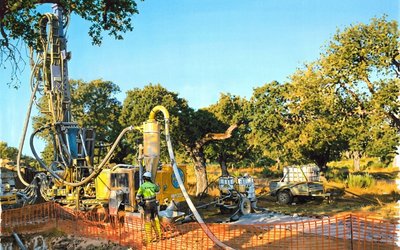
The Conchas Investigation Permit covers 31 square kilometres in southwest Salamanca province, within the Central Iberian Zone. Since 2021, Berkeley completed soil sampling, geological mapping, geophysics and two drilling campaigns. The 2022 program drilled five reverse circulation holes for 282 metres. The 2024 campaign added 33 RC and three diamond holes for a combined 2,087 metres. Mineralised vertical thicknesses range from 8 to 45 metres in the south and centre, and up to 70 metres in the north.
Data collected so far points to a multi-feeder system controlling the spatial position and thickness of the mineralised bodies.
Executive Director Robert Behets said the presence of rubidium and lithium highlights the potential strategic importance of Conchas.
“The MRE milestone follows two successful drilling campaigns and a positive initial assessment of the metallurgical characteristics of the multi-commodity mineralisation at Conchas that confirmed very good recoveries of lithium and rubidium can be achieved using flotation and magnetic separation methods,” he said.
“We will continue to systematically advance the project’s development with additional infill drilling to increase the resource classification, and a second phase of metallurgical test work to optimise the flotation and magnetic separation processes.”
Rubidium is classified as a critical mineral by the US and Japan. Lithium is designated critical and strategic by the European Union.
The company plans further infill drilling and metallurgical optimisation work.