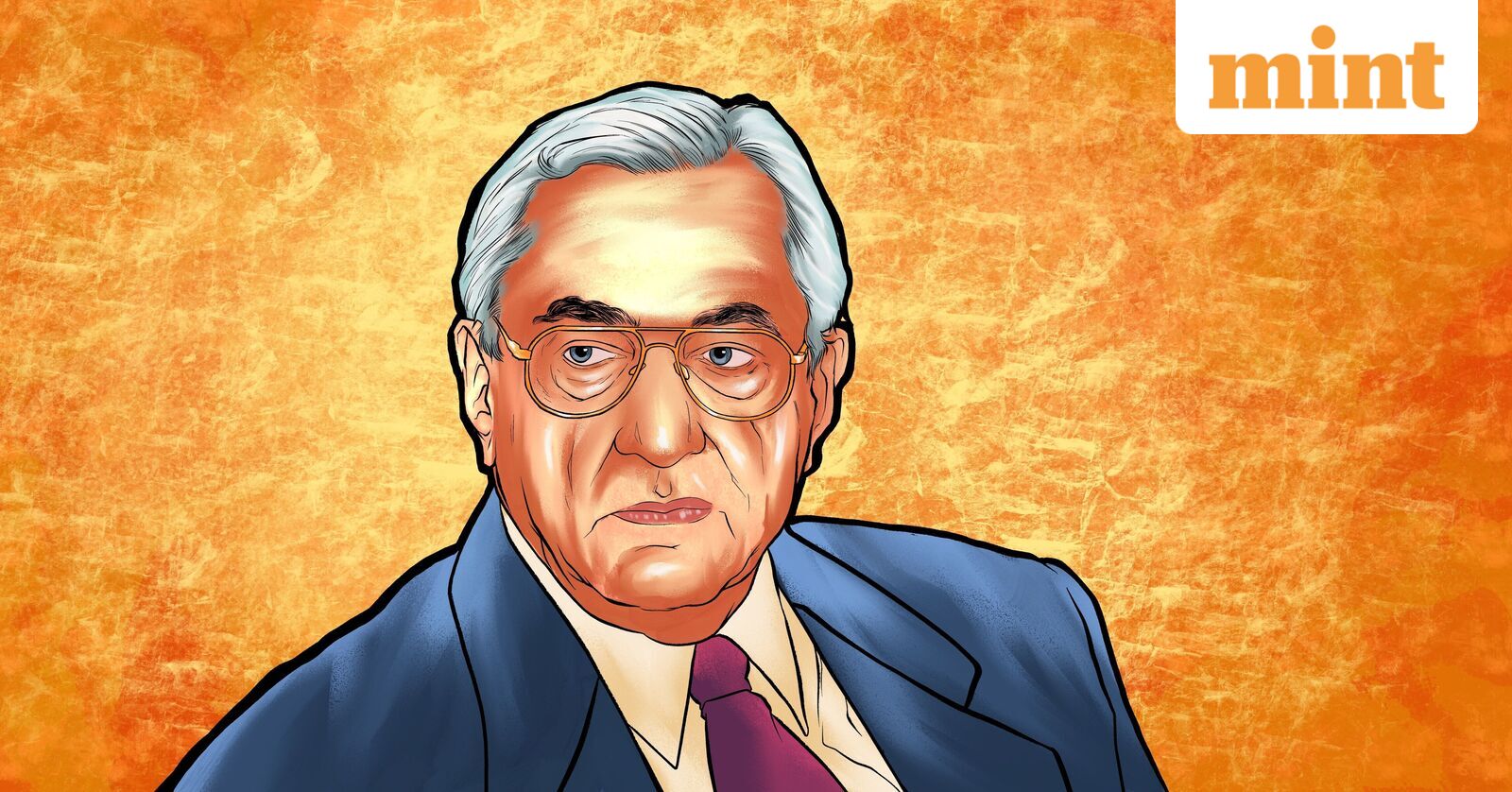
BILT went from ₹3,000 crore turnover to NCLT insolvency by 2023. The Thapar story shows how license-raj's protected businesses collapsed when liberalization hit.
Lalit Mohan Thapar's 1.2-acre bungalow on Amrita Sher-Gil Marg was the epicenter of license-raj capitalism's most extravagant parties. M.F. Husain paintings lined the walls. Politicians and diplomats crowded the card tables. Whisky flowed. The group he presided over was India's fifth-largest business house, with turnover of ₹3,000 crore by 1991-92.
That same bungalow was later sold to the wife of Yes Bank co-founder Rana Kapoor at a price investigators said was well below market value. Gautam Thapar, LM's nephew who inherited the flagship companies, was arrested in 2021 in connection with the transaction. The paper company at the heart of the Thapar empire, Ballarpur Industries Ltd (BILT), ended up in insolvency proceedings and was sold through an NCLT-approved process in 2023.
Thapar inherited the group from his father Karam Chand Thapar, who moved from Punjab to Calcutta in 1920 to build a coal-trading business. By the time LM took charge in 1962, the group spanned coal, jute, textiles, paper, engineering, banking and insurance. BILT grew into India's dominant paper company. Group turnover rose from ₹155 crore in 1970 to roughly ₹3,000 crore by 1991-92. That was the high-water mark of a protected economy where licenses limited competition and market positions were secure.
Then came 1991. Thapar's response to the opening of the economy was cautious. In November 1993, he joined seven other industrialists including Rahul Bajaj and Jamshyd Godrej in presenting finance minister Manmohan Singh with the Bombay Club petition. The group argued for a level playing field before Indian companies competed against multinationals. Around the same time, Thapar chaired an Assocham committee that recommended raising the foreign equity cap from 51% to 75%. That position was more liberal than many of the chamber's protectionist members supported.
The sharper irony arrived in 2001, when BILT acquired the Indian arm of Sinar Mas, the Indonesian paper giant whose greenfield entry in the 1990s had been exactly the kind of competition the Bombay Club petition feared. The acquisition was a strategic pivot. The Mint article described how the group did not renew itself more broadly.
The Mint article noted that the group diversified into numerous unrelated businesses, consuming capital without building scale or focus. In the protected world of license-raj, where competition was limited, such a strategy worked. Liberalization changed that equation, it said. Rather than modernizing its legacy businesses for global competition, the group appeared to seek refuge in protectionism. BILT, once a strong company, became vulnerable. Other businesses struggled with debt and technological obsolescence.
Friction over cross-holdings among family branches caused widespread strategic paralysis, the article said. In 1985, Thapar was arrested under the Foreign Exchange Regulation Act and briefly lodged in Tihar Jail. Political connections, once a valuable asset, offered little protection. In 1997, with the group valued above ₹3,500 crore, Thapar split it into three parts for his nephews. Gautam received the flagship BILT and Crompton Greaves holdings through a will that partly reversed the earlier division. The group's momentum had already stalled.
The Amrita Sher-Gil Marg bungalow became the most visible marker of the decline after Thapar's death in 2007. Gautam Thapar's Avantha Realty sold the property to Kapoor's wife. Investigators alleged the price was substantially below market value. They claimed the transaction was a quid pro quo for unpaid Yes Bank loans. Gautam Thapar was arrested in August 2021.
BILT's collapse follows a pattern that played out across dozens of Indian business houses after liberalization. A license-raj conglomerate diversified without focus and relied on relationships rather than operational efficiency. Adaptation to competition was elusive. The companies that survived concentrated capital and hired professional management. The ones that did not ended up in the NCLT.
Legacy market share did not protect BILT when the regulatory environment shifted. The Thapar group's paper business had decades of dominance. Scale and capital discipline mattered more than connections. The bungalow where Thapar once hosted diplomats and politicians over cards and whisky was sold at a price investigators said was below market value. That sale became the subject of enforcement scrutiny. Gautam Thapar was arrested in August 2021.
Prepared with AlphaScala research tooling and grounded in primary market data: live prices, fundamentals, SEC filings, hedge-fund holdings, and insider activity. Each story is checked against AlphaScala publishing rules before release. Educational coverage, not personalized advice.