Ball lightning, captured on spectrometer in 2012, offers a scientific template for studying UAP orbs. Avi Loeb outlines the sensor package needed to resolve the mystery.
Ball lightning has been reported for centuries, photographed rarely, and still lacks a fully confirmed physical explanation. It is almost certainly real.
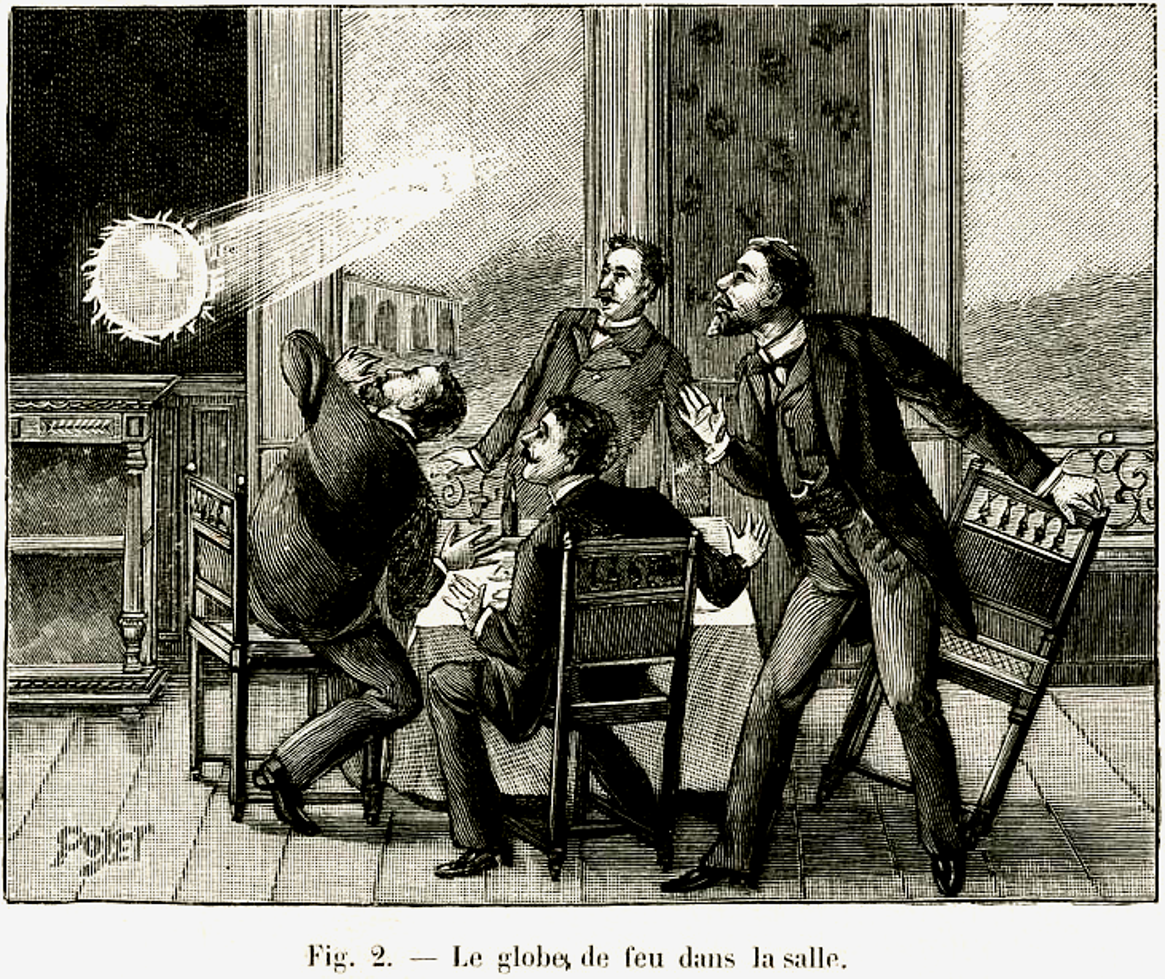
Witnesses describe a luminous, roughly spherical object, typically basketball-sized, lasting seconds to a few minutes. The average ball lightning appears as a sphere with a diameter of 30 centimeters, a luminosity similar to a 100-watt lamp, and a lifetime of about 10 seconds. That duration is much shorter than most orbs associated with Unidentified Anomalous Phenomena, which the Pentagon's All-Domain Anomaly Resolution Office and the Office of the Director of National Intelligence reported lasting hours.
Ball lightning often appears during or immediately after a thunderstorm, frequently following a nearby lightning strike. Given those circumstances, it is likely the result of a discharge sparked by the electric potential difference between charged clouds.
The phenomenon moves horizontally, sometimes hovering, sometimes drifting with air currents through open windows, doors, and down chimneys. It often produces a hissing sound and vanishes either silently or with a small explosion. In rare cases, ball lightning passes through glass windows or walls without causing apparent damage.
Like UAP orbs, ball lightning is a rare, transient, and unpredictable phenomenon, and therefore not well documented. Both reside in the scientific gray zone of phenomena supported mainly by eyewitness testimonies.
The most important development came in 2012, when a natural ball lightning event was accidentally captured on video with a spectrometer running during a field campaign studying ordinary lightning in Qinghai, China. That gave scientists the first quantitative emission spectrum of a real ball lightning event. The spectrum showed emission lines consistent with silicon, iron, and calcium – elements found in soil – supporting a physical model that associates ball lightning with silicon vapor.
The best-supported theory was proposed by Abrahamson and Dinniss in a 2000 Nature paper. The model is based on the observation that ball lightning floats freely through air and ends either in an explosion or disappearance, triggered during stormy weather. The interpretation suggests that when a normal lightning strike hits soil, chemical energy is stored in nanoparticles of silicon, which are ejected into the air. As the particles are slowly oxidized, the stored energy is released as heat and light over a timescale of seconds. The hot rarefied aerosol is buoyant, and the final disappearance occurs when the reaction completes or the structure destabilizes. The model does not require exotic physics, just a slow oxidation process in an aerosol cloud. An experimental investigation published in 2007 reported luminous balls with a lifetime of seconds by evaporating pure silicon with an electric arc.
Some skeptics have proposed that at least some ball lightning reports, particularly those involving observers very close to a lightning strike, could be caused by strong electromagnetic fields inducing visual artifacts from direct stimulation of the visual cortex or retina. That is taken seriously as a partial explanation for a subset of cases. It cannot account for reports with multiple independent witnesses or photographic evidence.
The ball lightning story offers a lesson for the study of UAP orbs. It took centuries for the existence of the phenomenon to be regarded as real by mainstream scientists because of its rare and transient nature. That status was transformed by the 2012 spectroscopic data. Before that data was collected, ball lightning was dismissed or treated skeptically.
A rigorous, well-instrumented observation of UAP orbs would similarly reveal their nature. The UAP Science Advisory Council recommends a sensor package for obtaining new data. A Doppler LIDAR, SODAR, or Doppler radar can measure acceleration and distance, separating objects that are not just drifting in the wind. A spectrometer attached to a telescope, able to respond within an hour to an alert, could infer the emission spectrum of a UAP orb and determine its surface temperature and composition. An array of modern digital Geiger counters or a large-surface-area scintillator could detect ionizing radiation from particles like neutrons and gamma-ray photons that travel great distances in air.
A wide-field visible camera array would continuously monitor the sky and detect moving or luminous objects before narrow-field instruments can be pointed at them. A high-resolution global-shutter tracking camera could capture shape, motion, rotation, lights, and structure without rolling-shutter distortion. Long-wave infrared thermal cameras could detect heat signatures day and night, helping distinguish aircraft, drones, birds, balloons, clouds, and unknown objects. An event-based camera could detect extremely fast motion, flashes, streaks, and sudden brightness changes that normal frame-based cameras may miss. Short-wavelength infrared cameras could improve detection in low light, haze, twilight, and some atmospheric conditions.
A radio-frequency spectrum analyzer with direction finding could detect and localize radio-frequency emissions associated with drones, aircraft, transmitters, interference, or unusual electromagnetic activity. A precision clock with atomic holdover would synchronize all local sensors and enable multi-site correlation, triangulation, and time-difference measurements. A cloud sensor or ceilometer would measure cloud cover and cloud-base altitude locally, critical for determining whether an object is below, inside, or above cloud layers. A star tracker or astrometric calibration camera would provide precise pointing calibration so visual detections can be converted into accurate sky coordinates, angular velocities, and trajectories. An acoustic microphone array with infrasound sensor could capture directional audible and low-frequency signatures from aircraft, drones, meteors, explosions, launches, or other sky events, providing an independent non-visual measurement channel.
The nature of UAP will be revealed by better scientific-quality data, not by magical thinking or opinion polls on social media.
Avi Loeb is chair of the UAP Science Advisory Council to the White House, Pentagon, FBI and intelligence agencies, director of the Galileo Project, and former chair of the astronomy department at Harvard University.
Drafted by a large language model from the source reporting linked above, then screened by automated publishing checks. It is not read by a journalist before publication. Some articles cite our Alpha Score. Verify prices and figures against the original source. Educational coverage, not personalized advice.