Axel targets field trial at Woolrich after column tests recovered up to 560ppm soluble TREO. The ASX-lister's Caladão resource holds ~861kt TREO and 16.7kt gallium. A scoping study would follow if the ISR concept holds in-ground.
Axel REE (ASX: AXL) has laid out a staged development plan for its Caladão rare earths and gallium project in Brazil, centred on in-situ recovery. The company is moving from bench-scale column testing toward a field trial at the Woolrich deposit, which holds 128 million tonnes at 1,013 parts per million total rare earth oxides.
The project hosts an inferred resource of 572 million tonnes at 1,502 ppm TREO, roughly 861,000 tonnes of rare earth oxides. A separate gallium resource of 439 million tonnes at 38 ppm adds 16,700 tonnes of metal, a material used in semiconductors and defence tech.
ISR – circulating a leaching solution through mineralised clay via wellfields – would let Axel skip open-pit mining, crushing, and milling. The company plans to use magnesium sulphate as the lixiviant, then remove impurities and precipitate a mixed rare earth carbonate. The approach remains conceptual; only column tests have been done so far.
Those column tests recovered up to 560 ppm soluble TREO. About 39% of the basket was magnet rare earths – neodymium, praseodymium, dysprosium, terbium. Axel also reported low aluminium, iron, thorium and uranium in the leach solution. If repeated at field scale, that could cut downstream processing and regulatory hurdles.
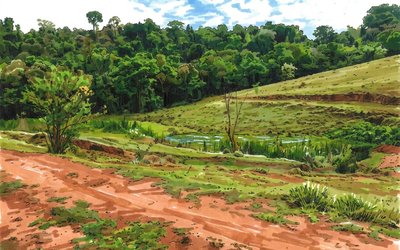
Woolrich covers roughly 2,000 hectares, with 12 identified wellfield zones. The first field trial will test whether the lab response holds in-ground – solution movement, recovery rates, reagent performance, hydrogeology, and environmental controls. Axel expects the trial to bridge column testing and a potential trial mining pathway.
The company is evaluating a hub-and-spoke model. Satellite wellfields would feed a central processing facility, letting production grow incrementally without committing upfront to large fixed infrastructure. Woolrich would be the initial hub; Paraíso and Tiger Creek provide expansion inventory if further work supports it. Additional hubs could eventually cover the broader Caladão system.
Gallium is treated as a separate future opportunity. Further metallurgical work is needed to determine whether it can be recovered with rare earths or on its own.
Near-term milestones include continued column testing, production of an initial mixed rare earth carbonate sample, resource upgrade drilling, finalising the field trial design, and advancing environmental and permitting work. After the field trial, Axel plans to update the mineral resource and complete a scoping study – the project's first major economic assessment.
The risk: the resource is still inferred. No economic study exists. The ISR flowsheet is conceptual until proven in the field. Axel is a small-cap explorer with no revenue, and funding for the next phases is not yet secured. The field trial and scoping study will determine whether the narrative shifts from early-stage promise to a credible development story.
Prepared with AlphaScala research tooling and grounded in primary market data: live prices, fundamentals, SEC filings, hedge-fund holdings, and insider activity. Each story is checked against AlphaScala publishing rules before release. Educational coverage, not personalized advice.