Australian Rare Earths' Koppamurra PFS delivers 99% IRR, A$858m NPV at A$178m capex. Maiden ore reserve 26Mt. Offtake talks and DFS next.
A$858 million post-tax NPV. A 99% post-tax IRR. A payback period of 0.9 years. That is the base case from Australian Rare Earths' Koppamurra pre-feasibility study, released Monday. The 12-year operation in South Australia's Limestone Coast will produce mixed rare earth oxide from shallow clay-hosted ore.
The study rests on a maiden probable ore reserve of 26 million tonnes at 920 parts per million total rare earth oxides. The broader resource is 243 million tonnes at 751 ppm. Initial capital is A$178 million for a 3 million tonne per annum processing plant.
Operating costs are US$34.14 per kilogram TREO. All-in sustaining costs come to US$38.32. Annual revenue is modelled at US$290 million, generating US$184 million in EBITDA.
Even when the model excludes inferred resources and uses only the ore reserve, the post-tax NPV is A$652 million. The payback period stretches to about one year. The numbers hold up under a narrower resource base.
Koppamurra's ore sits two to three metres above weathered limestone basement. That allows free-dig mining with no drilling or blasting and no hard rock crushing. The heap leach flowsheet uses diluted sulphuric acid and magnesium sulphate. Calcination happens offsite at a third-party facility.
The product is a mixed rare earth oxide containing about 25% magnet rare earths. Average annual production includes 435 tonnes of neodymium-praseodymium, 57 tonnes of dysprosium and terbium, plus yttrium, samarium, gadolinium, and lutetium. The company says the basket matters because several elements are exposed to constrained Western supply chains and Chinese export controls.
The PFS draws on more than 65,000 metres of drilling across 6,042 holes. A bulk sample pit and metallurgical test work with ANSTO, CSIRO, Bureau Veritas, and the University of Toronto underpin the design.
Managing director Travis Beinke said the PFS reflected years of methodical work. "The path ahead is clear: Detailed Feasibility Study initiation, Mining Lease submission, product qualification, adding more tonnes through the drill bit and advancing offtake and funding discussions," he said.
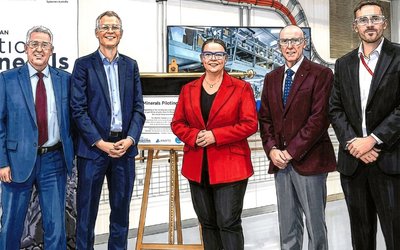
The company expects offtake discussions to accelerate as pilot-scale operations at ANSTO's new critical minerals processing facility in Sydney generate product samples. A mining lease application is targeted for 2026. A detailed feasibility study will follow.
An exploration target of between 680 million tonnes at 820 ppm and 3.62 billion tonnes at 540 ppm provides potential to extend the mine life. The current PFS uses about 71% probable reserves and 29% inferred resources.
Beinke said the PFS was the "hallmark of a project designed with simplicity in mind." The next milestones are the DFS and mining lease application.
Prepared with AlphaScala research tooling and grounded in primary market data: live prices, fundamentals, SEC filings, hedge-fund holdings, and insider activity. Each story is checked against AlphaScala publishing rules before release. Educational coverage, not personalized advice.