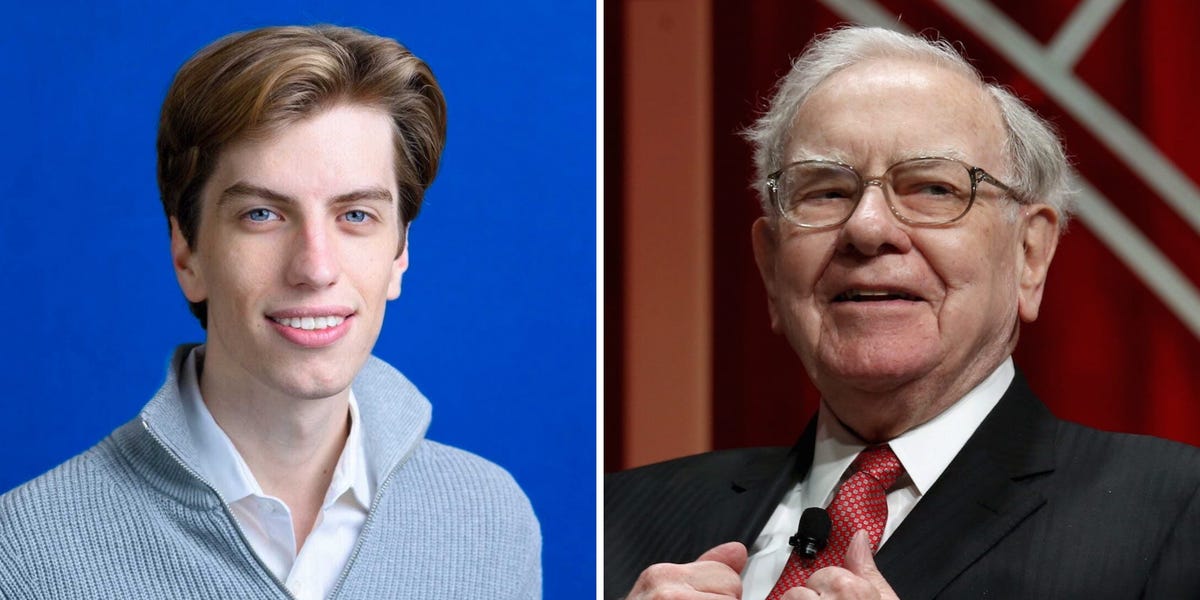
Leopold Aschenbrenner's $45 billion hedge fund, Situational Awareness, collapsed in late July after a sharp drop in AI stocks triggered margin calls. The firm was forced to sell most of its publicly traded portfolio to Ken Griffin's Citadel. The 24-year-old former OpenAI researcher had built the fund in under two years and notched a 1,000% gain this spring.
Warren Buffett, who retired as Berkshire Hathaway's CEO at the turn of the year, avoided such disasters over six decades. His stock returned more than 6,000,000% in that period, far outpacing the S&P 500's 46,000% gain. Several of Buffett's close followers told Business Insider the Situational Awareness fiasco shows two core tenets of his investing philosophy.
Ross Gerber, CEO of Gerber Kawasaki Wealth and Investment Management, said Aschenbrenner's implosion can be "understood as a lesson in hubris, leverage, and insufficient experience." "The goal is not to become rich as quickly as possible," Gerber said. "The goal is to build wealth in a way that allows you to keep it." He added that Buffett has demonstrated investors can produce extraordinary returns over long periods without relying on reckless amounts of borrowed money.
Michael Burry, the investor of "The Big Short" fame, said in an email to Business Insider that Aschenbrenner is one of many young investors who've made "unbelievable gains with leverage and options in the stock markets, chasing momentum and believing they can do no wrong." "Aschenbrenner just wins the prize for his generation's largest ego," Burry said. "That is saying something."
Why Leverage Sank Aschenbrenner's Fund
Situational Awareness reportedly employed four times leverage, meaning it borrowed $4 out of every $5 it invested. Larry Cunningham, author of "The Essays of Warren Buffett" and director of the University of Delaware's Weinberg Center, said the firm's disaster, and previous meltdowns at Archegos Capital Management in 2021 and Long-Term Capital Management in 1998, showed how dangerous excessive borrowing can be. "Leverage and concentration can make investors look brilliant for a time, but they leave little margin for being wrong, early, or unlucky," Cunningham said. "Long-term wealth is built not only by finding great opportunities, but by avoiding the handful of mistakes that can take you out of the game."
Paul Lountzis, a longtime Berkshire shareholder and president of Lountzis Asset Management, said Situational Awareness' issues showed the value of some of Buffett's defining characteristics: prudence and discipline, along with a long-term perspective. "Patience is just so hard for most investors, and many are always looking for rapid ways to get rich," Lountzis said. "The problem is that often leads to large losses." He added that "while IQ is important once you reach a minimum level, your behavioral and emotional makeup are far more important."
John Longo, a finance professor and author of "Buffett's Tips," said that Aschenbrenner's main problem was a "lack of risk management controls." Situational Awareness not only used heavy leverage, but it also seemed to be unprepared for its short positions to rise in value and its long positions to fall in value simultaneously, Longo said.
Tren Griffin, author of "Charlie Munger: The Complete Investor," said the key lesson for investors is knowing what "fraction of capital to wager to maximize compounded growth of capital." He said that amount can be calculated using the "Kelly criterion," a formula discovered by Bell Labs researcher John L. Kelly Jr. and endorsed by Munger.
Berkshire Hathaway's class B shares (BRK.B stock page) carry an AlphaScala Alpha Score of 51, labeled Mixed. The stock has been a steady performer, reflecting Buffett's cautious approach. Buffett waited. Berkshire's cash pile more than doubled to over $370 billion during his last two years as CEO. He refused to overpay for stocks in a red-hot market or outbid private equity buyers for acquisitions. He also didn't repurchase his own company's stock when it no longer struck him as a bargain.
"Long-term wealth is built not only by finding great opportunities, but by avoiding the handful of mistakes that can take you out of the game," Cunningham said.