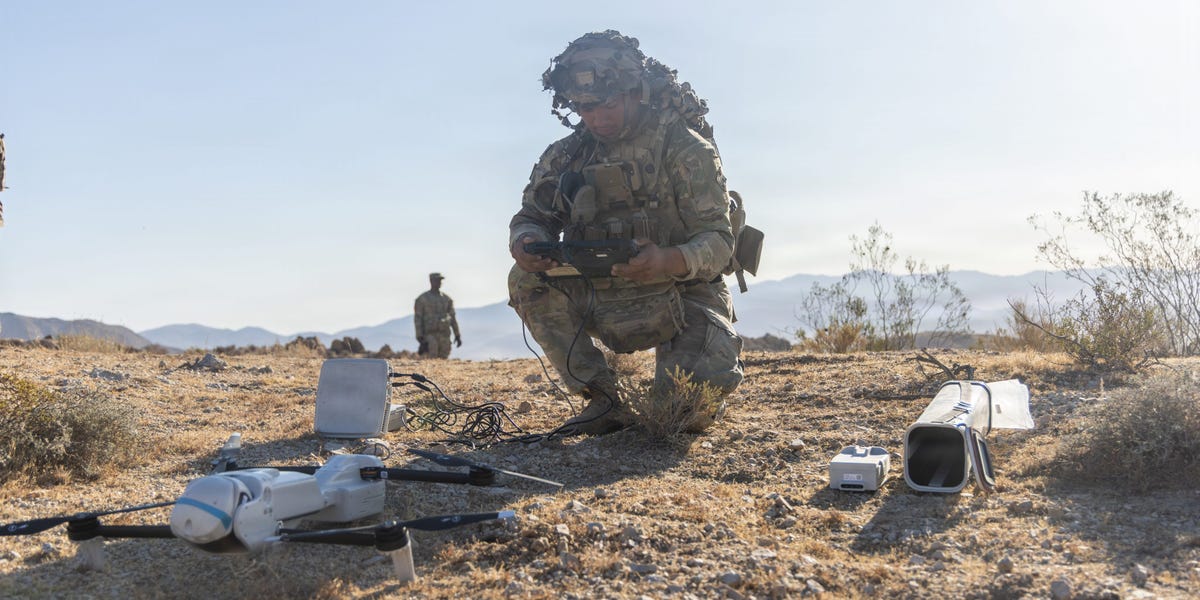
The U.S. Army's experiments with small drones at Fort Irwin revealed heat-related performance limits and signal failures, according to soldiers who operated the systems. Business Insider observed the trials as part of the service's push to field small uncrewed aerial systems across the force.
Soldiers used four drone types including Teledyne FLIR Defense's Rogue I, Teal Drones' Black Widow, Anduril's Bolt-M, and the Neros Archer. They weighed the pros and cons of each in simulated combat.
"The heat's been a very big thing when it comes to this drone in particular," Sgt. Ramontez Bennett said of the Bolt-M. Bennett said the temperature limited flight time and forced him to keep the drone moving rather than hovering, because "the longer you keep it around in the air, it's gonna overheat."
Heat caused overheating hardware and reduced battery life. Soldiers improvised, covering an antenna with a T-shirt soaked in ice water, Army leaders said.
Connectivity problems also emerged. Simulated enemy jamming and heavy winds caused signal loss. The Archer and Rogue I have a "return to home" function if connection fails. The NOMAD ground robot lacked that option; it stopped where it was, requiring soldiers to retrieve it. Rocky terrain cut its range in half, soldiers said.
None of the drones Business Insider saw were connected to the Army's Next Generation Command and Control network. Army leaders said vendors were still working toward interoperability. Some drones were not yet formal Army programs.
The challenges carry implications for defense contractors. Teledyne (TDY) and Red Cat Holdings (RCAT), which owns Teal Drones, are among the suppliers under evaluation. Anduril's Bolt-M is also in the mix, though Anduril is private.
Soldiers also faced trade-offs on gear. "That's the trade-off," Lt. Col. Shawn Scott said. "That's the balance, and it's always going to be hard to find."
Spc. Christopher Frank said soldiers had "seen the worst scenarios of these things, and we've seen the best," citing loss of connection and physical damage. Frank and his spotter, Sgt. Gabe Tedro, were the only two scouts in their platoon qualified on the Archer. They learned field tricks like leaving the drone case behind to reduce weight.
Army leaders said soldier feedback from the exercise was critical for assessing how systems performed. The next major milestone will be when these drones achieve interoperability with NGC2 and move toward formal program-of-record status.