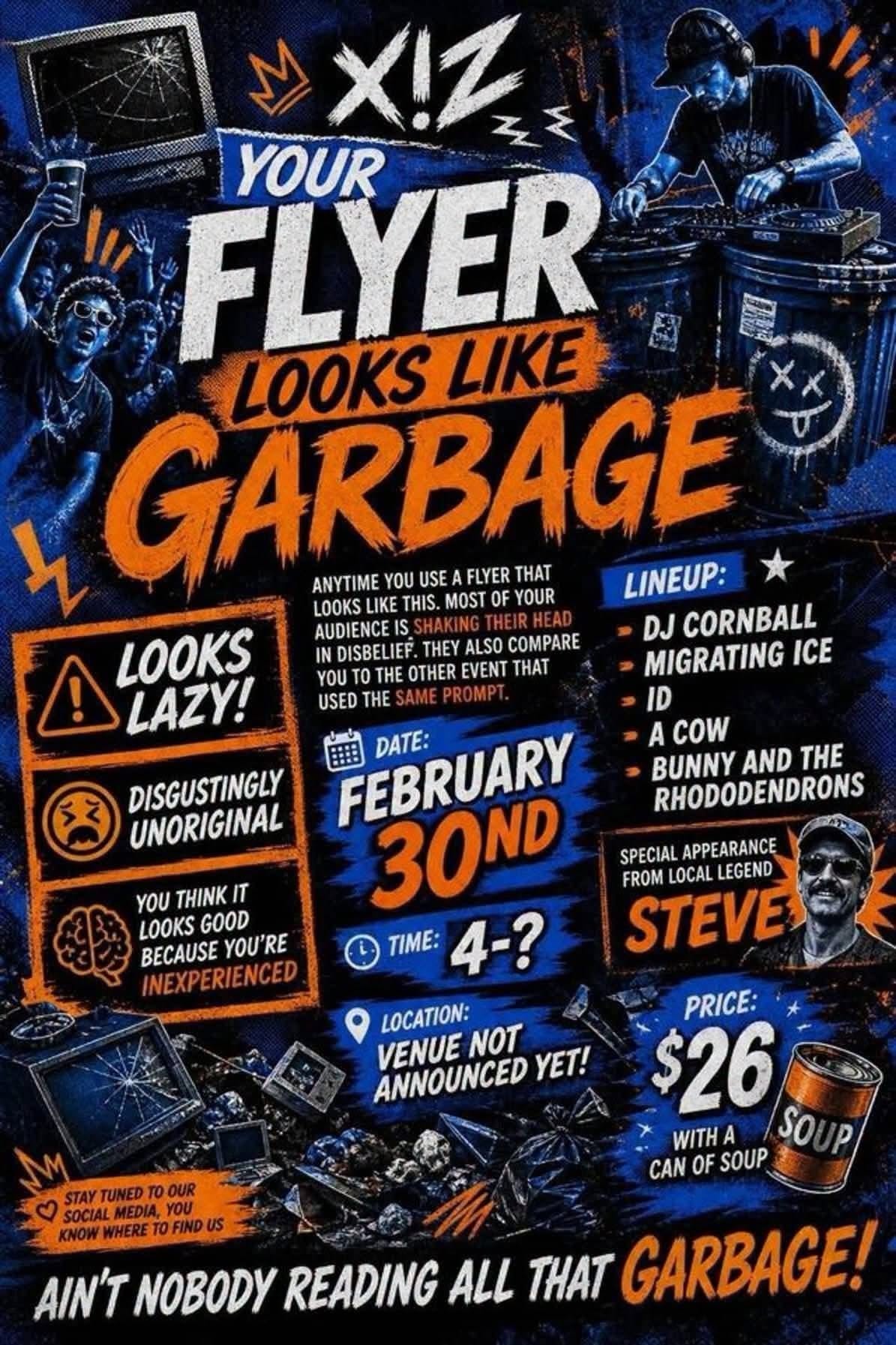
A new fault line is opening in the voiceover industry. The question is not whether AI can generate promotional graphics. It's whether using them–or even touching up a human design with AI tools–crosses a line.
Recent weeks have seen sharp criticism of voiceover professionals who post flyers featuring fully AI-generated images. The complaints are familiar: the graphics look cheap, generic, disconnected from the person or service. Worse, many artists see the practice as a betrayal at a time when performers, illustrators, and writers are fighting to protect the value of human work.
But the debate has a blind spot. Not every use of AI is the same. A graphic that begins with a human designer's template and is later sharpened or resized with an AI-assisted tool is not the same as typing a prompt and letting a machine produce the entire image. The first involves taste, judgment, and creative decisions. The second replaces them.
Social platforms don't always communicate that difference. An "AI Info" label may appear on content that was merely reformatted or retouched, leading viewers to assume the whole graphic was generated from scratch.
That raises a larger question for the community. Does paying for an AI subscription make someone complicit, even when the tool is used for research, transcription, or formatting human-created material? Is there an acceptable middle ground where generative impersonation is rejected but non-generative assistance is treated like any other productivity technology?
Some voice actors are comfortable using AI wherever it saves time or money. Others draw a hard line. What's often missing, according to a recent industry commentary, is a clearly defined principle.
If the position is that all AI use is a betrayal of artists, that requires consistency. It means examining the AI features quietly embedded in editing software, smartphones, email platforms, and photo applications. If the position is that AI is acceptable only when it doesn't replace human creativity, then what does "replace" mean? Does sharpening a human-designed graphic qualify? Generating a background? Suggesting a headline?
For the voiceover industry, whose central product is human performance, the choices send a message. Something can be legal, cheap, and efficient while still being strategically tone-deaf.
The useful conversation is not whether AI is good or bad. It's whether a particular use replaces human creativity, assists it, misrepresents its origins, or damages trust. The industry needs to define its own line–not the one that gets the most applause in a Facebook thread, but the one that holds up when the tools keep changing.
AI is not going away. Neither is the need for human judgment. Right now, that judgment may be the most important creative tool the industry has.