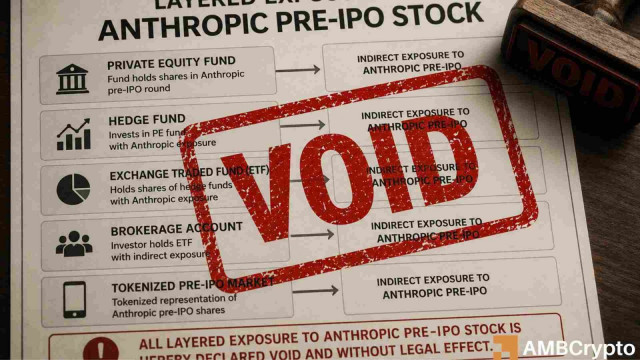
Anthropic declared all unauthorized share transfers void in its latest legal guidelines, putting secondary-market investors in tokenized pre-IPO offerings on notice that their holdings may be worthless. The AI company, widely expected to pursue an initial public offering later this year, said any sale or transfer of its stock not approved by the board will not be recognized on its books and records. The move immediately cast a legal shadow over a fast-growing niche that lets retail and accredited investors gain synthetic exposure to private tech names before they list.
Anthropic’s Void Clause Freezes Secondary Market Claims
The revised legal language leaves no ambiguity. The company stated in its updated terms that any unapproved transfer is void and that it will refuse to acknowledge the transaction. The guideline also explicitly targets the structures most common in pre-IPO secondary markets.
Any sale or transfer of Anthropic stock, or any interest in Anthropic stock, that has not been approved by our Board of Directors is void and will not be recognized on our books and records.
Special Purpose Vehicles and Tokenized Securities Are Explicitly Prohibited
The ban extends beyond direct private sales to the special purpose vehicles that many secondary platforms use to pool investor money and hold a single share certificate. Anthropic said those arrangements are captured by the restriction. The company added that tokenized securities claiming to represent a claim on its equity are especially suspect.
Any third party claiming to sell Anthropic shares to the general public–whether through direct sales, ‘forward contracts,’ tokenized securities, or other mechanisms–is likely either engaged in fraud or offering an investment that may have no value due to our transfer restrictions.
The language matters because it is one of the first times a high-profile pre-IPO company has called tokenized pre-IPO exposure fraudulent in its own corporate governance documents. OpenAI issued a similar warning, signalling that large private AI firms are moving in lockstep to restrict secondary trading.
Who Owns the Voided Shares? The Exposure Map
Secondary platforms have seen a surge in volume as retail demand for pre-IPO access collided with the AI boom. Hiive and Forge, two of the largest venues for accredited-investor secondary trades, reported massive interest in artificial intelligence, fintech, and crypto companies planning to go public. Hiive’s most recent annual report highlighted those sectors as the primary driver of activity. Many of those trades are executed through SPVs that now sit directly in the path of Anthropic’s prohibition.
Hiive and Forge Ride the Pre-IPO Wave
Both Hiive and Forge operate as regulated marketplaces for accredited investors, yet their reliance on SPV structures means that even properly documented transactions could be challenged if the underlying company refuses to recognize the beneficial ownership. Anthropic’s position that any interest in its stock is void if unapproved cuts through the SPV wrapper and questions the value of the stake held by the vehicle. For investors who bought exposure on these platforms, the risk is not just a paper loss but a potential zero.
Tokenized Offerings on Retail Platforms
A separate layer of exposure sits on retail-facing platforms that have begun marketing tokenized pre-IPO shares to offshore users. Robinhood, PreStocks, and Bitget’s IPO Prime all offer or have offered synthetic exposure to companies such as SpaceX, OpenAI, and Anthropic. These products are often structured as forward contracts or tokenized derivatives rather than direct equity, yet Anthropic’s guidelines dismiss the entire category: any mechanism that claims to sell exposure to the general public is likely fraud or worthless. That puts a large, and largely unquantified, pool of retail capital at legal and financial risk.
Implosion Risk: FTX Comparisons and the Linqto Precedent
Market insiders are not treating the Anthropic language as boilerplate. Two prominent voices warned that enforcing the void clause could trigger a chain reaction across private secondary markets.
Moonrock Capital’s Dedic Sees FTX-Like Bloodbath
Simon Dedic, founder of Moonrock Capital, said the move could trigger an FTX-style bloodbath. The comparison is not casual. Much like the commingled assets and opaque liabilities that unwound during the FTX collapse, the synthetic pre-IPO market has built layers of derivative claims on a thin base of actual equity. If the issuer disallows those claims, the house of cards collapses.
Norgard on Synthetic Ownership and Fraud Accumulation
Brian Norgard, a market analyst, sharpened that warning with a crypto market analysis lens, drawing a direct line from Anthropic’s stance to the broader private-market ecosystem.
If Anthropic starts invalidating layered SPVs and other ‘creative’ financing structures, private markets are in for a reckoning. The SpaceX IPO will expose just how much synthetic ownership and outright fraud has accumulated in private.
The SpaceX IPO is the marquee event that many investors have been positioning for. Norgard’s point is that a large-scale invalidation of claims by any major issuer would reveal how much of the secondary market is built on contractual promises rather than enforceable rights, a risk that Fluid Oracle Failure Triggers Nearly $20M in Bad Debt highlighted in crypto when a DeFi protocol’s oracle failure exposed the brittleness of synthetic claims.
Linqto’s Collapse as a Precursor
A smaller-scale version of this scenario already played out. Ripple investors who bought exposure through the now-bankrupt Linqto platform were left holding claims with uncertain value after the platform failed. The combination of issuer transfer restrictions and platform insolvency wiped out retail participants who believed they owned a piece of a private company. Anthropic’s void clause creates the conditions for a replay at far larger scale.
Legal Challenge May Test Transfer Restrictions
Gabriel Shapiro, a crypto-focused attorney, argued that Anthropic’s threat could itself trigger a lawsuit seeking court clarification on the validity of equity transfer restrictions. If a platform or group of investors challenges the blanket voiding of secondary interests, a court ruling could either reinforce the company’s right to restrict transfers or carve out exceptions for certain structures. That legal uncertainty is itself a risk factor: until a ruling materializes, the value of tokenized pre-IPO positions remains in limbo.
What Would Contain the Damage – and What Inflames It
The most immediate risk-reduction scenario is a voluntary unwinding of positions by platforms before Anthropic takes enforcement action. A clear statement from the company that it will not retroactively void trades executed through regulated venues before a certain date would also narrow the exposure window. A court decision that limits the reach of transfer restrictions to direct share transfers, leaving SPV interests intact, would contain the fallout.
The risk escalates sharply if Anthropic begins sending cease-and-desist letters or formally refusing to recognize the ownership records of SPVs and tokenized structures. The resulting forced unwinding could create cascading liquidity demands, particularly in tokenized markets where fractional interests are traded on best crypto brokers and crypto platforms. A SpaceX IPO that exposes a parallel layer of synthetic claims would magnify the contagion, turning a single-company legal position into an industry-wide reckoning. crypto market analysis tools would track the fallout through on-chain and tokenized securities venues immediately.
Practical rule: when the issuer says your derivative contract is fraud, the counterparty’s solvency, not the contract’s notional value, becomes the only thing backing your position.