Sam Altman, OpenAI's chief executive, posted a prompt on X this week that let a non-coder build a live website in under two hours. The experiment, published by Business Insider, offers a concrete look at how far AI-assisted software creation has come.
The prompt was simple: "I want to build a website for planning a trip with friends. The website should let people create a profile, share their budget, vote on a destination, select dates, check activities, and comment. After voting closes, the host can lock the destination and assign tasks." Altman wrote it from his phone.
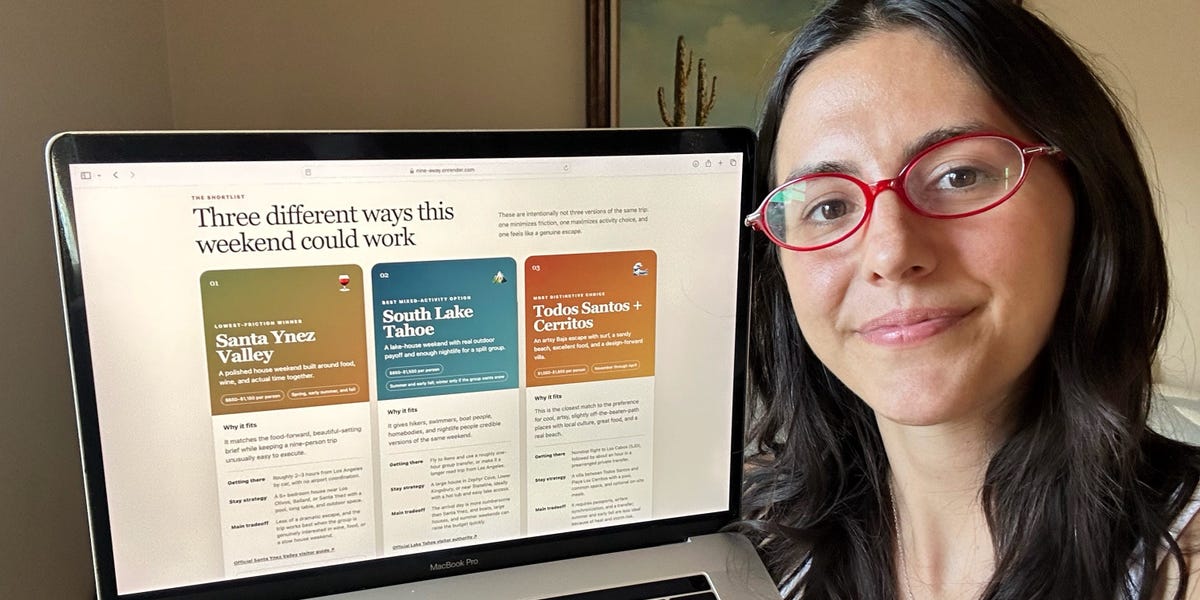
The user copied the text into ChatGPT Plus, set to GPT-5.6 Sol with intelligence on "High." Nine minutes and 47 seconds later, the model returned three destination options, a download link for a complete website, and an email draft. The destinations – Santa Ynez Valley, South Lake Tahoe, and Todos Santos – matched the user's stated interests.
ChatGPT provided a README file with installation instructions. The user had no coding background and asked for plain-language steps. The model walked through opening Terminal on a Mac, downloading Python, signing up for GitHub, and hosting the site on Render for $7.25 a month. After the site went live, the user asked about free options. ChatGPT recommended Cloudflare and acknowledged it should have suggested that from the start.
OpenAI, when contacted for the story, pointed to a recently launched feature called Sites. It lets users create, preview, edit, and host websites entirely within ChatGPT for free with a Plus subscription. The tool is in public beta. The model again said it should have recommended Sites first.
The user later transferred the site to a Sites workspace and asked for small tweaks – allowing users to edit or delete comments, moving the access code window higher. ChatGPT worked for 14 minutes and deployed the changes correctly.
Altman's Prompt in Action
The episode illustrates the core promise of "vibe coding" – the idea that people without traditional programming skills can build custom applications by describing what they want in natural language. The term gained traction after Andrej Karpathy, a former OpenAI researcher, used it to describe a workflow where the AI does the heavy lifting and the human focuses on intent.
Altman's prompt was not tailored to the user. It was the exact text a billionaire tech CEO typed from his phone. That it produced a useful website for someone else, with no customization, suggests the approach is more repeatable than skeptics assume.
The user wrote no code. The closest interaction was copying short strings from ChatGPT into the Terminal. The final site allowed friends to create profiles, share budgets, vote, select dates, check activities, and comment. The host could lock the destination after voting and assign tasks.
OpenAI's Sites feature, still in beta, removes the need for third-party hosting. The user said the process would have been even simpler starting there. The company is positioning the tool as a way to lower the barrier to web creation, competing with platforms like Wix and Squarespace that already integrate AI assistants.
Market Context
OpenAI remains a private company valued at roughly $300 billion in its latest funding round, according to reports. Its largest investor, Microsoft, has integrated ChatGPT into products like Azure and Copilot. A broader shift toward AI-generated software could reduce demand for traditional web development skills, though it may also expand the total pool of people building applications.
Google, Meta, and Anthropic have released similar code-generation tools. Google's Gemini can write and execute Python code. Anthropic's Claude offers a feature called Artifacts for building small web apps. The competition is intensifying around the user experience of turning natural language into working software.
The experiment also highlighted current limitations. The model initially recommended a paid hosting service when a free one existed. It failed to mention its own Sites feature until prompted by the company's press team. Those are the kind of edge cases that improve with feedback, the article noted.
Altman's prompt gave the user exactly the jump-start needed to understand how vibe coding works. The user said they now see "software-shaped solutions" in everyday problems and are planning the next project.
OpenAI's Sites feature is available now in public beta for Plus subscribers. No date has been set for a full rollout.