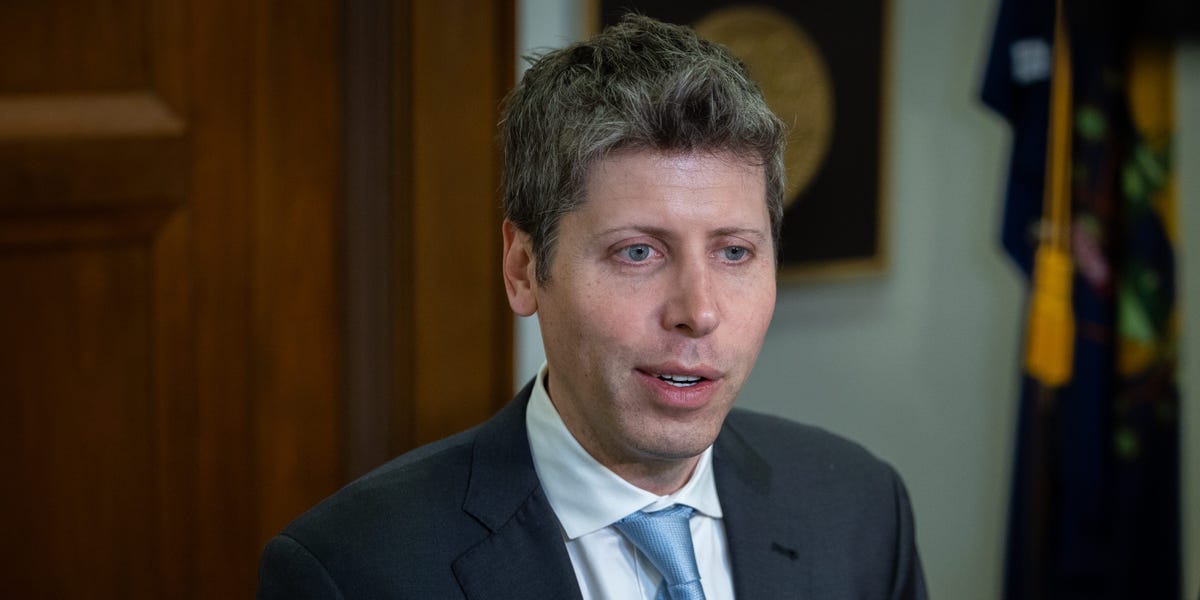
OpenAI CEO Sam Altman said he worries that artificial intelligence will eventually be controlled by a handful of companies, models, or people, leaving most consumers without a say in how the technology develops.
"The right approach is to say we want people deeply in control of the future," Altman said on David Senra's podcast, released Sunday. "Society and the models are going to co-evolve."
The other possibility Altman described is AI breaking free from human handlers. He said a fear of that outcome could paradoxically lead to the first scenario.
"There are a lot of people who are so nervous about the magnitude of those risks and get so taken by that and feel a need to protect the world," he said. "Like, you know, 'we should trade off a lot of liberty for safety.'"
Altman was likely referring to Anthropic CEO Dario Amodei. Amodei has warned repeatedly about the dangers of rapid AI development. In a June essay, he wrote that the company's new Mythos models pose "very real risks" to cybersecurity, the financial sector, critical infrastructure, and national security.
Amodei has used those warnings to call for greater government regulation. Altman's comments suggest he sees that approach as trading liberty for safety.
Anthropic was the only major AI company last month not to sign a letter endorsing open-weight models, which let developers share, download, modify, and deploy AI models on their own infrastructure. China has embraced open-weight models, allowing it to keep pace with Silicon Valley at a fraction of the cost. Some U.S. companies – including Nvidia, Meta, and Microsoft – have argued that America needs to do the same or risk losing ground.
OpenAI, though it has not released the source code of its frontier models, did release two open-weight models last year: gpt-oss-120b and gpt-oss-20b.
During the podcast, Altman also said AI leaders in the United States have failed to show the public how the technology can give people greater autonomy. "We are about to see the greatest boom in people starting smaller businesses than we have ever seen," he said. "I think AI is empowering that."
The open-versus-closed debate has real implications for the companies powering AI. Nvidia supplies the chips that train and run models; Microsoft has invested billions in OpenAI. If open-weight models win out, barriers to entry fall, potentially boosting demand for Nvidia's hardware as more startups build their own systems. If closed models dominate, power concentrates among a few large players, raising the stakes for regulation and antitrust scrutiny.
AlphaScala's proprietary scoring system rates MSFT at 71 out of 100 (Moderate) and NVDA at 68 out of 100 (Moderate), reflecting their current positioning in the competitive environment. The tension Altman described – between safety-driven control and the risk of concentrated power – is the central unresolved question in AI policy. His podcast remarks put that conflict in plain terms, with the coming policy decisions likely to shape which vision prevails.