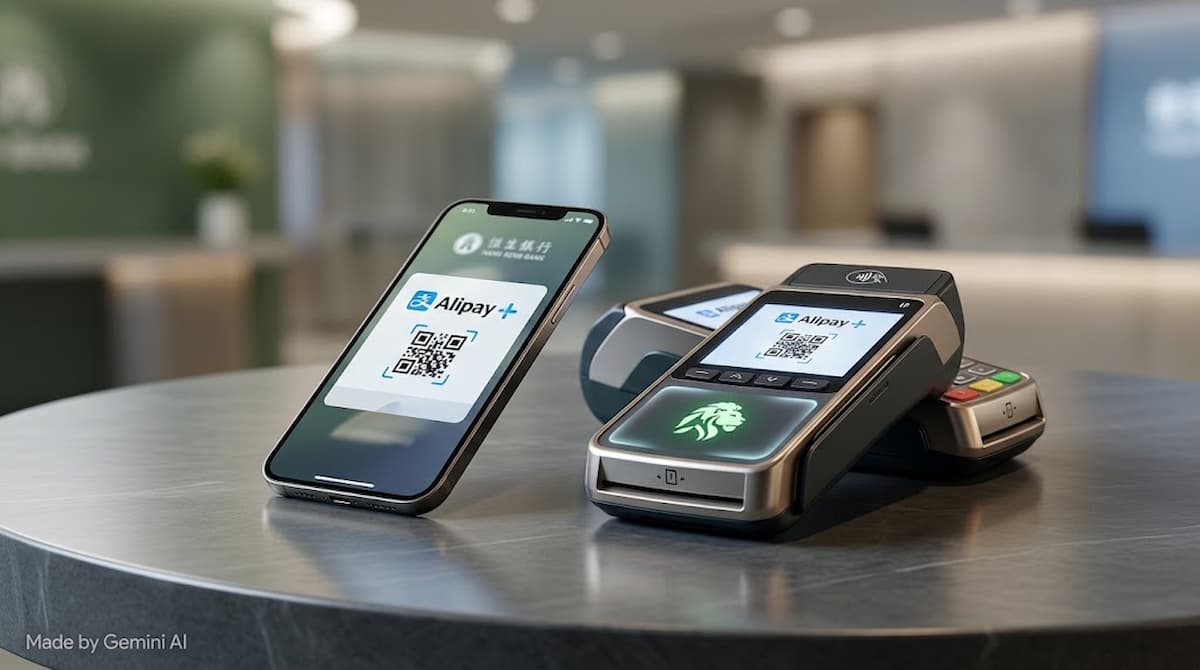
Ant International has added Hang Seng Bank to its Alipay+ network, giving the Hong Kong lender's mobile app access to a cross-border QR merchant footprint that spans more than 50 digital wallets and over 220 markets. The partnership extends a bank partner roster that already includes Public Bank Berhad in Malaysia, Bank of the Philippine Islands and Asia United Bank in the Philippines, OCBC in Singapore, Kasikorn Bank and Siam Commercial Bank in Thailand, and Vietcombank in Vietnam. The network also connects to more than ten national QR infrastructure systems, including Malaysia’s DuitNow and Thailand’s PromptPay; others include Uzbekistan’s HUMO.
Ant International positions the integration as a distribution argument: a single integration gives a bank’s mobile app access to the full QR merchant footprint across multiple markets, eliminating the need for bilateral agreements. Beyond payments, the Alipay+ Super App Platform lets bank partners embed third-party mini-programmes and services such as travel bookings and social features. The company said this acts as a retention tool while banks face pressure on customer engagement and uncertain macroeconomic conditions.
McKinsey data cited by Ant International shows customer experience leaders among banks achieve higher returns and faster growth, with lower costs. The company did not disclose specific engagement figures from existing bank partners.
Ant International also flagged two adjacent platform plays: the Falcon TST AI FX model, used by Citi and [Barclays], and Whale, a blockchain platform for 24/7 cross-border liquidity transfer, with Standard Chartered and HSBC among early partners. The FAlcon model is described as capable of long-term forex forecasting at up to 93% accuracy.
The timing aligns with a structural shift in Asia Pacific payment flows. Ant International projects consumer-to-business and consumer-to-consumer outbound cross-border payment volume from the region will reach $3.7 trillion by 2032, roughly doubling from 2024 levels. The growth is driven by rising digital wallet adoption and regional travel. Asia Pacific outbound growth is expected to outpace the global average, making the corridor commercially attractive.
Alipay+ competes with Mastercard in cross-border payments through its network partnerships with regional wallet operators, and with Visa’s cross-border consumer payment rails. There are also growing bilateral real-time payment linkages between central banks in South-East Asia. The regional interoperability agenda supported by ASEAN could reduce the advantage of a centralised gateway over time. For now, Alipay+’s merchant network depth and links to national QR schemes give it a distribution lead, particularly for banks seeking rapid time-to-market rather than bespoke bilateral deals.
Mastercard holds an AlphaScore of 65/100, classified as Moderate in our [propeitetary model.[Barclays, a client of Falcon TST, has an AlphaScore of 59/100.
The Hang Seng partnership is a foothold in Hong Kong, a market at the intersection of Chinese Mainland consumer travel and international financial flows. Hang Seng is the first Hong Kong institution to join. How many follow will indicate the speed of Alipay+’s density build in the territory.