Stocks● Neutral
AI's Intelligence Inversion: Judgment Becomes the Scarce Resource
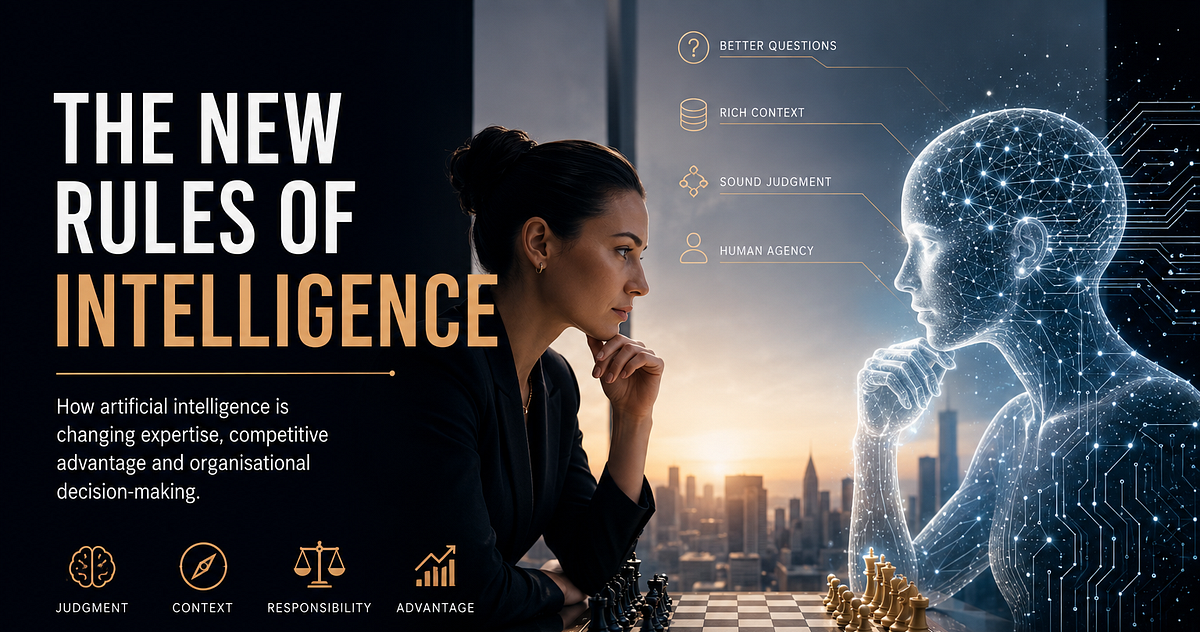
As AI makes answers abundant, the value of judgment, context, and accountability rises. The new competitive advantage is not who can produce the most, but who can decide best.
Continue with
Artificial intelligence is making answers abundant. The next competitive advantage will not come from who can produce the most content, but from who can judge which content is right, relevant, and worth acting on.
That is the central argument of a new analysis of AI's impact on expertise and organizational decision-making. The framework, outlined in a recent essay, identifies four layers of professional intelligence: production, interpretation, judgment, and agency. The value migrates upward as AI improves.
Production is the ability to generate an answer, document, or model. AI is making this layer faster and cheaper. A junior employee can now produce a credible market analysis, draft a strategy memo, or generate a financial model in minutes. The output may not always be correct, but it is often good enough to challenge the economics of work that previously required significant time and training.
Interpretation is the ability to understand what an output means within a specific market, organization, or situation. An AI system can identify patterns in a dataset. It may not know that one customer segment is politically sensitive or that a particular partner relationship is deteriorating. Proprietary organizational knowledge matters here. Much of what makes a company function is distributed across documents, software systems, previous decisions, and informal relationships.
Judgment is the ability to choose between competing interpretations under uncertainty. It requires recognizing trade-offs, assessing incentives, calibrating confidence, and deciding which risks are acceptable. AI can provide probabilities and scenarios. It cannot determine what an organization should value. Whether a company should optimize for speed or trust, enter a market early despite regulatory uncertainty, or back a technically exceptional founder with limited commercial experience -- these are questions of preference, timing, and responsibility, not information.
Agency is the ability to act and remain accountable for the result. An AI system can recommend that a company close a division or pursue an acquisition. It cannot own the consequences. That distinction becomes increasingly important as AI moves from assisting with tasks to participating in workflows and decisions.
The Judgment Gap
One of the most important findings from workplace AI research is that less experienced workers often receive the largest immediate productivity gains. A study of 5,172 customer-support agents found that access to a generative AI assistant increased productivity by an average of 15%, with particularly strong benefits for less experienced workers. Research conducted with Boston Consulting Group found that consultants working on tasks within the model's capability frontier completed more work, faster, and produced higher-rated outputs. But when tasks fell outside that frontier, AI users were more likely to reach incorrect conclusions.
This creates a paradox. AI narrows the output gap while potentially widening the judgment gap. Two people may produce equally polished analyses, but only one understands the assumptions underneath them. Two companies may deploy the same model, but only one knows where it should not be trusted.