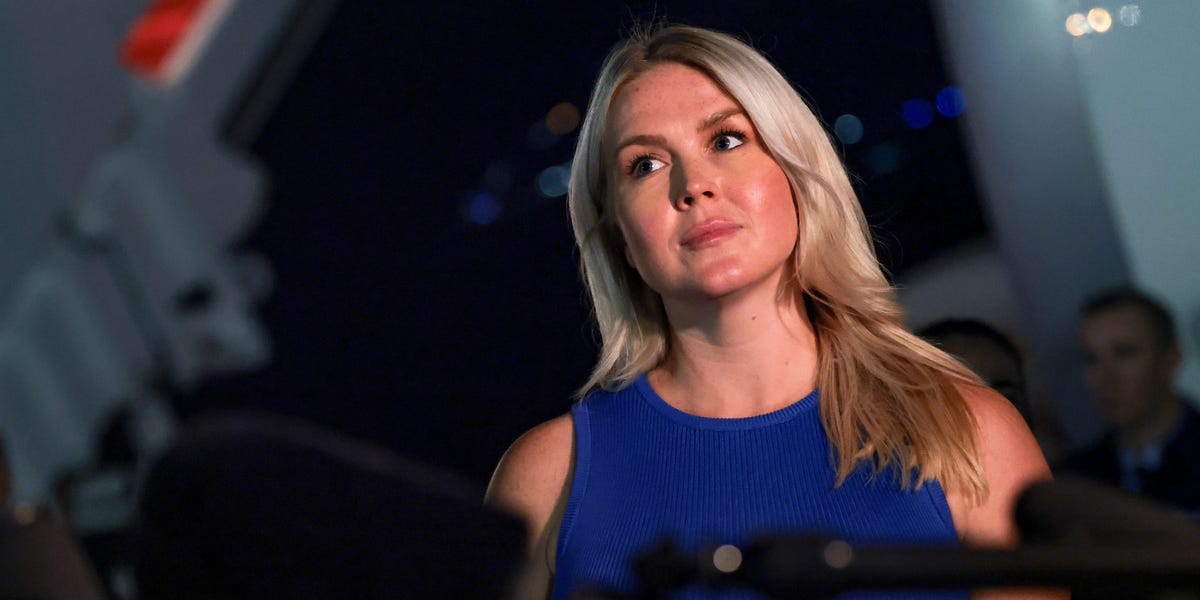
Outgoing White House press secretary Karoline Leavitt announced Wednesday she would leave her role at the end of August, citing the difficulty of balancing the job's demands with raising two young children. A post on X carrying the news included a 'Made with AI' label at the bottom, a detail users flagged and that disappeared hours later, Business Insider reported.
The label does not mean AI wrote the statement, according to X's official guidelines. The platform applies the tag to media it determines to be AI-generated or manipulated. What triggered the label on Leavitt's post, which included two photographs, was not immediately clear.
Trump said in a post on X that Leavitt was departing "so she can spend more time with her beautiful young children and family," adding that she would become one of his top outside advisors. Leavitt, 28, became the youngest White House press secretary when Trump returned to office in 2025. Trump has yet to announce her replacement.
The incident adds to a series of public disputes over AI content labeling. Companies across social media and AI development are rolling out detection mechanisms. YouTube said in July it would demonetize mass-produced generic content and AI personas designed to game the platform. Substack and Pinterest have launched tools meant to help readers identify AI-generated content.
Anthropic said this week that new Claude models will weave an "imperceptible watermark" into generated text. The signal can survive copying, pasting, and some editing, though extensive rewriting, translation, or combining output with other text could remove it, the company said. Anthropic cautioned that its watermark would not prove Claude wrote an entire document, and that using the chatbot to proofread or translate human writing could also leave a detectable mark.
Business Insider's Katie Notopoulos wrote Tuesday that the watermark could complicate life for people reluctant to acknowledge AI use. "Once AI detectors or watermarks are more ingrained in popular products, does it become more or less embarrassing to be caught using AI to write?" Notopoulos wrote. "I'm not really sure where the evolving norms around AI writing will land."