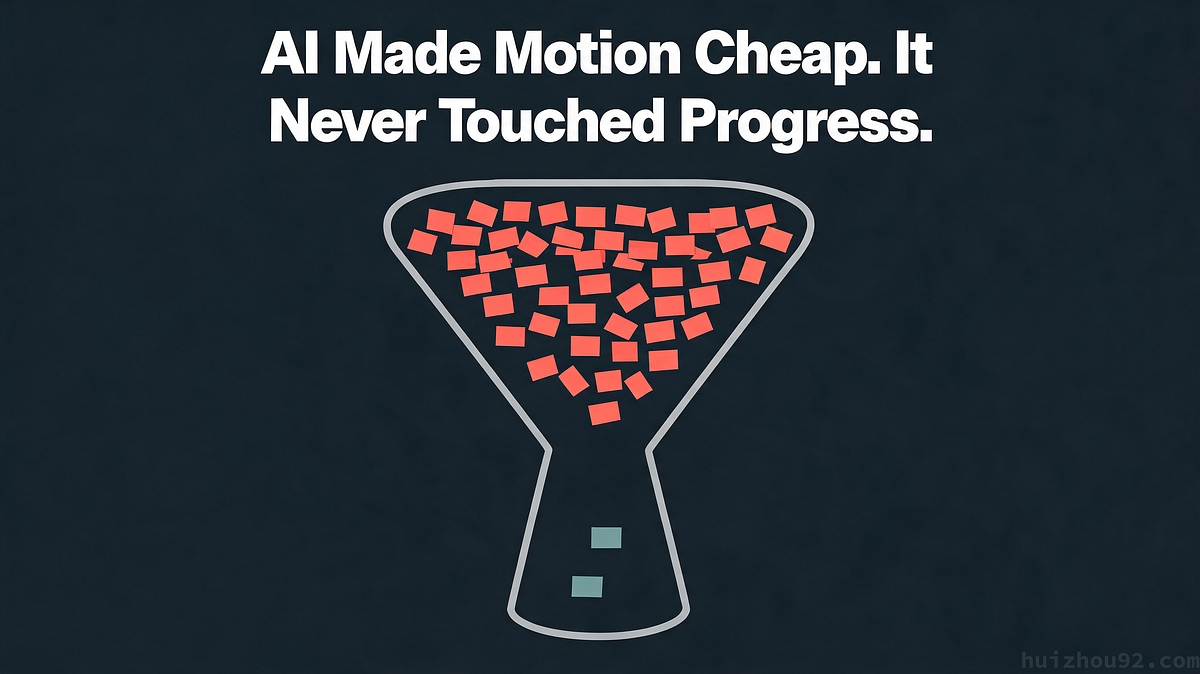
Codex has 5M weekly users, but OpenAI's Akshay Nathan warns that AI makes motion cheap without touching the judgment that turns output into real progress.
I was listening to a Latent Space interview with Akshay Nathan, who leads core product engineering at OpenAI, when he said something that stuck with me more than any of the usage numbers around it.
"I think maybe the trap is like conflating motion and progress," he said. "I think motion is much easier now than ever before because of the tooling that we have. But progress requires you to be like very prescriptive and deliberate about like what you're trying to achieve."
He wasn't complaining about AI. He builds it. He was describing a trap his own product creates.
Codex now has more than 5 million weekly active users. OpenAI's own newsroom put a number on who they are: roughly 20% of that base is non-developers, and that segment is growing more than 3x as fast as the developer one. Overall usage across ChatGPT Work and Codex was up more than 10x from January 2026.
The framing OpenAI leans on: there are roughly 100x more people who use code than people who can write it. That's the addressable market. That's the pitch.
None of that is in dispute. Adoption is real, and it's fast. The question Nathan raised isn't whether people are using the tool. It's whether using it more produces more of anything that matters.
Here's the mechanism, and it's not complicated once you see it.
Writing a first draft of anything, code or a strategy memo, used to cost time. That time acted as a filter. You thought twice before producing a bad version of something, because producing it wasn't free.
AI tooling removed that cost. Now producing a version of anything is close to instant. A team can generate ten pull requests, ten slide decks, ten strategy memos in the time it used to take to produce one.
What didn't get cheaper: deciding which of those ten is worth shipping. That step still runs on human judgment, at human speed. Nathan's "prescriptive and deliberate" is really a description of that judgment step, the part of the work that AI tooling didn't touch.
So activity goes up. Commits and drafts, generated artifacts of every kind, all up. And a team can watch that dashboard and feel like it's moving faster, because it is. It's just moving, not necessarily toward anything.
This isn't a uniform problem. It shows up hardest in exactly the kind of work Nathan's own numbers say is growing fastest: knowledge work without a clear finish line.
A developer fixing a bug has a test suite. Pass or fail is not a matter of opinion. Motion and progress collapse into the same thing, because the validation step is automated and instant.
A marketer drafting ten campaign angles has no such test suite. Neither does an analyst generating ten different takes on the same dataset. Someone still has to read all ten, decide which one is actually right, and defend that choice. AI made the drafting free. It left the deciding exactly as expensive as it always was.
That's the 20%-of-Codex-users-and-growing-3x-faster group Nathan mentioned. It's not that non-developers are misusing the tool. It's that they're the group most exposed to a trap that only bites when the finish line is fuzzy.
If activity volume is the wrong metric, the right one isn't complicated; it's just less flattering to look at.
Progress is whatever survives contact with the outcome you actually wanted. A pull request that passes review and ships. A forecast that still holds up next quarter.
None of those are counted by "messages sent" or "drafts generated." All of them require someone to have been prescriptive about the target before the AI ever started producing anything, exactly the discipline Nathan was describing as the part that got harder to skip and easier to skip at the same time.
Easier to skip, because motion feels like enough now. Harder to skip, because when a team full of cheap motion ships nothing that survives contact with reality, the gap shows up eventually, just later than it used to.
The tooling Nathan's team built made it possible to generate ten times as much. It didn't make it possible to want ten times as many different things. That gap is where the trap lives, and it's not going to show up on a usage dashboard.
Drafted by a large language model from the source reporting linked above, then screened by automated publishing checks. It is not read by a journalist before publication. Some articles cite our Alpha Score. Verify prices and figures against the original source. Educational coverage, not personalized advice.