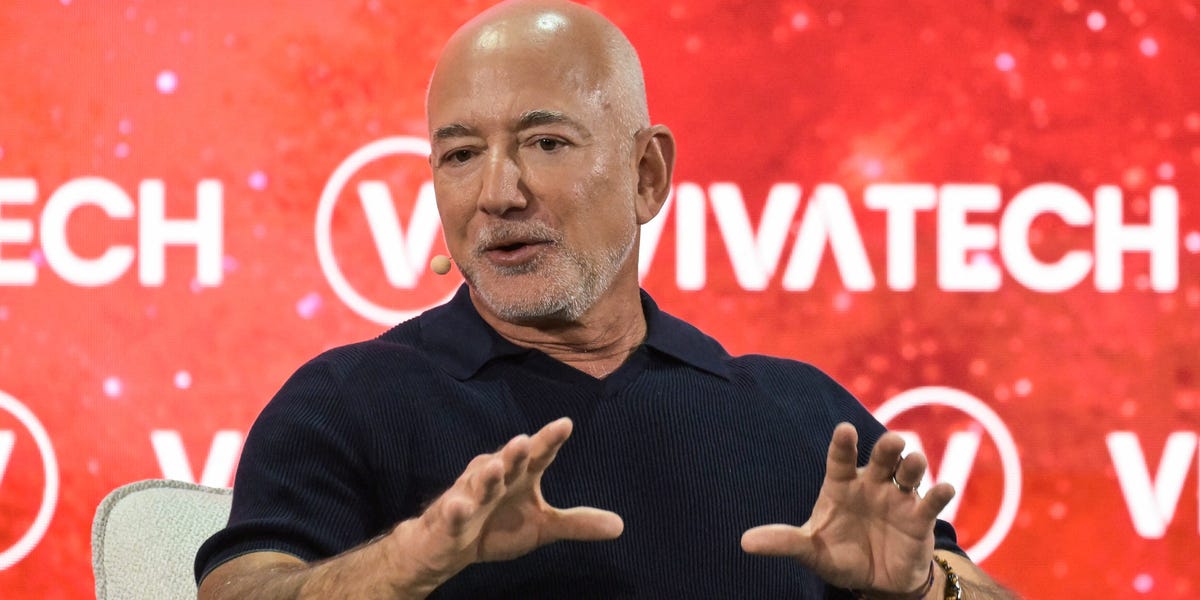
Jeff Bezos offered a counterweight to the dominant AI-jobs narrative. Speaking at the VivaTech conference in Paris on Wednesday, the Amazon founder said artificial intelligence is more likely to generate a labor shortage than mass unemployment.
Bezos argued that the technology will boost productivity across industries, raising the demand for workers rather than replacing them. He pointed to Amazon's own automation experience: the company added hundreds of thousands of employees even as it deployed robots and machine learning in warehouses. The pattern, he said, mirrors earlier waves of technological change that expanded overall employment.
The prediction runs against a wave of forecasts warning of job displacement. Goldman Sachs estimated last year that 300 million full-time roles globally could be exposed to automation. Bezos did not cite that figure but said such projections miss an offsetting dynamic – the new tasks that increased productivity creates.
Productivity gains are the transmission mechanism. When companies can produce more with the same labor input, they lower costs, cut prices, and stimulate demand. That demand pulls more workers into new roles. Bezos described this as a “virtuous cycle” that has repeated across the industrial revolution, the internet boom, and the cloud computing era.
The real risk, he suggested, is a shortage of skilled labor to implement and manage AI systems. Amazon has struggled to fill AI engineering roles, a constraint that limits how fast it can deploy the technology. Other large employers report similar bottlenecks. That shortage could push wages higher for technical roles while leaving lower-skilled roles broadly stable.
Bezos also touched on the timeline for artificial general intelligence – AI that matches or exceeds human capability across most tasks. He estimated AGI is still several years away and said the market is underestimating how much work remains. That caution tempers the near-term fear of disruption.
For investors, the implication cuts across sectors. Companies that can integrate AI into their operations without hitting a labor bottleneck – those with strong internal training pipelines or access to technical talent – stand to widen their margin advantage. Labor-intensive service industries facing the tightest hiring markets may see the biggest competitive shifts.
Bezos closed with a note on education. He said the public and private sectors need to invest heavily in retraining, not as a safety net but as a growth strategy. The alternative is a world where productivity grows but enough workers lack the skills to participate, creating a different kind of social stress.
The Amazon founder’s view gives a concrete frame for an otherwise abstract debate. If he is right, the macro risk shifts from unemployment to wage-driven inflation in high-skill labor markets and supply constraints in AI-ready industries.