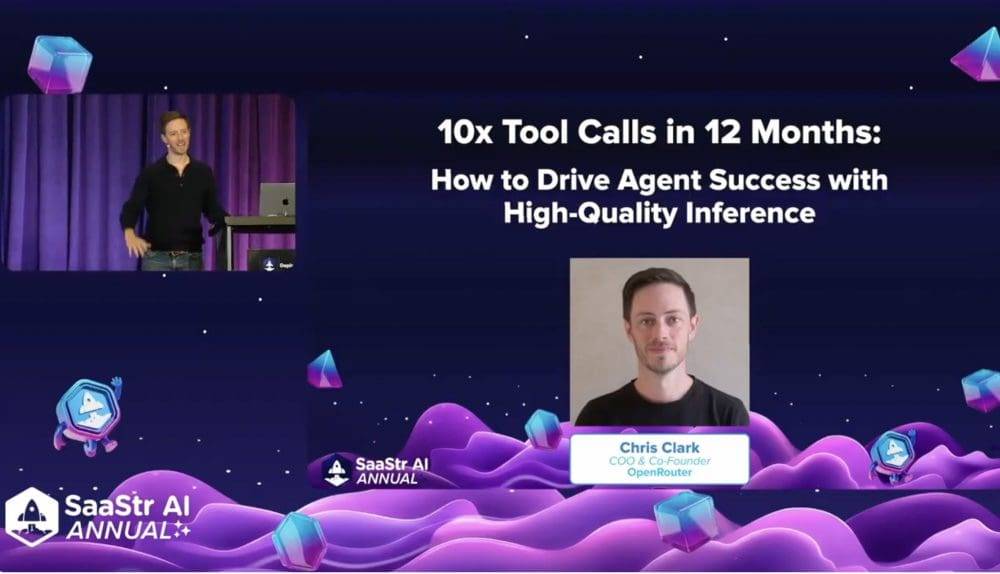
The Agent Token Cliff Is Here
Chris Clark, COO and co-founder of OpenRouter, runs the largest AI gateway in the world. His platform connects about 70 model providers and hundreds of models through a single integration. That vantage point produces a number that should reset every B2B founder's AI budget. OpenRouter expects to process about 28 trillion tokens in a single week. That is roughly 1 percent of all global inference, and more tokens than Salesforce has processed in the entire lifetime of the company.
Half that volume comes from the US and half from the rest of the world, making OpenRouter's data a fair proxy for real global trends. The trend that matters for every company building on AI is the one Clark put front and center at a recent industry event.
For two years the message was go make AI work for your company, and it was hard. People chatted with models, dropped some custom data into a project, and got modest results. In the last few months that changed. Agents started working. You can ask an agent to do something and it gets done. In OpenRouter's data, agentic token usage is now overtaking human usage, and you do not need the chart to feel it. Everyone building right now feels it.
The Token Bill Nobody Modeled
The part most teams have not priced in is the cost of that shift. Agentic usage burns far more tokens than people anticipated. A human turn in a chat box is short. An agentic turn carries a heavy context load: tool call definitions, MCP gateway definitions, skill front matter, plus reasoning and tool calls going back and forth before the agent returns anything. The token bill for one agentic task can dwarf a hundred human chats. If your forecast still models AI spend like people typing into a box, your forecast is wrong.
Practical rule: Budget agentic spend as a multiple of human usage, not an extension of it. Plenty of large companies have already burned through their annual AI budgets early because they sized the bill for chat and got hit with agents.
Inference Quality Varies by Provider, Not Just Model
Clark's framing is that agents need three things to succeed, and the first is inference quality that holds up. The surprise is that the same model performs differently depending on who serves it. Artificial Analysis benchmarked one open-weight model across many providers and got variable results from identical weights. Same math, same numbers, different scores.
This is mostly not quantization, and it is not providers sabotaging each other. There is a large amount of software sitting between raw model weights and a valid API response, and plenty of room to misconfigure it, introduce bugs, or parse tool calls incorrectly. The takeaway for anyone building on top of a model: where you source your tokens changes the quality of what you get back, even when the model name on the label is the same.
The Infrastructure Layer Matters More Than the Weights
Key insight: The hard part of running agents in production is no longer just picking a good model. It is inference quality that varies by provider, tool-call success that varies by provider, and failover when a provider degrades. Those used to be someone else's problem. With agents as your dominant token consumer, they are now your architecture, whether you build that layer yourself or buy it.
Tool Calling Is the Load-Bearing Wall
The second requirement is tool calling, and the data shows how central it has become. Looking at one frontier model family on OpenRouter, around 55 percent of requests asked for tools, the model used those tools 83 percent of the time, and 46 percent of completions finished because of a tool call. The line on that trend marches steadily upward, which maps to how agents work. They are not chatting. They are calling tools, reading results, and calling more tools.
That makes tool calling the load-bearing piece of agentic performance. A model that reasons beautifully but botches its tool calls is useless inside an agent.
What a Tool Call Actually Is
A tool call is a JSON result from the model that says call this tool with these parameters. If the JSON is malformed, the tool name is invented, or the parameters are wrong, the call fails and the agent stalls. And success rates vary meaningfully by provider, driven by the same infrastructure quirks that move inference quality.
Clark made it concrete with a live demo, which is a brave thing to do on stage with a non-deterministic system. He fired 213 tool calls at an open-weight model running on one provider and got an error. Then he switched providers by editing a saved preset, same model, same API, same code, and reran. The errors disappeared, because the second provider had a cleaner implementation. OpenRouter monitors this across thousands of API endpoints in real time and routes agents around the providers that are failing, whether the failure is uptime, malformed tool calls, or something else. Same model slug in your code, fewer broken agents in production.
The Routing Layer Is Now Core Infrastructure
Stack these three points and a clear conclusion falls out. The hard part of running agents in production is no longer just picking a good model. It is inference quality that varies by provider, tool-call success that varies by provider, and failover when a provider degrades. Those used to be someone else's problem. With agents as your dominant token consumer, they are now your architecture, whether you build that layer yourself or buy it.
Risk to watch: Assume your tool-call success rate, not just your model choice, decides whether your agents work. Treat the routing and failover layer as core infrastructure, not a nice-to-have.
The Budget Line Item That Keeps Growing
And the cost side deserves its own line on the P&L. The token blowups are not theoretical. Plenty of large companies have already burned through their annual AI budgets early, because they sized the bill for chat and got hit with agents. The fix is to forecast agentic spend for what it is, a multiple of human usage, not an extension of it.
The chat era is the baseline you are leaving behind. The next year of your AI bill, your reliability problems, and your performance gains will all be driven by agents, and agents behave nothing like a person at a keyboard. Budget tokens like a real and growing line item. Assume your tool-call success rate, not just your model choice, decides whether your agents work. And treat the routing and failover layer as core infrastructure, not a nice-to-have.
The companies that figure this out will ship agents that quietly succeed in the background. The ones that do not will ship agents that fail in ways they cannot see, on a bill they did not plan for.