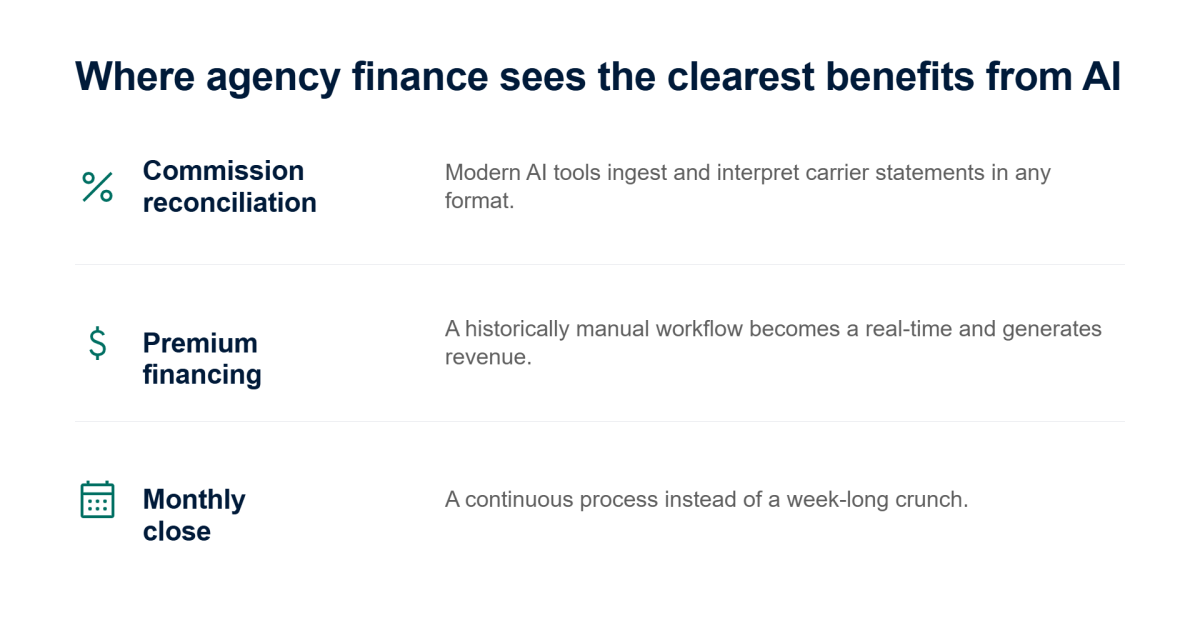
The argument that agency finance is moving from a cost center to a strategic function rests on a concrete shift: the grunt work of commission reconciliation is now automatable. Industry benchmarks show some agencies spend more than 4,000 hours a month on commission entry and validation alone. That figure comes from a recent analysis of agency operations.
Carriers send statements in dozens of formats, and payment timing varies by line of business. The data was never standardized. AI tools that can ingest any format, normalize the data, match transactions against policy records, and flag exceptions for human review are turning that into a review task. The change is not incremental. It is a different operating model.
Premium financing is the second area where the returns are measurable. The workflow has historically been paper-based and phone-heavy. When financing lives inside the agency management system, agencies get real-time visibility into what is owed and what is at risk. Policies eligible for financing automatically surface offers to the insured. The agency controls the parameters. The cost to finance is nearly zero, so revenue from financing grows without adding overhead.
The monthly close is a proof point. For most agencies, close still takes a week of pulling data from multiple systems. When reconciliation, payments, and financing all run inside the same system of record, the number that used to require five days is available every day. Agency accounting teams spend 15 or more hours a week manually gathering and reconciling carrier statements, according to user research cited in the report. That time is not going toward strategy.
Full AI adoption in insurance jumped from 8% to 34% year over year between 2024 and 2025, according to Datagrid. Agencies that have moved beyond piloting are finding that the gains compound. Automated reconciliation makes reporting more reliable. Reliable reporting improves forecasting. Financing visibility in real time means account managers see risk before it becomes a cancellation.
The transition is not just operational. Finance staff who have spent years navigating manual workflows may be skeptical. The framing that matters: AI eliminates low-value work so their judgment goes toward higher-stakes decisions. Data quality is also a prerequisite. Agencies with inconsistent policy coding or carrier records that live in someone's memory need to clean that up first.
On the vendor side, insurtech consolidation means agencies should ask who owns the financing relationship once it is signed and what happens if the platform is acquired. The agencies that benefit most will pursue connected workflows on their own terms, with a platform that serves the agency rather than locking it in. In a market that is consolidating quickly, agencies that build this financial infrastructure now get better cash flow visibility, more reliable reporting, and financing relationships that still belong to them.