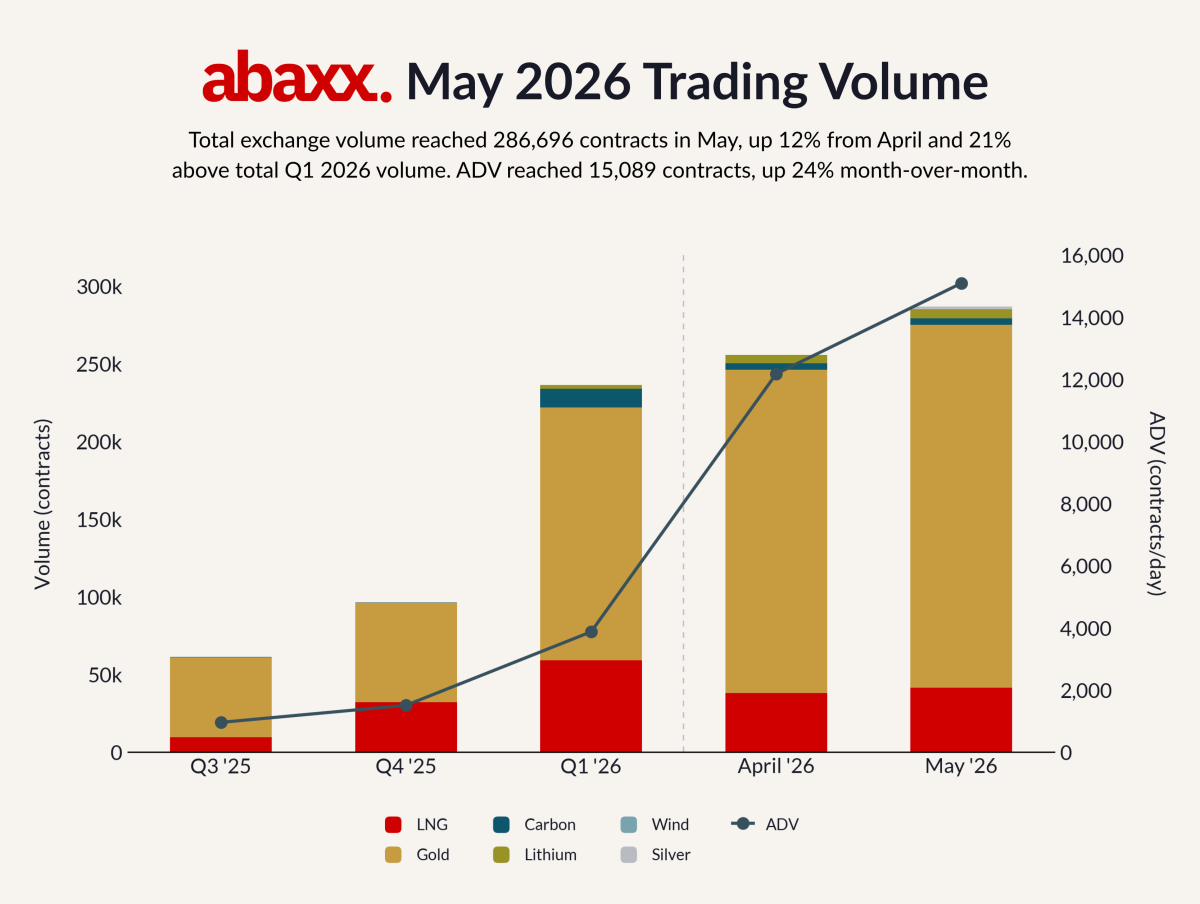
Abaxx Technologies Inc. (TSX:ABXX)(OTCQX:ABXXF) reported May 2026 trading volume records across its commodity exchange, with the most consequential number being LNG futures volume reaching 41,453 contracts, equivalent to over 40% of global JKM futures volume on other exchanges. Total exchange volume hit 286,696 contracts, a 12% increase from April and exceeding total Q1 2026 volume by 21%. Average daily volume of 15,089 contracts was nearly four times the Q1 ADV of 3,872.
The headline numbers describe a straightforward growth story. The better market read concerns liquidity fragmentation, benchmark transition risk, and execution cost implications for traders who rely on JKM as the reference price for Asian LNG. A new physically deliverable Gulf of Mexico FOB contract and a North Pacific Asia DAP contract are now capturing meaningful share of notional flow. That changes the calculation for anyone hedging Asian LNG exposure.
The Market Share Number – 40% of JKM
Combined volume across Abaxx’s two LNG futures contracts reached 41,453 contracts in May, a new monthly high. The company explicitly compares this to “over 40% of global JKM futures volume across other exchanges during the month.” JKM (Japan Korea Marker) is the dominant benchmark for spot LNG delivered into Northeast Asia, traded primarily on CME and ICE. Abaxx’s contracts are structured differently: GOM FOB is physically deliverable at Gulf of Mexico export terminals, and NPA DAP is deliverable at North Pacific Asian ports.
Why the comparison matters
The 40% figure is not a direct market share of all LNG futures – it is a comparison against JKM volume specifically. That still represents a significant shift in where liquidity is forming. If Abaxx continues to capture a growing share of flow, the JKM benchmark itself could face a liquidity drain, making it more expensive to execute large hedges on incumbent exchanges. For traders, the immediate implication is that spreads between Abaxx LNG contracts and JKM may widen or narrow depending on which pool attracts the next wave of commercial hedgers.
Mechanism: Physical delivery vs. financial settlement
Abaxx’s LNG contracts are physically deliverable, whereas JKM futures on CME are financially settled against the S&P Global Platts JKM assessment. Physical delivery ties the futures price directly to the physical cargo market, reducing basis risk for producers and off-takers. The trade-off introduces operational and logistical complexity that financial settlement avoids – traders who only need price exposure may prefer the financial contract, while those with physical cargoes may shift to Abaxx.
Gold and Lithium Records – Diversification or Distraction?
Gold Singapore futures (GKS) reached 233,650 contracts in May, a new monthly high. Lithium Carbonate Singapore futures (LCS) hit 5,884 contracts, also a record. These volumes dwarf the LNG contract in absolute terms, the context is different.
Gold: The co-located spot advantage
Abaxx’s gold futures benefit from the co-located Abaxx Spot physical gold pool in Singapore, enabling efficient physical delivery and OTC transfers. The 233,650 contracts represent a growing fraction of global gold futures volume – COMEX trades roughly 500,000 contracts per day. The record is notable for the exchange’s own trajectory, it does not yet signal a threat to the incumbent.
Lithium: A niche with potential
Lithium futures are still an emerging asset class. 5,884 contracts is a record for Abaxx, it remains tiny compared to established metals. The contract’s relevance depends on whether battery material producers and automakers adopt it for hedging. For now, it is a watchlist item rather than a trading opportunity.
Silver Launch – Early Signal or Noise?
Silver Singapore futures (SSP) recorded 1,694 contracts in its first trading week following the May 22, 2026 launch. That is a modest start. Silver futures are a crowded space with established liquidity on COMEX and the Shanghai Futures Exchange. The first-week volume suggests some initial interest, it does not indicate a viable alternative yet. Traders should monitor whether the contract sustains daily volume above 500 contracts after the launch novelty fades.
Exposure and Risk for Commodity Traders
For traders and risk managers, the Abaxx growth story creates several concrete exposures:
- LNG hedgers using JKM futures face potential liquidity fragmentation. If commercial flow shifts to Abaxx, JKM bid-ask spreads could widen, increasing execution costs.
- Arbitrage traders may find opportunities in the spread between Abaxx GOM FOB and JKM, especially if physical delivery constraints create pricing dislocations.
- Gold and silver traders have a new venue for Asian-hour trading, volume is still too low to rely on for large orders without slippage.
- Clearing risk: Abaxx Clearing is a new central counterparty. Traders should evaluate margin requirements, default fund contributions, and recovery procedures compared to established CCPs like CME Clearing or ICE Clear.
What would reduce the risk
- Sustained volume growth across all contracts for at least three consecutive months, demonstrating stickiness.
- Increased participation from major commodity trading houses and producers, deepening the liquidity pool.
- Regulatory endorsement from Singapore’s Monetary Authority or other jurisdictions, reducing counterparty uncertainty.
What would make it worse
- A clearing incident – even a minor operational glitch – could spook nascent liquidity.
- JKM liquidity improves or CME/ICE introduce competing physically deliverable contracts, pulling flow back.
- Volume reverts in June or July, suggesting the May record was a one-off driven by a specific cargo schedule or hedging cycle.
Next Decision Point for Abaxx and LNG Benchmarks
The June and July volume data will be the first test of whether May was a trend or a spike. Abaxx’s own ADV trajectory – from 3,872 in Q1 to 15,089 in May – is steep. A pullback to 10,000 or below would signal the growth rate is not sustainable. Conversely, if ADV holds above 12,000, the exchange becomes a credible alternative for LNG hedging.
For traders, the practical step is to add Abaxx LNG contracts to the execution toolkit without abandoning JKM yet. Running parallel hedges and monitoring the spread will reveal where the true liquidity lies. The physically deliverable nature of Abaxx contracts means any trader with cargo exposure should evaluate whether the basis risk reduction outweighs the operational cost.
For context, Cheniere Energy (LNG) holds an Alpha Score of 66/100, reflecting moderate fundamentals in the sector. As the largest US LNG exporter, Cheniere’s cargoes are directly relevant to the GOM FOB contract. Traders watching the Abaxx volume trend should also watch Cheniere’s production and export schedules, physical delivery volumes will ultimately anchor the futures price.
The May record is a signal, not a conclusion. The next two months will determine whether Abaxx becomes a structural part of the LNG hedging landscape or a statistical outlier in a single month’s data.