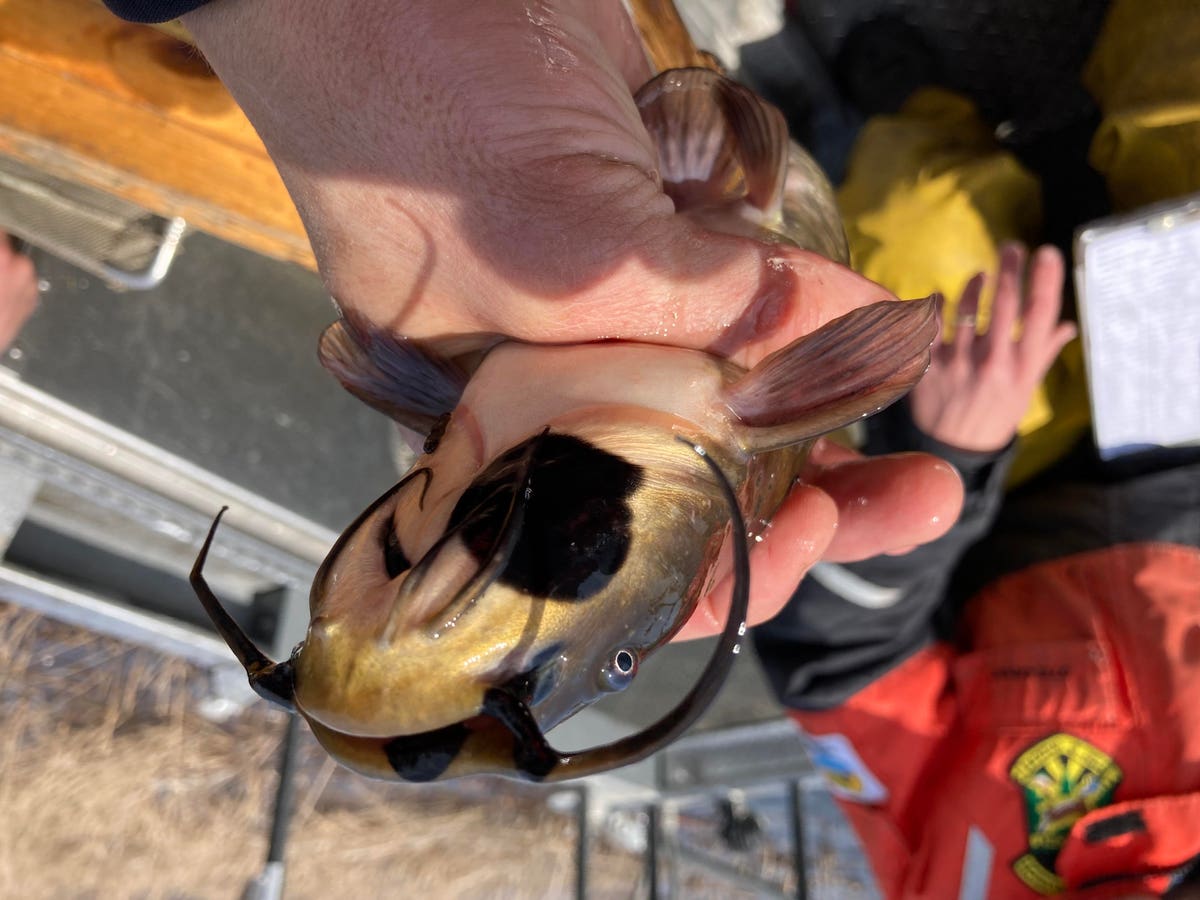
A contagious melanoma is spreading through brown bullhead catfish in Lake Memphremagog. It is the fourth transmissible cancer known to science and the first in fresh water.
In 2012 an angler pulled a brown bullhead out of Lake Memphremagog with what looked like tar smeared across its skin. He brought it to Peter Emerson, a fish biologist with the Vermont Fish and Wildlife Department, who had surveyed the lake since 2009. Emerson had never seen anything like it.
Within three years the black growths were on a quarter to 40 percent of the lake's bullhead. This week researchers at the University of Vermont reported in Nature that the melanoma is contagious, spreading from one fish to another as living cancer cells.
It is the fourth type of transmissible cancer known to science, the first in a fish and the first in fresh water.
Cancers found in a cluster usually have a common cause, a chemical carcinogen or an infection. Brown bullhead are a sentinel species for pollution because they develop liver tumors in water contaminated with polycyclic aromatic hydrocarbons, and walleye carry a retrovirus that causes skin sarcomas.
So, these are the causes the researchers hunted for, hard and for years. Vermont biologists tested the watershed for those hydrocarbons after Tropical Storm Irene tore through in 2011, thinking the flooding had stirred up a point source. Waters with far higher levels held clean fish. Tissue went to the bioinformatics core at the University of Vermont from about 2014 on, yet years of sequencing turned up no virus and no microbe of any kind.
Julie Dragon, the associate professor of microbiology and molecular genetics who directs that core, went looking for a shared mutation instead. In an ordinary cancer each tumor is a close genetic relative of the animal it grew in, and a family tree of cancers and non-cancerous tissue puts every tumor next to its own host. The Memphremagog trees came out the other way around: all the tumors in one cluster and all the fish in another, with hundreds of thousands of mutations shared across cancers in different fish and absent from the fish carrying them.
Drafted by a large language model from the source reporting linked above, then screened by automated publishing checks. It is not read by a journalist before publication. Some articles cite our Alpha Score. Verify prices and figures against the original source. Educational coverage, not personalized advice.