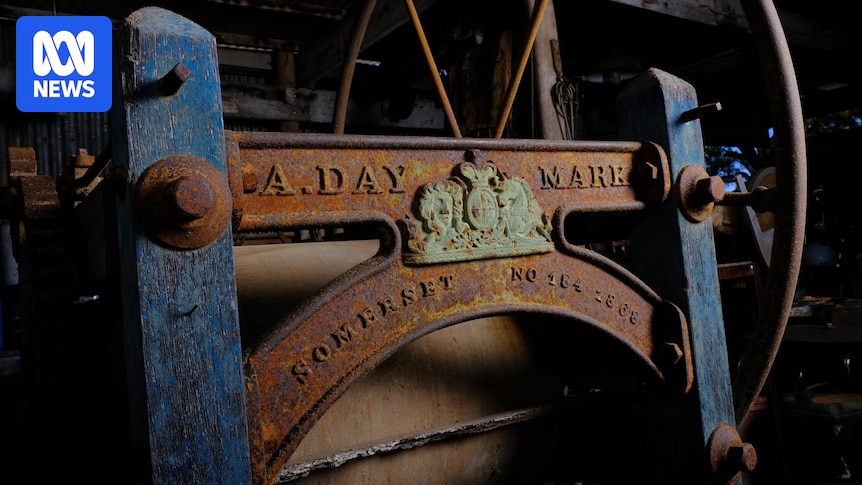
A restored cider mill in Braidwood, Australia, crushed its first apples in more than a century. The event, a local heritage demonstration, holds a sharper lesson for anyone holding a mixed stock: the gap between what you can see and what you need to know is often filled by patient, resourceful guesswork.
The mill, originally built in 1868 by the Albert Day Foundry in Somerset, had been stationed at a cider factory near Braidwood before falling silent. Carpenter Ned Bott took on the refurbishment with no manual, no clear photographs, and only the rusted remnants to guide him. That starting point mirrors the position of an investor staring at a company with a 50/100 Alpha Score, a label that screams neither buy nor sell, but demands a deeper rebuild of the thesis.
The Carpenter’s Problem: No Blueprint, Only Fragments
Bott spent hours searching for images of a similar mill and found nothing. "So I had to work off what was there and recreate what I believed to be in existence at the time," he said. The market equivalent is a stock where the obvious metrics are inconclusive. Welltower Inc. (WELL), a healthcare REIT, carries that exact mixed signal. The Alpha Score of 50 doesn’t tip the scale; it forces an investor to reconstruct the valuation from scattered clues: demographic tailwinds, interest-rate sensitivity, and property-level operating trends that aren’t neatly summarized in a single multiple.
Bott’s four weeks of actual work, spread over one and a half years, underscores the rhythm of real due diligence. The bulk of the time wasn’t hammering; it was waiting, searching, and testing assumptions. For a mixed stock, the catalyst rarely arrives on schedule. It might be a rate decision, a lease renewal cycle, or a shift in skilled nursing occupancy. The investor who expects a quick resolution is the one who strips the gears.
The Breakthrough: A Missing Photo from Hestercombe
A late-stage discovery changed the project. "In the last couple of weeks, we managed to get hold of someone who posted some photos of the same mill on a farm in Hestercombe [UK]," Bott said. The photos revealed intricate parts that were missing, adding a final layer of work. In a mixed stock, the equivalent is often a single data point that re-contextualizes the whole picture. For Welltower, that could be a quarterly same-store net operating income print that diverges from the sector, or a capital-recycling transaction that proves the portfolio’s mark-to-market value.
Most investors treat a 50/100 score as a reason to walk away. The better read is to treat it as a partially assembled machine. The missing piece isn’t always a number; sometimes it’s a relationship. Bott didn’t find a schematic; he found a community connection. For a REIT, the missing piece might be a local operator’s expansion plan or a regulatory change that only matters if you’ve mapped the facility-level exposure. The source of the breakthrough is rarely the sell-side note everyone else is reading.
The Ingenio Mechanism: Why the 1670s Design Still Matters
The mill is an Ingenio type, invented in the 1670s. Braidwood cider maker Gary Sully explained the watershed moment: earlier stone trough mills crushed everything, including pips and stalks, which are full of arsenic and impart a bitter, unrefined taste. The Ingenio mill introduced a gap that let pips and stalks pass through the roller, yielding a cleaner juice. The mechanism wasn’t about more force; it was about selective pressure.
A mixed stock often suffers from a market that is crushing everything together. Welltower’s portfolio spans senior housing, outpatient medical, and long-term/post-acute care. Each segment has a different sensitivity to labor costs, reimbursement policy, and cap rates. The simple read treats the whole company as a bond proxy that wins or loses on the 10-year yield. The better read separates the pips from the pulp. Senior housing operating portfolios (SHOP) are driven by occupancy and rate growth, which can accelerate even as rates stay high if supply is constrained. Outpatient medical buildings have longer leases and steadier cash flows, behaving more like traditional net-lease assets. The Ingenio gap is the analytical separation of these streams. Without it, the valuation tastes bitter.
The Press and the One-Tonne Question
Bott’s next job is an apple press from the early 1900s, capable of pressing one tonne or more at a time. If restored, it will work alongside the mill. The press represents the conversion of crushed material into a finished product. For Welltower, the press is the capital allocation decision that turns property income into distributable cash flow and, ultimately, dividend growth. The company’s ability to press a tonne of apples–meaning, to aggregate and deploy capital at scale–depends on its cost of equity and debt. A mixed score often reflects uncertainty about that very conversion rate. If the equity multiple is compressed, the press leaks; acquisitions become dilutive, and the growth narrative stalls.
There are plans to produce cider using apples grown on the property where the mill was kept at Majors Creek. "Many years ago, we grafted the root remnant trees of the Wilton Cider Factory, where the press and presser came from," Sully said. The vertical integration–growing the apples on the same land that once housed the equipment–is a reminder that the best catalysts are often internally sourced. Welltower’s development pipeline and redevelopment projects are its grafted trees. They don’t depend on the acquisition market; they depend on execution. When a mixed stock’s internal growth vectors are undervalued, the setup is more asymmetric than the headline score suggests.
The Decision Point: What Confirms the Restoration
The mill performed well at its demonstration, and there are plans to use it regularly. The confirmation wasn’t a one-time crush; it was the commitment to a repeatable process. For a mixed stock, the decision point isn’t a single earnings beat. It’s evidence that the restored mechanism can operate under normal conditions. Watch for Welltower’s same-store SHOP revenue growth to hold above 5% for consecutive quarters, even as rate-cut expectations shift. Watch for external management contracts to convert to owned assets without a spike in leverage. And watch for the dividend to be covered by funds from operations with a margin that doesn’t rely on one-time gains.
Bott built his own cider mill during COVID lockdown using objects he found around his house. That resourcefulness–creating a working model from limited parts–is the final lesson. Before committing large capital to a mixed stock, build a small-scale thesis. Test it with a starter position. If the mechanism works, the press can handle a full tonne later. The Alpha Score of 50 is not a verdict; it’s an invitation to do the carpentry.
For more on the stock, see the WELL stock page. For broader context on how mixed signals play out across sectors, read our stock market analysis.