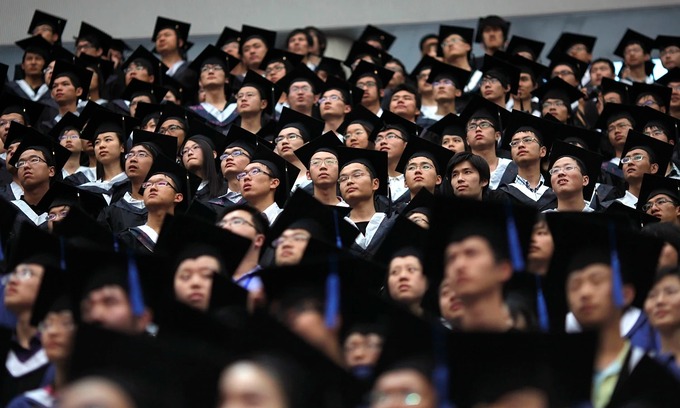
Indonesian student enrollment at Chinese universities reached about 20,000 as of January 2026, the Indonesian embassy in Beijing said. That is up from roughly 13,000 a decade earlier. The rise comes as traditional destinations such as the United States, Britain, Canada and Australia tighten student visa rules.
The trend is not solely a visa story. China has become Indonesia's largest trading partner and biggest foreign investor in mineral processing. Over $65 billion poured into nickel and EV battery plants over the past decade. Those factories need skilled technicians. Chinese universities, from Tsinghua to Chongqing Jiaotong, are positioning themselves as the training grounds.
Double-degree programs now link Indonesian campuses like LSPR Institute to Shanghai University of Finance and Economics. Institut Teknologi Bandung runs a joint master's program in battery materials with Central South University and GEM. Universitas Indonesia signed an MOU with Tsinghua in November 2025, following an earlier pact with Peking University.
Stella Christie, Indonesia's deputy minister of higher education, described the uptick as a "huge increase." She told The Straits Times that Tsinghua recently reserved 50 places annually for Indonesian high-school graduates, an offer China has not extended to any other country. Christie, herself a Harvard graduate who became a Tsinghua professor before entering the cabinet, said high school students in Aceh told her they wanted to study at Tsinghua, not an Ivy League school.
Agnes Helena Claresta Hariyadi, 20, studies tourism management at Chongqing Jiaotong University on a partial scholarship. "China has a massive economy, strong tourism prospects, and is a leader in the AI sector. I am hoping to secure a job here after graduation," she said.
The shift reverses a legacy that dates to the 1950s, when Indonesian economists trained at the University of California, Berkeley under the "Berkeley Mafia" program. Today's realignment is tied to China's push into Indonesia's nickel belt. Chinese firms control roughly three-quarters of Indonesia's refining capacity, according to the U.S. National Bureau of Asian Research. That creates a direct pipeline: universities supply graduates, and the industrial parks absorb them.
The education pivot would strengthen if Chinese investment in Indonesia continues at its current pace and if U.S. visa restrictions stay tight. It would weaken if Indonesia develops sufficient domestic university capacity to meet industry demand, or if geopolitical friction disrupts academic exchanges. The numbers so far point in one direction. The Indonesian embassy data shows 20,000 enrolled in China. That is about 7,000 more than a decade ago.