The death toll from Tropical Cyclones Maymay and Luis and the southwest monsoon reached 15, with 13 injured and nine missing, the Philippine National Police said.
The death toll from the combined effects of Tropical Cyclones Maymay and Luis and the southwest monsoon has risen to 15, the Philippine National Police said Monday. Another 13 people were injured and nine are missing. The PNP stressed that official confirmation of fatalities will come from the Office of Civil Defense, and its own count reflects only ground-level data.
Deaths were caused by drowning, electrocution, rockfall or landslide, and fallen trees. Two were in Region 1, seven in Region 4A, and six in the Cordillera Administrative Region. Police and other agencies rescued 50 people across four regions.
The OCD's latest situational report listed 13 deaths, still subject to validation, along with nine injured and one missing. The National Disaster Risk Reduction and Management Council reported eight fatalities in Benguet, Rizal, and Batangas, and one person missing.
About 223,000 families, or 752,000 people, were affected in nine regions. A total of 412 evacuation centers housed roughly 10,000 families, or 34,400 people. The disasters damaged 300 houses, 276 partially and 24 destroyed. Infrastructure damage was estimated at P1.12 billion, agricultural losses at P3.53 million. Government agencies provided P33.94 million in assistance, the NDRRMC said.
President Ferdinand Marcos Jr. ordered all government agencies to accelerate infrastructure maintenance and relief distribution as the enhanced southwest monsoon persists. Presidential Communications Office Undersecretary Claire Castro said the president directed immediate assistance to flood-affected residents, especially those in remote communities and returning evacuees.
Department of Public Works and Highways Secretary Vince Dizon inspected flood-prone urban centers including Las Piñas, Manila, and Quezon City. He reported observable improvements in water recession rates in areas such as Navotas, Valenzuela, Manila, and G. Araneta Avenue, which historically suffered deep, prolonged floodwaters. Dizon acknowledged that resolving the nation's flooding woes remains a long-term challenge. "There is no overnight solution. Decades of unaddressed issues in project execution mean this will take time, but we must be continuous and consistent," he said.
The DPWH is strengthening dredging operations, installing high-density polyethylene pipes, and ensuring round-the-clock operation of major pumping stations. Metropolitan Manila Development Authority Chairman Don Artes said joint inspections uncovered structural obstructions hindering water flow. Major issues included broken concrete barriers along EDSA busways that trapped runoff, utility pipes laid inside drainage culverts, and illegal encroachments along riverbanks. "Garbage is also a huge factor in slowing down the flow of water, causing flash floods on our main roads," Artes said. Heavy debris, including discarded furniture and appliances, frequently clogs pumping station turbines.
The DPWH confirmed strict enforcement against delinquent contractors. Blacklisted firms involved in flood control anomalies are barred from future public bidding.
The Philippine Atmospheric, Geophysical and Astronomical Services Administration said heavy rainfall is expected to last until Wednesday. Pagasa Administrator Nathaniel Servando said the rainfall will be concentrated in Zambales, Bataan, and Occidental Mindoro, with intensity reduced to 50 to 100 millimeters of rain.
OCD Assistant Secretary Laurence Mina reported that the combined weather systems have affected 384,520 families, or 1,310,000 individuals nationwide. Malacañang said about 5 million family food packs and nearly 245,500 nonfood relief items are ready for deployment. Social Welfare Secretary Rex Gatchalian said the government continues to increase its stockpile. As of Aug. 9, the Department of Social Welfare and Development maintained millions of family food packs in around 1,000 warehouses. "This is the largest stockpile the country has had since we started implementing this system," Gatchalian said.
MMDA Chairman Artes dismissed viral videos of deep flooding in Balintawak. "I just want our countrymen to be aware because there are a lot of fake news in the past few days, particularly one post that went viral that a lot of people shared that the water in Balintawak is too deep. Which is not true," he said in Filipino. He advised people to avoid sharing false information.
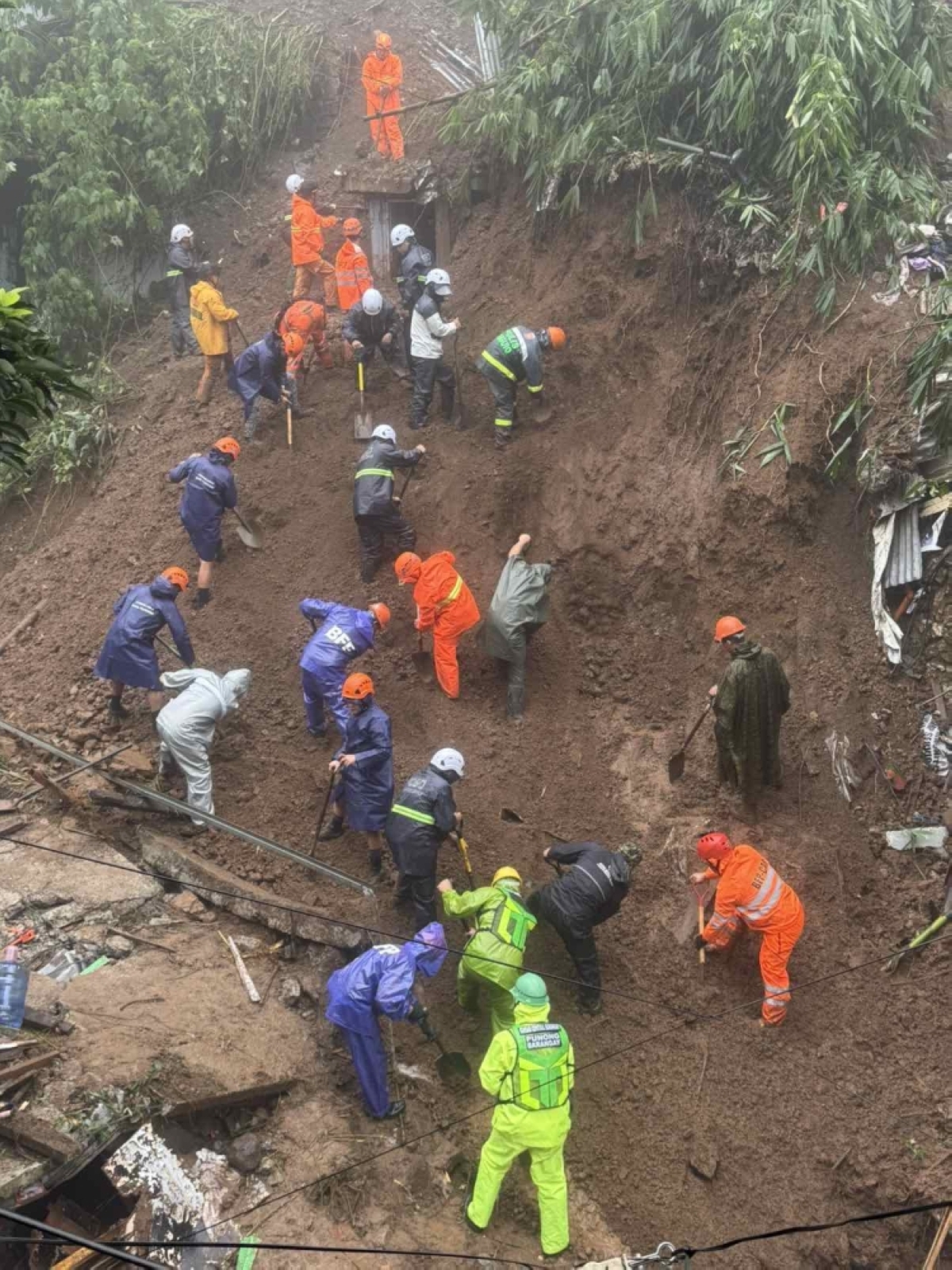
In Baguio City, rescue teams searched for six people still missing after a landslide buried three houses in Barangay Guisad Surong Sunday afternoon. Mayor Benjamin Magalong supervised the search, rescue and retrieval operations as rescuers dug through tons of soil and debris amid persistent rains. Authorities said 13 people were initially accounted for. Seven had been retrieved as of Monday, with four confirmed dead and three others rescued and brought to hospitals. Rescuers from various agencies and civilian volunteers continued working despite difficult weather. Magalong directed barangay officials and police to continue rounds in communities, especially in areas vulnerable to landslides. Residents in high-risk areas were urged to evacuate.
Baguio and Benguet remained under heightened alert. Pagasa reported that Baguio recorded 1,413 millimeters of rainfall from Aug. 1 to 9, the highest nine-day rainfall accumulation in the country during that period. The prolonged rains have saturated soil and mountain slopes, increasing the threat of landslides. As of Monday, Baguio City, La Trinidad, Sablan and Tuba were under a Yellow Heavy Rainfall Warning. Other municipalities in Benguet experienced light to moderate rains, with some areas receiving heavy rainfall.
The landslide brought back memories of a deadly disaster in the same area. On Oct. 18, 1967, a massive landslide struck Guisad Surong at the height of Typhoon Trining, killing dozens. Typhoon Trining, internationally known as Typhoon Carla, killed about 250 people, with another 30 missing. Baguio recorded 1,216 millimeters of rainfall in a 24-hour period from Oct. 17 to 18, 1967. Among the survivors was Virgie Cacao, now 69, who lost nine family members in that disaster.
Drafted by a large language model from the source reporting linked above, then screened by automated publishing checks. It is not read by a journalist before publication. Some articles cite our Alpha Score. Verify prices and figures against the original source. Educational coverage, not personalized advice.