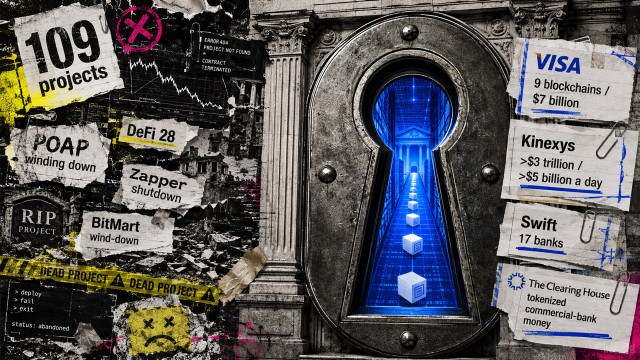
A tracker built by CryptoSlate has identified at least 109 crypto projects that shut down or became inactive in 2026 as of Aug. 5. DeFi accounted for 28 of them, more than any other sector.
The count captures a harsh cull across crypto. At the same time, banks and payment networks are processing real volume on some controlled blockchain systems while extending or testing others. The evidence offers no capital-flow link between the project closures and institutional buildout, and project counts cannot be compared directly with payment volumes or infrastructure announcements. The tracker simply maps where pressure is landing.
The tracker assigns 99 records to projects marked shut down, six to projects winding down, and four to inactive products. Behind DeFi, the largest categories are gaming with 15 records, infrastructure with 13, layer-1 and layer-2 projects with 12, and NFTs with 10. Wallets, exchanges and analytics products account for another 18.
Its timeline peaked at 27 recorded deaths in April, then eased to 21 in May, 20 in June and 14 in July. August had three through Aug. 5. The tracker lacks a comparable 2025 count and a denominator for projects launched this year, leaving the 109 total as a bounded snapshot rather than an industrywide failure rate.
POAP is the newest high-profile example. Co-founder Isabel Gonzalez said on Aug. 3 that the project was winding down after more than five years. She linked the decision to crypto's funding cycles and distribution dynamics, which made it difficult to build a sustainable company without eroding the ethos that gave POAP meaning.
DeFi's 28 entries make it the largest sector in the tracker, and recognizable interfaces are among the losses. Zapper founder Sébastien Audet announced the dashboard's shutdown in July, with closure scheduled for Aug. 3.
The current cluster also includes centralized venues. BitMart announced an orderly wind-down on July 26, with trading scheduled to stop Aug. 26 and platform operations set to terminate Jan. 31, 2027. BitMEX announced its exchange closure three days earlier. Those exits broaden the retrenchment beyond permissionless finance and weaken any clean decentralized-versus-centralized survival story.
Some entries record the completion of older consolidation plans. Polygon zkEVM's July sunset carried out a deprecation announced in June 2025, when Polygon cited technical limitations and weak differentiation, along with declining activity.
The contrast is most visible when crypto project shutdowns are put beside institutional blockchain growth.
Institutional blockchain activity spans several maturity levels. Visa and JPMorgan report live scale. The Clearing House is describing planned infrastructure, while Swift is preparing an initial deployment with banks. Together, they reflect a broad shift toward governed blockchain rails, though the figures measure different stages of adoption.
Visa said in April that its stablecoin settlement pilot had expanded to nine blockchains and reached a $7 billion annualized run rate, up 50% from the previous quarter. The pilot remains small beside Visa's overall business, yet it represents live settlement activity across a growing set of networks.
JPMorgan said Kinexys, its institutional blockchain platform, had processed more than $3 trillion since inception and was averaging more than $5 billion a day. The system serves institutional clients through controlled access and bank-managed money.
The next layer is shared bank infrastructure. The Clearing House announced a planned system for clearing and settling tokenized commercial-bank money. The proposal would connect blockchain activity with the RTP and CHIPS networks and support round-the-clock settlement.
Swift said in July that its blockchain-based shared ledger was ready for initial use with 17 banks preparing tokenized cross-border payment trials. That is an early deployment, distinct from Visa's settlement run rate or Kinexys' cumulative volume.
All four models preserve trusted operators and compliance controls, with institutional governance baked in. Early crypto treated financial intermediaries as the problem to be removed. These systems make the intermediary responsible for access and settlement certainty, using blockchain for programmability and continuous operation.
The juxtaposition with the shutdown tracker shows which applications are gaining institutional support and which parts of the crypto-native product layer are struggling. It establishes coexistence, not a mechanism: the sources do not show money leaving POAP, Zapper, or a DeFi protocol and moving into a bank ledger.
Crypto remains alive. The 109 records map selection pressure across projects and business models. Permissionless products continue to operate, while several of the largest measured blockchain uses now fit regulated distribution, bank money and controlled access. For cypherpunks and decentralists, the technology's success may arrive in a form that grants intermediaries more power than the original vision allowed.