Yen's Relentless Slide to Test Ueda's Capacity to Calm Traders
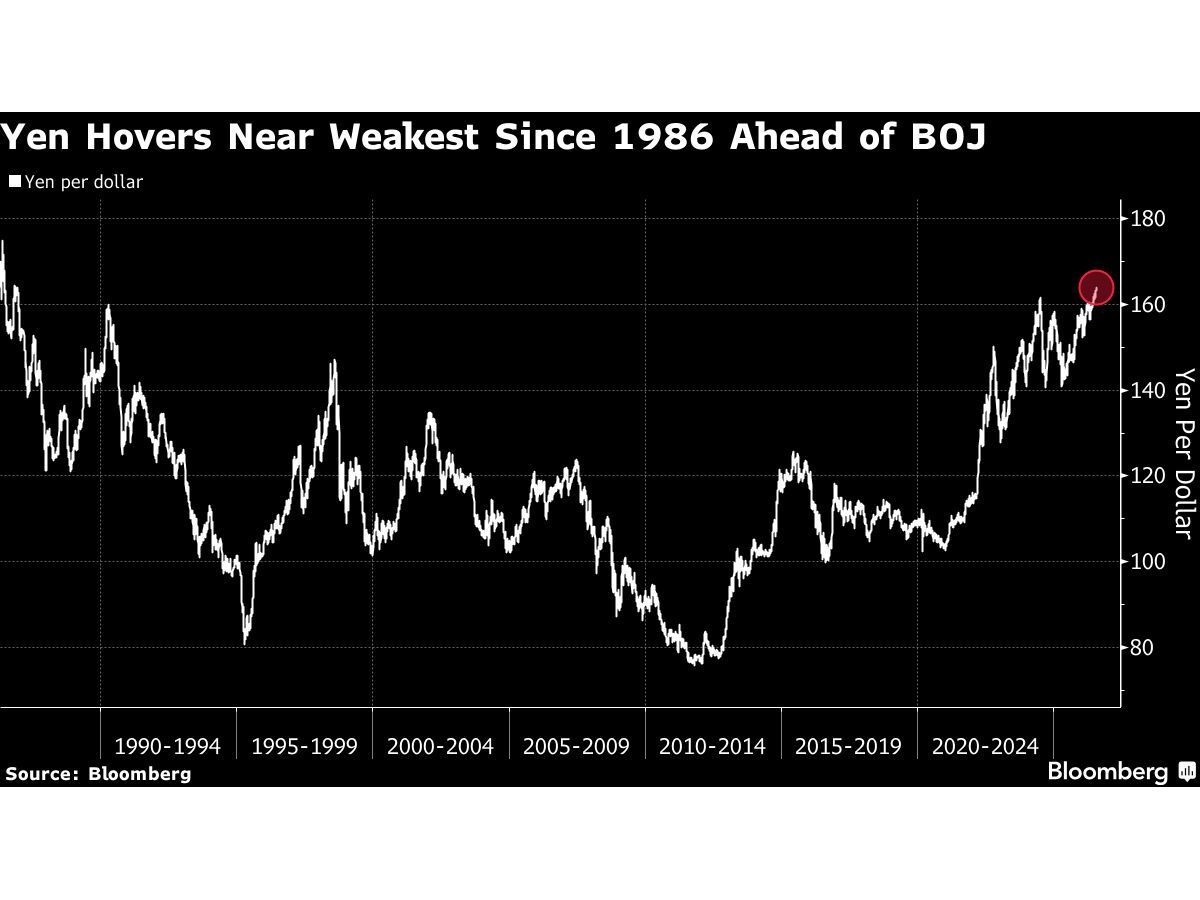
BOJ Governor Ueda faces a critical test Friday as the yen flirts with 165 per dollar. OIS pricing shows a 29% chance of a September hike. Analysts warn a dovish hold could push dollar-yen beyond 165.
The Bank of Japan meets Friday. Governor Kazuo Ueda's post-meeting press conference is the event that yen traders are circling on their calendars.
The BOJ is widely expected to leave interest rates unchanged. That leaves Ueda's tone as the only lever. The yen has already fallen to its weakest against the dollar since 1986. It touched levels below 160 in June and kept sliding this month.
Pressure comes from multiple directions. Rising oil prices push import costs higher. Wide interest-rate differentials between Japan and the U.S. keep the carry trade alive. Fiscal concerns add another weight. Last quarter's record ¥9.8 trillion intervention from the Ministry of Finance failed to halt the decline.
Overnight index swaps price about a 29% chance of a rate hike by September. The probability rises to roughly 78% by October. That leaves plenty of room for disappointment if Ueda does not signal urgency.
“If Ueda is not sufficiently hawkish, then the yen will continue to weaken beyond 165 to the dollar,” said Mark Dowding, chief investment officer at RBC BlueBay. “I think that Ueda will open the door to a hike at the September or the October meeting, but he is unlikely to be hawkish enough to cause the yen to rally sharply.”
Samara Hammoud, a strategist at Commonwealth Bank of Australia, echoed the caution. “For the yen to strengthen materially, the BOJ would likely need to deliver a meaningful hawkish surprise, such as clearer forward guidance on the timing of the next hike or signaling that a larger move remains on the table,” she said. “Even with a hawkish outcome, we do not expect dollar-yen to reverse course, as fundamentals including the terms of trade and interest rate differentials remain unfavorable for the yen.”
BOJ officials are open to raising rates at a faster pace, according to people familiar with the matter. The yen's continued weakness adds to upside inflation risks. Half the economists surveyed by Bloomberg expect the central bank to wait until December to lift its benchmark rate. Prime Minister Sanae Takaichi's government is seen as a potential obstacle to further action, given concerns about the economic impact and a proposal to lower the tax on food.
Bloomberg strategist Mark Cranfield argued that the yen needs more than incremental moves. “The yen does not need another gentle nudge. It needs shock and awe,” Cranfield wrote. “The BOJ needs to put a bigger option on the table. Signaling a 50bp hike is possible would show it is serious about catching up, rather than content to remain behind the curve.”
The BOJ's policy rate stands at 1%. Officials have talked about a neutral rate near 2%. Getting there through incremental tightening could take until 2028, even under a faster schedule.
For related analysis on the yen's trajectory after the last BOJ hike, see: Dollar Holds above JPY 160 after BOJ Hike; Aussie Firms on RBA Hold
Drafted by a large language model from the source reporting linked above, then screened by automated publishing checks. It is not read by a journalist before publication. Some articles cite our Alpha Score. Verify prices and figures against the original source. Educational coverage, not personalized advice.