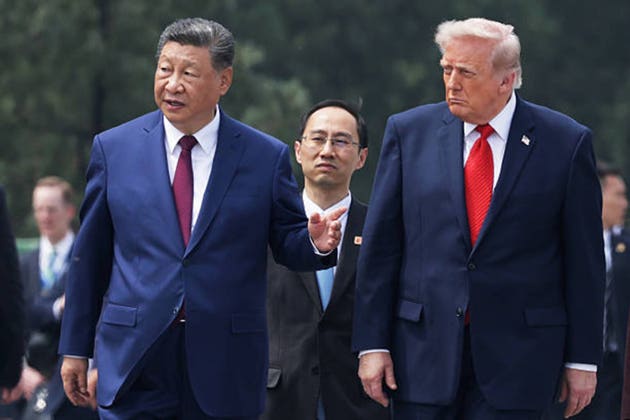
Xi's criticism of Japan's military buildup at Xi-Trump talks signals Asia security shifts. Watch defense stocks, tech supply chains, and trade routes.
The meeting between Xi Jinping and Donald Trump placed Japan at the center of a growing security rift. Xi criticized Japan's military buildup, a direct challenge to Tokyo's recent push to double its defense budget to 2% of GDP. For investors, this is not a generic geopolitical headline. It creates specific sector-level questions around defense budgets, supply chain geography, and trade route security.
Xi's criticism signals Beijing's opposition to Japan's accelerated rearmament. The naive read is that Asia risk premiums rise broadly. The sharper market read focuses on Japanese defense contractors. Under Japan's new national security strategy, procurement budgets are expanding for platforms such as Aegis destroyers, F-35 fighters, and long-range missiles. If China's opposition pressures Tokyo to slow spending, the direct beneficiaries – industrials tied to defense prime contracts – see a catalyst delay. If instead, Japan doubles down to counter Chinese pressure, spending accelerates. The decision now rests on how Washington responds. A reaffirmed US security guarantee could embolden Japan; a softer stance could cool procurement.
Rising China-Japan tensions do not stop at defense. Semiconductor and automotive supply chains cross the East China Sea daily. Japan is a critical supplier of chip materials and precision machinery. Chinese pressure on Japan could amplify existing tech decoupling trends, pushing more electronics supply chains out of China and into Southeast Asia. Shipping routes through the East China Sea and South China Sea face higher insurance and rerouting costs. This affects freight rates and inventory lead times.
The concrete decision point is Japan's next budget cycle and the US-Japan security treaty reaffirmation. If Tokyo proceeds with its 2% of GDP target despite Chinese criticism, Japanese defense stocks rally on confirmed spending. If a US administration signals reduced commitment, Japan may pursue independent capability at a faster pace – a positive for domestic defense primes but negative for US arms exports. Watch for statements from Japan's Ministry of Defense and joint US-Japan communiqués.
For a broader perspective on how defense line items drive sector performance, see $54.6B Defense Line Item: A $1.5T Budget's Hidden Catalyst. For more context on market implications of macro shifts, visit the stock market analysis page.
This is a catalyst that demands sector-level precision, not a binary risk toggle. The signal is not that Asia is dangerous. The signal is that two of the region's largest economies are hardening positions, and capital will reprice accordingly.
Prepared with AlphaScala research tooling and grounded in primary market data: live prices, fundamentals, SEC filings, hedge-fund holdings, and insider activity. Each story is checked against AlphaScala publishing rules before release. Educational coverage, not personalized advice.