The $5.1 Billion Question: Can WSP Hold Margins While Growing?
Montreal-based engineering firm WSP has more than doubled its annual revenue in three years. ENR's 2026 Top 500 Design Firms ranking shows total revenue jumping from $2.3 billion in 2022 to nearly $5.1 billion reported for 2025. In the Texas & Southeast region, WSP climbed from $542 million in 2021 to $1.185 billion in 2025, securing second place on this year's regional Top Design Firms ranking.
The headline read is straightforward: acquisitions scale the top line, and revenue follows. WSP purchased John Wood Group plc's environment and infrastructure business in 2022 and TRC Cos. earlier this year. The Wood Group deal alone added approximately 6,000 employees and strengthened WSP's footprint in Florida, Georgia and the Carolinas.
The better read is harder. Revenue growth from acquisition is mechanical. Operating margin growth is not. The market's real test for WSP is whether its expanding project pipeline – anchored by multibillion-dollar programs in Atlanta and Florida – generates fatter margins or simply bigger cost bases.
The Two Acquisition Vectors
WSP's acquisition strategy followed two distinct paths. The Wood Group purchase added geographic reach and environmental expertise. The TRC acquisition brought power and energy sector depth. Together they create a bundled-service capability that allows WSP to bid on larger projects combining civil, environmental, and energy work under one contract.
At the time of the Wood Group purchase, WSP President and CEO Alexandre L'Heureux said the move would "contribute to the achievement of our strategic ambitions while expanding our geographical range and adding expertise in key sectors. This will create even greater momentum as we future-proof our cities and our environment."
Claudia M. Bilotto, WSP's Atlanta-based Southeast region executive, described how this bundling works in practice. "We have clients like Amazon where we're able to provide services from site location, due diligence and civil work all the way to the engineering of the data center itself and the facility," she said. "Being able to provide a full suite of services to clients is a critical part of our growth strategy, and it's been really effective."
What this means: A client that hires WSP for site due diligence is likely to stay for structural engineering and construction oversight. The bundling creates a natural upsell path that locks in revenue across multiple project phases – a structural advantage pure organic growers need years to replicate.
The Atlanta and Florida Pipeline as Margin Driver
ATLNext and the $11.6 Billion Airport Program
Top among WSP's current contracts is its work leading the Atlanta Aviation Associates joint venture delivering the $11.6-billion ATLNext program at Hartsfield-Jackson Atlanta International Airport. WSP handles program and project management support, quality management, safety oversight, constructibility reviews, and supplier diversity outreach.
Contained within that program is the $1.4-billion expansion of Concourse D. The project uses 19 modular construction units moved more than a mile across two runways to widen the concourse from 60 to 99 feet and extend its length by 288 feet. The CM at-risk joint venture of Holder Construction Group, C.D. Moody Construction Co., Bryson Constructors, and Sovereign Construction and Development is executing the build.
Edmund Ramos, WSP vice president for aviation delivery and the project's deputy program director, said WSP's role goes beyond traditional program management. "Our main contribution is helping the airport balance heavy construction with daily operational demands."
Westshore Interchange and the Phased Design-Build Model
In Florida, WSP is lead designer for the estimated $1-billion Westshore Interchange project – Tampa's largest-ever highway construction contract. The joint venture of Superior Construction and The Lane Construction Corp. engaged WSP for the phased design-build (PDB) project, which will add capacity in general-use and tolled express lanes, upgrade the east end of I-275 at the Howard Frankland Bridge, and construct new direct connectors to Tampa International Airport.
The PDB approach is the first of its kind for a major transportation initiative in Florida. WSP will collaborate with FDOT and the joint venture to refine design in phases as work progresses.
WSP's additional Florida projects include:
- Raw water supply wellfield and injection well systems in Polk County, Fla.
- Living shorelines in Apalachicola Bay
- A shore power system at PortMiami
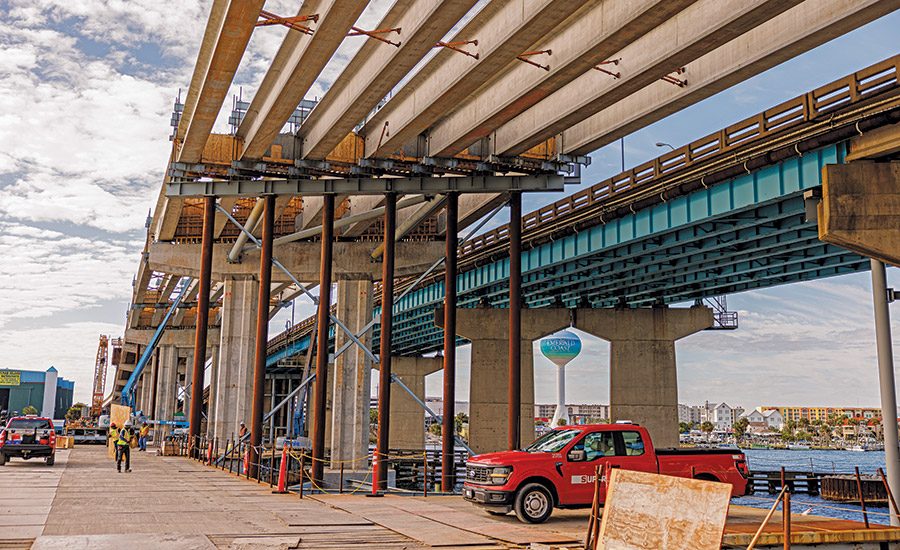
- Lead design on the $171-million John T. Brooks Bridge in Fort Walton Beach
Evan Lawrence, construction project manager with Superior, cited WSP's work on the Brooks Bridge as evidence of their execution capability. "Their problem-solving ability is second to none because they are such a big resource," he said. He added: "A lot of engineers understand what it looks like on paper, they don't know what it looks like in the field. WSP really just truly understands how we have to build. It's a more agreeable approach where we're going to have cost overruns, we're going to have issues on the job, let's work through them. There's never any pointing fingers."
Practical rule: A collaborative PDB model reduces adversarial contract disputes that often erode margins on large infrastructure projects. This execution edge is hard for smaller competitors to replicate because it requires both scale and a history of trust with clients.
| Project | Value | Location | WSP Role | Key Differentiator |
|---|
| ATLNext Program | $11.6 billion | Atlanta | Program management, design, quality oversight | 19 modular units moved across runways |
| Concourse D Expansion | $1.4 billion | Atlanta | Design oversight, CM-at-risk support | 60 ft to 99 ft widening, 288 ft extension |
| Westshore Interchange | ~$1 billion | Tampa | Lead designer, PDB procurement | First Florida PDB for major transportation |
| I-285 at I-20 Interchange | $1.25 billion | Atlanta | General engineering consultant | Started construction in 2025 |
| John T. Brooks Bridge | $171 million | Fort Walton Beach | Lead design firm | 2,111 ft long over Santa Rosa Sound |
The Operational Overhaul: Katus Watson as COO
Talent Pipeline and Community Engagement
In April 2025, Katus Watson joined WSP as U.S. chief operating officer. Previously with Jacobs for eight years, Watson most recently served as executive vice president and general manager for that firm's Canada and U.S. East region. Based in Tampa, he is charged with overseeing operational performance.
Watson sees WSP positioned to address major infrastructure challenges. "Whether it's transportation, energy transition, data centers, environmental remediation, sustainability and defense," he said, "we have the depth, the talent and the skill sets to help address all of these challenges."
Risk to watch: A new COO from a competitor introduces integration risk. If Watson fails to translate Jacobs' operational playbook to WSP's larger and more decentralized structure, margin improvement may lag revenue growth.
Developing Professionals Network as a Retention Tool
WSP's developing professionals network (DPN) functions as a structured retention program for junior engineers. Richard Sinz Lopez, a civil engineering consultant in WSP's Atlanta office, said the DPN offers real opportunities that competitors cannot match. "No other company has developed a young professionals network as robust, well-organized, well-structured as the DPN."
Bilotto added: "We have a lot of very experienced project managers who have done big jobs before, we also have the infrastructure to support them."
In an industry where talent churn can kill project continuity, WSP's investment in retention at the junior level directly supports its ability to staff large multiyear contracts without overpaying for replacements.
What Confirms or Weakens the Setup
The technical setup for WSP depends on margin execution, not revenue growth. Revenue is already in the pipeline – the ATLNext project alone runs for years. What investors need to see is operating margin expansion as the bundled-service model matures.
Confirming signals include:
- Operating margins rising above 10% as TRC integration delivers cross-selling wins
- Earnings reports showing TRC's power and energy clients migrating into WSP's civil work
- New contract wins in The Stitch – a "transformational civic infrastructure investment" creating 17 acres of park space atop a platform over the Downtown Connector in Atlanta
Invalidating signals include:
- A federal funding freeze or state revenue shortfall delaying projects like the I-285 interchange
- Cost overruns on the PDB Westshore Interchange that compress margins
- Competitors such as AECOM, Jacobs, or Stantec winning key Southeast contracts that WSP expected
The Stitch project represents a high-visibility win that would solidify WSP's reputation with public clients. Georgia's $1.25-billion I-285 at I-20 West Interchange, which started construction in 2025, also keeps the firm active in Atlanta's booming market.
The Next Events on the Calendar
The TRC acquisition closed only months ago. Operational synergies typically take 12 to 18 months to materialize fully. Look for earnings reports that show margin expansion as TRC's power and energy clients are cross-sold into WSP's existing civil work. The company's ability to manage the PDB procurement on the Westshore Interchange without major cost overruns will provide a real test of its execution capability.
A new COO, a growing retention program, and a project backlog tied to long-term infrastructure demand create a technical setup where WSP is positioned to deliver steady revenue growth with manageable execution risk. Revenue doubling is not a one-off spike. It results from a deliberate scale-building strategy that now has the operational depth to sustain it. The risk is not in the backlog. It is in operating margins that must follow the revenue trajectory for the stock to keep its premium.
Bottom line for traders: WSP's Southeast dominance will be hard to challenge if margins expand in line with revenue. If they do not, the acquisition machinery may have grown faster than the company's ability to extract value from its expanded scale. The confirmation period runs through the next two earnings cycles.
Key insight: WSP's bundled-service model creates an upsell path that smaller competitors cannot easily match. Revenue follows scale. Margins follow execution. The two are not moving at the same speed yet.