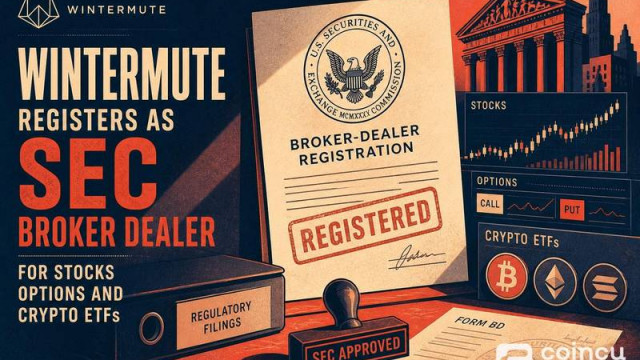
Wintermute, one of the largest crypto-native trading firms, has registered as an SEC broker-dealer and plans to trade stocks, options, and crypto ETFs in the United States, the company said. The move gives the firm a formal regulated foothold inside U.S. securities market structure, an expansion beyond its core role as a crypto spot and derivatives market maker.
The registration brings Wintermute under SEC oversight for its securities trading, a status that typically requires net capital rules, customer-protection obligations, and compliance with market-access regulations. The firm submitted its application to the SEC's Crypto Task Force, according to the company's written submission.
Wintermute's broker-dealer status covers three product categories: listed equities, listed options, and crypto ETFs, the firm said. That combination places the firm at the intersection of equity market-making, derivatives, and regulated digital-asset exposure. The Block first reported the registration details.
Crypto ETFs are the most direct bridge between Wintermute's existing business and the new license. The firm already provides over-the-counter liquidity in tokenized products, including a gold-backed token desk. A registered broker-dealer can handle the creation-redemption process for spot Bitcoin and Ether ETFs, a role that unregistered shops cannot fill for many institutional counterparties.
Stocks and options open a wider lane. Wintermute can now make markets in conventional equities and equity derivatives, a business that places it in direct competition with established market-making firms like Citadel Securities and Virtu Financial. The crypto-native firm brings algorithmic trading technology built for 24/7 markets to a U.S. equities regime that operates standard exchange hours, a structural difference that may shape how it allocates capital between the two businesses.
Registering as a broker-dealer is a regulatory milestone. For many institutional counterparties, including pension funds, endowments, and registered investment advisers, trading with an SEC-registered firm is easier than onboarding an unregistered crypto shop. Compliance teams at those institutions are more likely to approve counterparties that fall under SEC net capital rules and FINRA oversight, rather than firms that operate entirely outside regulated market infrastructure.
The move comes as regulators in multiple jurisdictions refine their approach to digital-asset securities. The SEC has issued guidance on when tokenized assets qualify as securities, while the CLARITY Act, which would create a formal crypto regulatory framework, has stalled in the Senate. Wintermute's decision to pursue a U.S. broker-dealer license rather than wait for a dedicated crypto regulatory regime is a bet that traditional securities rules are the more durable path.
The firm's own market commentary has been cautious on near-term crypto conditions. In July, Wintermute warned that Bitcoin could fall as summer liquidity dries up. The broker-dealer registration diversifies Wintermute's revenue sources: the firm can now earn fees from equity options, stock-market making, and ETF flows, not just crypto spot and derivatives spreads.
What is not yet public: which specific products Wintermute will trade first, how much capital it has allocated to the broker-dealer, and which counterparties have signed on. The registration establishes the regulatory capacity, but the commercial reality depends on client adoption and the firm's ability to compete in equities markets where spreads are razor-thin and the largest players have years of order-flow relationships.
Wintermute joins a small group of crypto-native firms that have crossed into registered U.S. securities market-making. Most of the largest crypto exchanges, including Coinbase and Kraken, operate broker-dealer affiliates but have focused their market-making on their own platforms. Wintermute's strategy of operating as a third-party liquidity provider across venues, rather than an exchange, gives it a different set of incentives: the broker-dealer is a tool to access order flow wherever it sits.
The direction mirrors wider policy shifts. Russia recently signed a law allowing regulated retail crypto trading. The SEC's enforcement focus has shifted toward tokenized securities and stablecoin compliance. Wintermute's bet is that the U.S. securities framework, originally written for stocks and bonds, can accommodate crypto ETFs and eventually direct crypto trading under the same rules.
For traders tracking Wintermute's expansion, the next concrete signals are the firm's first U.S. equity trades and which counterparties disclose Wintermute as a liquidity provider. The registration is step one. The order flow is step two.
MA stock page
crypto market analysis