The U.S. stock market has risen roughly 10% in 2026. Non-U.S. equities are up 13%. Those headline numbers mask a series of violent rotations in individual names and entire indexes, moves that traders say reflect a system awash in leverage and compressed cycles.
South Korea's benchmark index more than doubled in less than six months. It then crashed more than 40% in five weeks. Friday's session saw the index jump 13%. The two biggest names, SK Hynix and Samsung, make up roughly half the index. Both are in the AI arms race.
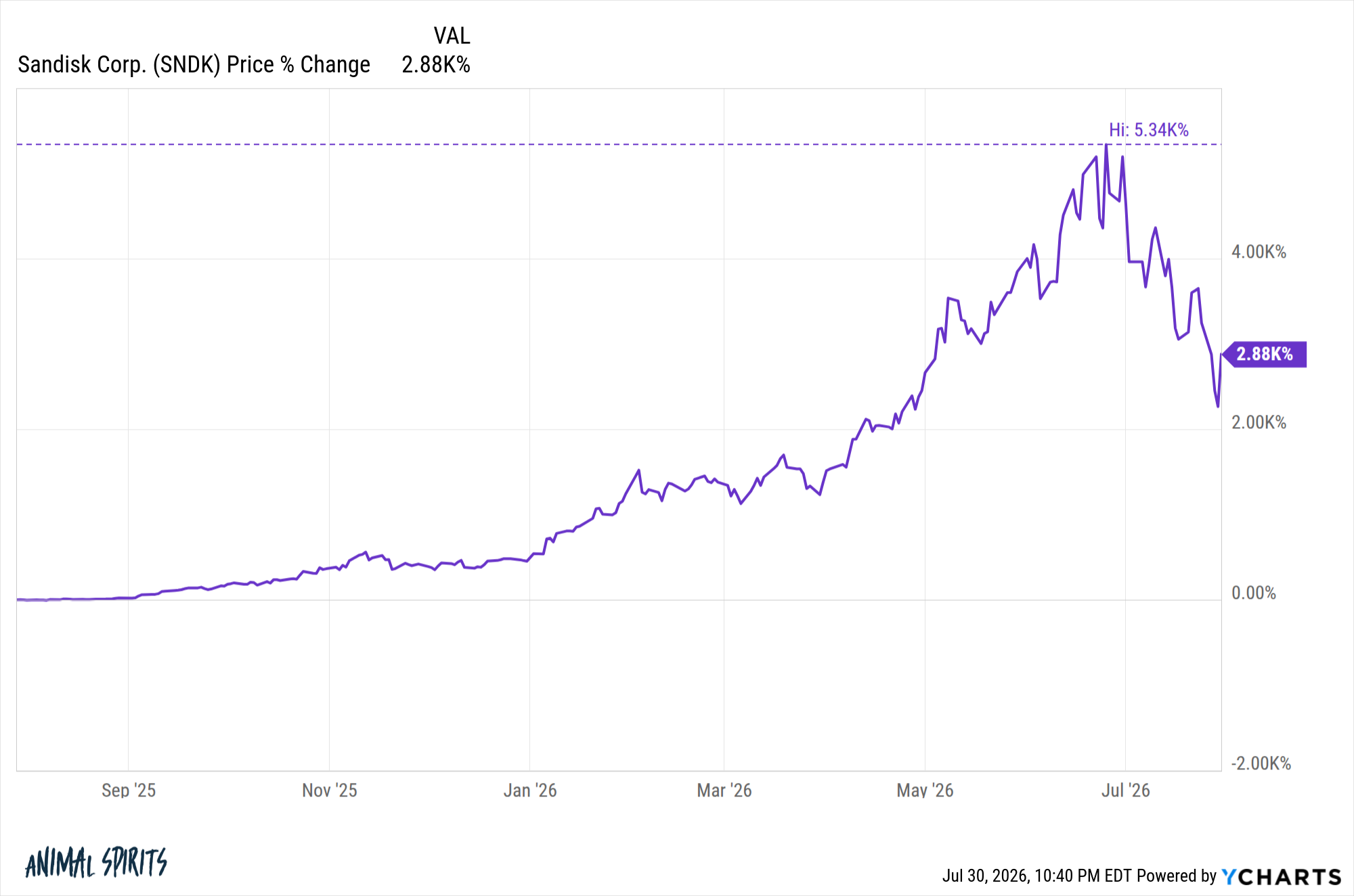
Semiconductor stocks have been the epicenter of the extremes. SanDisk surged more than 5,300% in the 12 months through late June. It then lost nearly 60% of its value in four weeks. Thursday brought a 26% single-day rebound. Investors are trying to figure out AI winners and losers, and hyperscaler AI spend has made chip stocks massive beneficiaries.
IBM suffered its worst one-day drop in over a century as a public company, falling 25% after earnings.
A cluster of beaten-down tech names snapped higher on Thursday. Microsoft added 15%. Micron gained 18%. Western Digital rose 15%. SK Hynix climbed 18%. Each had been in a deep drawdown heading into the session.
Friday's session was a study in dispersion. Apple fell 7%. Roblox dropped 30%. Reddit lost 21%. Amazon surged 15%.
The outsized moves come as leveraged positions are unwound, traders said. Hedge funds and retail investors alike have been forced to blow out of positions after piling on borrowed money during the AI-driven rally. The speed of the information age amplifies these swings, they added.
The MSFT stock page carries an Alpha Score of 68, labeled Moderate, with the stock at $464.72 after a 3% gain. IBM scores 40, rated Mixed. Roblox holds a Weak score of 29.
Market cycles are compressing. Single-day moves of 15% to 30% in large-cap tech names are becoming routine. The pattern suggests that any new catalyst – an earnings miss, a geopolitical shock, a shift in Fed expectations – could trigger another round of violent rotations.