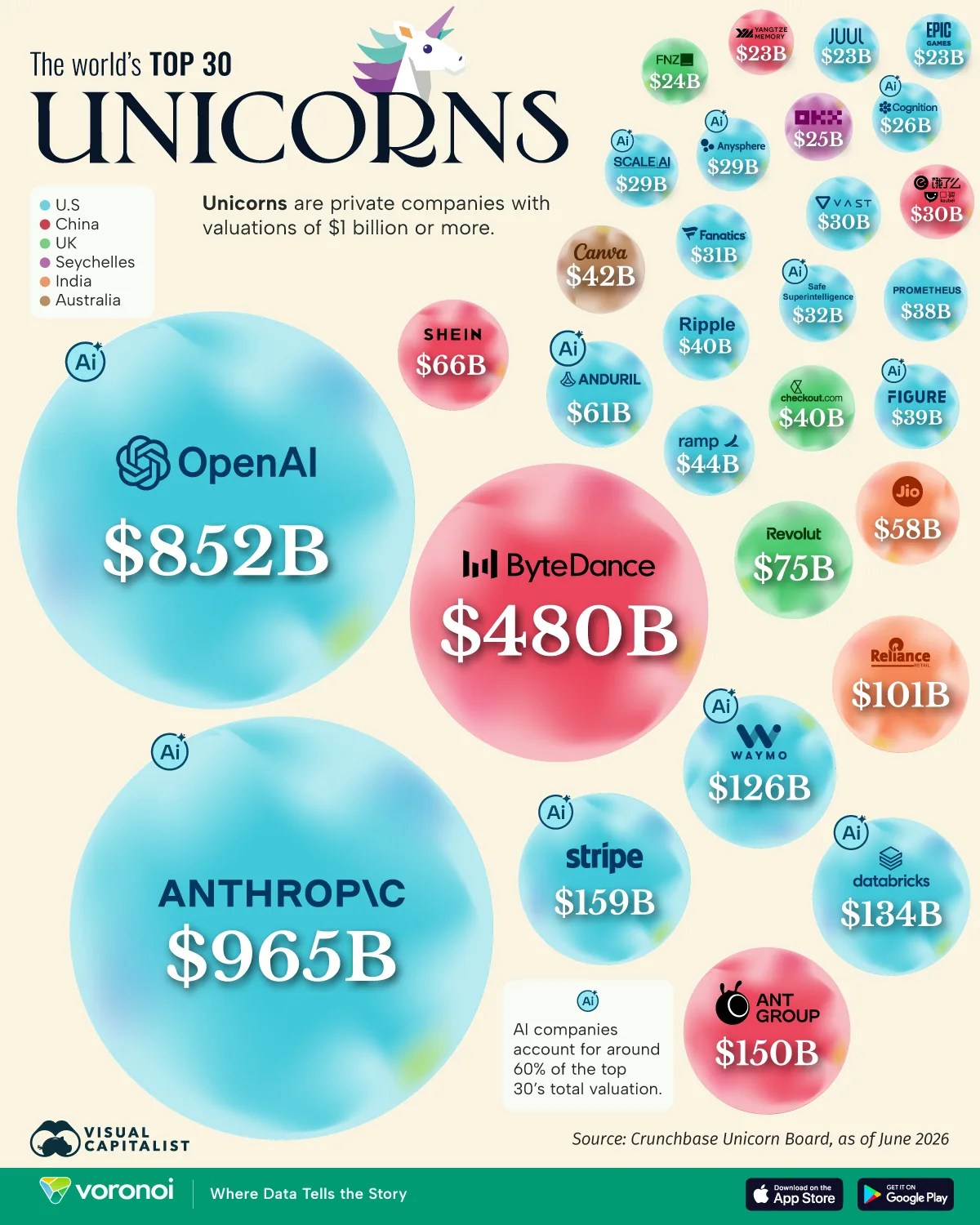
ByteDance leads at $225 billion. SpaceX, Stripe, Shein, and Databricks follow. The IPO window is open for some sectors. Timing will decide which unicorns keep their private valuations.
ByteDance leads the global unicorn ranking at $225 billion. SpaceX follows at $150 billion. Stripe, Shein, and Databricks round out the top five. All are private companies worth $1 billion or more that have never sold a share on a public exchange.
The list is long. The valuations are large. The waiting game is the story.
Rudiger Dornbusch once said things take longer to happen than you think they will, then happen faster than you thought they could. That quote fits the unicorn cohort right now. For years, investors watched these companies accumulate private capital, delay IPOs, and push the boundaries of what a private market can hold. The slow phase has lasted a long time.
The Dornbusch turning point may be close. A handful of the biggest names – the payments processors, the rocket builders, the enterprise software platforms – have been preparing for public listings. Their private valuations reflect optimism that may or may not survive the scrutiny of quarterly earnings calls. The gap between private and public pricing is the risk.
The simple read says unicorns are waiting for better market conditions. The better read says the conditions are already here. The IPO window has opened for some sectors. AI and defense-related companies have found a warm reception. The ones that hesitate risk being left behind when the window closes again.
Timing matters. A company that files in the next quarter might price at a premium. A company that waits another year might face a different rate environment, a different regulatory mood, and a different set of comparable public companies. The Dornbusch logic works both ways: the slow buildup of private capital has made these companies larger and more capable, the fast phase of public-market reality will test their unit economics and growth narratives.
The ranking itself is a snapshot. It changes every few months as new unicorns are minted and old ones either go public or get marked down. The next update will show more names from emerging tech hubs – not just Silicon Valley London, Bangalore, and Shenzhen. The geography of unicorns is spreading.
For the reader who tracks these names, the key question is not which unicorn is biggest. It is which ones will make the transition to public ownership without losing half their private valuation. The ones that do will prove Dornbusch right. The ones that do not will prove that private markets can sustain high prices only as long as no one needs to sell.
Prepared with AlphaScala research tooling and grounded in primary market data: live prices, fundamentals, SEC filings, hedge-fund holdings, and insider activity. Each story is checked against AlphaScala publishing rules before release. Educational coverage, not personalized advice.