Stocks● Neutral
Why the AI Jobs Forecast Misses the Real Bottleneck
Gartner's AI jobs forecast is accurate. The real constraint is human trust, not job counts. Gen Z's declining trust signals where value will be captured.
Continue with
Gartner projects that AI will affect roughly 9 million jobs globally by 2030 – jobs lost and gained, with gains overtaking losses around 2029. The number is careful, credible, and probably right. The problem is not that it is wrong. The problem is that it is a spotlight. While the industry argues over whether AI will create or destroy jobs, the risk that can actually hurt an organization is standing in the dark.
The number in the spotlight is ordinary.
Nine million jobs sounds enormous. Set it against the workforce change the U.S. has already absorbed since 1950 – roughly 104 million net new jobs, plus massive sector reshuffling from farm mechanization, mainframes, ERP, the internet, cloud, and mobile. Against that backdrop, 9 million over seven years is a fraction of normal churn. It is about 9% of what the workforce added across those decades, and less than some single sectors gained on their own. Every prior wave moved comparable or larger numbers, and the economy adapted each time. If raw job counts were the danger, the economy would have collapsed five technologies ago.
What the forecast cannot see.
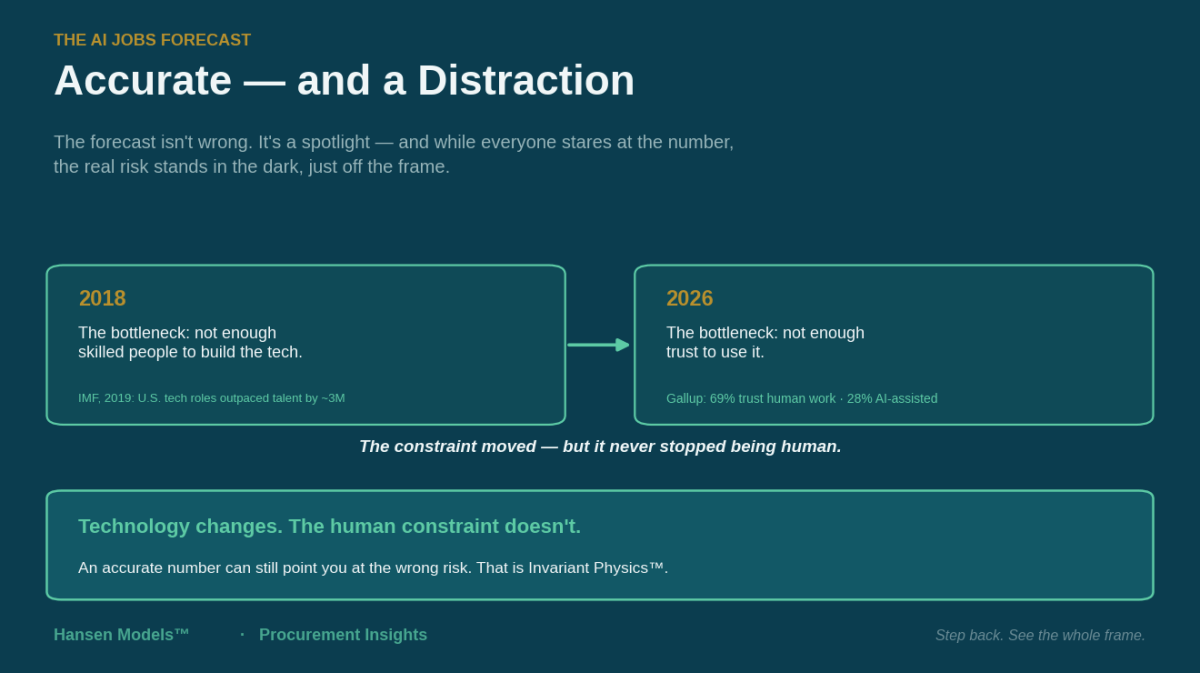
Look back to 2018. The high-tech sector's problem then was not a shortage of technology – it was a shortage of people to build it. The IMF's Finance & Development magazine documented the scramble: technology and science jobs in the U.S. already outnumbered qualified workers by roughly 3 million as of 2016, and the global shortage of high-skilled tech workers was projected to deepen through 2030. The binding constraint was human – the supply of skilled people – not the availability of the technology itself.
Now move to 2026. AI tools are abundant, capable, and cheap. The constraint did not disappear. It moved. A Walton Family Foundation, GSV Ventures and Gallup study of Gen Z (fielded February–March 2026, 1,572 respondents aged 14–29) found that the first generation raised on these tools trusts them less the more they use them. Gen Z workers place more trust in work done without AI (69%) than in AI-assisted work (28%), and almost none – 3% – trust AI-only output. In a single year, their excitement about AI fell from 36% to 22%, hopefulness from 27% to 18%, while anger rose from 22% to 31%.