The Fragmentation Tax on Live Sales Calls
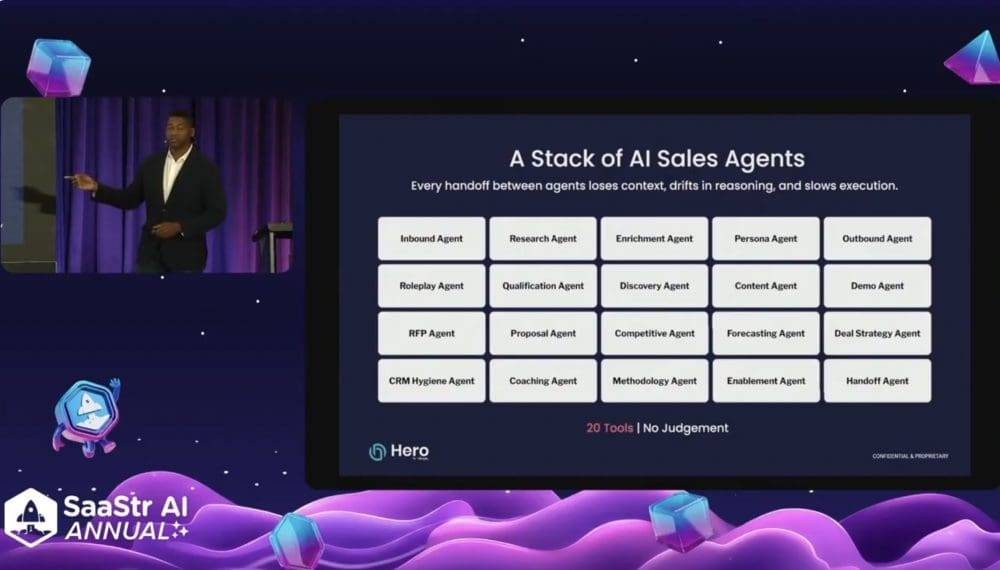
Most go-to-market teams spent the last 18 months buying an agent for every discrete sales task – one for lead scoring, one for meeting prep, one for objection handling, one for contract review. Jarod Greene, CMO of Vivun, told the SaaStr AI audience that his team now walks into deals and routinely finds 15 to 20 agents stitched together inside a single sales org. The result is slower execution and lost context, and the cost shows up where it hurts most: the live call.
Greene’s number: roughly 40 percent of first meetings end in no decision, often filed as “ghosted.” Buyers arrive informed – they already did their research via AI. The only thing they need from the rep is the information they could not find on their own. When the rep fumbles or says “let me get back to you,” the deal quietly dies. The problem is not that any single agent is bad. It is that no agent holds the full picture, and the handoffs between them are where the deal leaks.
Why Context Hops Break the Deal
Foundation models are excellent inside a single context window – hand one a transcript, a doc, and a set of call notes, and it will summarise, transcribe, and reason beautifully. A real B2B sales question is rarely one context. The question behind the question needs to know the persona, the buying cycle, the buyer’s power, the incumbent, the competitor, and the objection underneath the stated objection. Vivun calls each of those connections a “hop.” A complex deal is 8, 10, even 20 hops deep.
Greene’s research found that foundation models start getting wonky after about the third hop. Great context once, twice, maybe three times. Then new information enters the picture and the model drifts, gets weird, and starts to hallucinate. That is the exact moment a high-stakes deal needs the model to be sharp, and it is the moment most agent stacks fall apart.
Greene’s framing: the LLM is the map, not the brain. It is exceptional at breaking down language. It does not carry your sales reasoning. It does not know your process, your people, your platforms, or your methodology. Those are the things you spend years training into your best reps, and foundation models on their own do not retain them.
The Better Architecture: One Teammate, One Intelligence Layer
That reframes the whole agent question. The problem with the 20-agent stack is not that any single agent is bad. It is that no agent holds the full picture, and the handoffs between them are where the deal leaks. A teammate that carries sales reasoning – the winning behaviours pulled from millions of CRM interactions, and your specific context – can hold the thread across all 20 hops. Twenty disconnected agents cannot.
The bigger implication is enablement. The old playbook was to sit with your best seller, study what they do, and train the rest of the team toward it. About 90 percent of sales methodology training is forgotten if not applied in the first two weeks. Companies spend millions on methodology providers and watch most of it evaporate. Give that methodology to one AI teammate instead, and it holds it permanently and reminds the rep what to do, what to know, what to say, and what to show in the moment that matters.
Greene cited three predictions from Gartner for orgs that adopt AI sales teammates:
- Shorter sales cycles – the rep stops saying “let me get back to you.”
- About 40 percent less product-specific training time – the AI teammate is the product expert.
- Much shorter ramp – eight months to first deal compressing to two, or eight weeks compressing to two.
Vivun’s power users reported a 50 percent reduction in sales time, plus higher win rates and bigger deals. The pitch: one teammate, one intelligence layer, one platform – not 20 agents.
What This Means for Salesforce (CRM) and the AI Sales Platform
Salesforce (CRM) sits at the centre of this shift. The company has been integrating its Einstein AI copilot across Sales Cloud, Service Cloud, and Marketing Cloud, positioning it as the single intelligence layer that sits on top of the customer data a company already owns. If the market moves from point agents to consolidated teammates, Salesforce’s platform advantage deepens. The company’s Data Cloud and its ability to pull context from CRM, collaboration tools, and conversational intelligence give it a head start in building the one-teammate architecture Greene describes.
AlphaScala’s proprietary model assigns CRM an Alpha Score of 46/100, labelled Mixed, suggesting the market has not yet priced in the consolidation thesis. The stock currently trades at roughly 28x forward earnings, a premium that reflects its SaaS durability. For investors, the key question is whether Salesforce can convert its CRM data moat into a defensible AI teammate product – or whether point-agent startups will continue to fragment the stack.
The Confirmation and Risk Signals
What would confirm the thesis:
- Salesforce reports accelerating adoption of its AI copilot features in earnings calls.
- Customer win rates improve for deals that use the full AI stack versus point agents.
- Competitors like Microsoft (Dynamics 365) or HubSpot announce consolidation plays, validating the move away from fragmentation.
What would weaken it:
- Vivun or others show that a single platform still suffers from context drift beyond a certain number of hops.
- Enterprises continue buying agent-by-agent because procurement rules prefer best-of-breed point solutions.
- Open-source LLMs allow companies to build their own context-hopping logic cheaply, bypassing platform vendors altogether.
The Investor Reading on CRM’s AI Strategy
For now, the smarter bet is consolidation. The instinct to buy an agent for every task felt responsible and looked like progress. The fragmentation tax is real, and your customers feel it on the calls that decide your quarter. If your AI GTM roadmap is still a shopping list of discrete agents, you are accumulating handoffs, stale context, and the third-hop drift that loses deals. The companies still adding their 21st agent are solving last year’s problem.
Read more: CRM stock page | stock market analysis