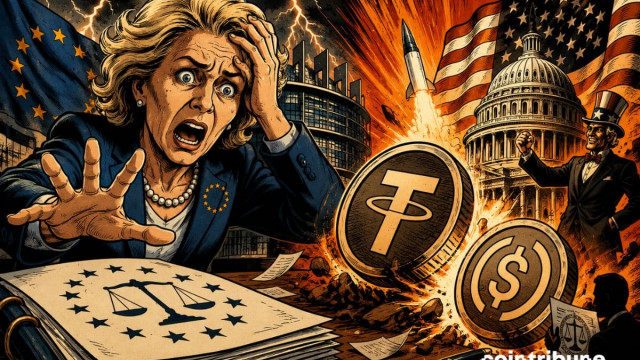
Three years after MiCA took effect, Europe's crypto framework is losing ground to dollar-backed stablecoins and the U.S. GENIUS Act. Platforms are leaving, and the Bank of France wants tighter rules, not looser ones.
The European Commission has started revising MiCA, its crypto regulatory framework, three years after the original rules took effect. The trigger is straightforward: dollar-backed stablecoins are eating the market, and the U.S. GENIUS Act has made the gap worse.
MiCA was implemented in 2023 to regulate spot crypto trading. It was never designed for the stablecoin explosion that followed. The GENIUS Act, signed into U.S. law this year, lets stablecoin issuers hold reserves in U.S. government debt. That strengthens the dollar's grip on digital asset markets. Europe's rules require stablecoin issuers to park reserves in the traditional banking system, a restriction that euro-denominated stablecoins like EUROC have struggled to overcome against USDC and USDT.
Brussels wants MiCA 2.0 to cover stablecoins and tokenization more broadly. The question is whether the timeline works.
As of July 1, 2026, ESMA published an official list of 244 MiCA-authorized crypto platforms out of the 3,389 that were previously registered across the EU. Binance, which missed the licensing deadline, suspended services for European residents. That pushed users toward compliant platforms like Kraken and OKX, which have been running aggressive acquisition campaigns.
Some European startups are moving operations to Switzerland or Singapore, where the regulatory touch is lighter. The pattern is visible in the data: Europe's share of stablecoin exchange volume has been shrinking relative to the U.S. and Asia since late 2025.
The Bank of France is pushing for tighter MiCA rules, not looser ones. That puts the Commission in a bind. A stricter framework would protect retail investors but accelerate the platform exodus. A looser one would keep platforms in Europe but risk the consumer safeguards that MiCA was built on.
The next concrete date is the European Parliament's scheduled review of MiCA's stablecoin provisions in October 2026. That is when the trade-off between competitiveness and investor protection becomes a vote.
Prepared with AlphaScala research tooling and grounded in primary market data: live prices, fundamentals, SEC filings, hedge-fund holdings, and insider activity. Each story is checked against AlphaScala publishing rules before release. Educational coverage, not personalized advice.