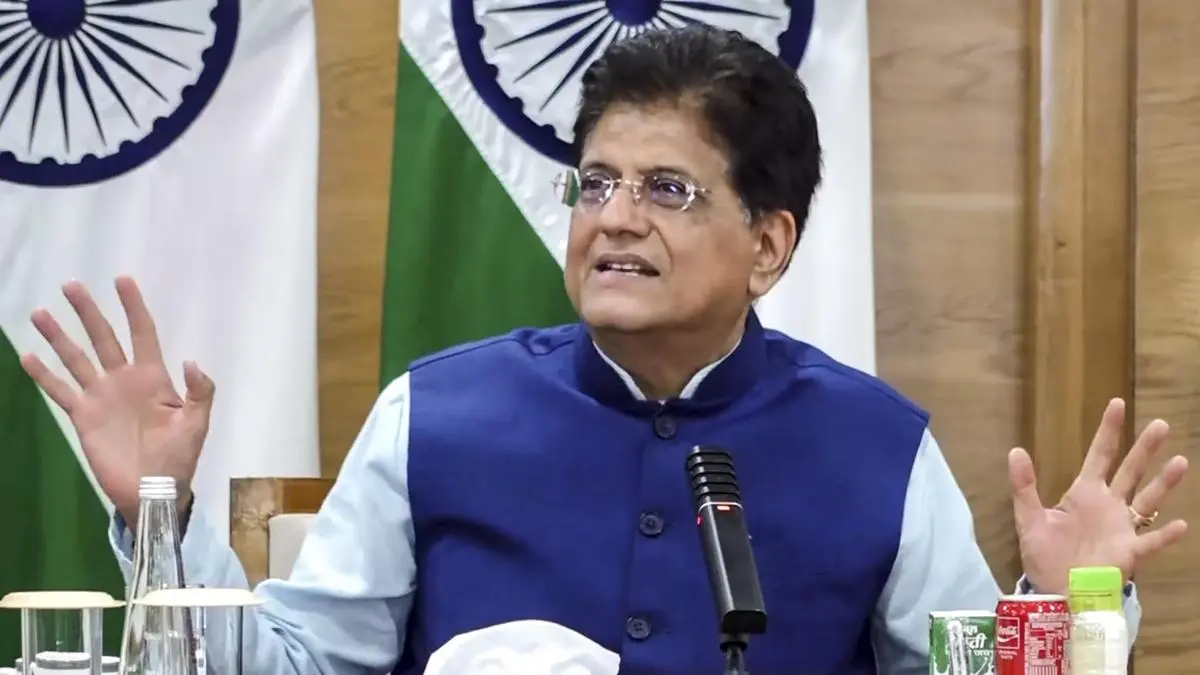
Union Commerce Minister Piyush Goyal said India’s economy would not reach its stated target of $30 trillion by 2047 without broader international engagement. Speaking at the closing session of the India Global Innovation Connect, he laid out a roadmap built on free-trade pacts, demographic complementarity, and cost arbitrage.
“We have a very clear roadmap and a stated goal to make India a developed country by 2047,” Goyal said. “At that point in time, I would think the Indian economy should be anywhere in the ballpark of about $30 trillion. This will not be possible unless we expand our international engagement.”
The logic is not about protectionism or self-reliance. Goyal framed it as a two-sided opportunity. Developed economies – Europe, the US, Canada, Israel, Gulf countries, Australia, New Zealand – face ageing populations and rising costs for research, production, and development. India has young workers and a 1.4 billion consumer base. “They have ageing populations and therefore need young talent and skill, which India has in abundance,” he said.
“Cost of production and cost of research and development in these developed economies are becoming prohibitively high,” Goyal added. “Therefore, a partnership between India and such developed countries complements each other rather than competes with them.”
The minister pointed to concrete results. India has signed nine free trade agreements in the last three to three and a half years, covering 38 countries. “These cover 38 countries, significantly richer and more prosperous than India,” he said. The pacts give those nations access to India’s growing market while directing capital into Indian industry. “They also have significant capital, pools of capital, which they want to deploy. And India is a perfect opportunity.”
Goyal also met Claude Smadja, chairman of Smadja & Smadja, on the sidelines of the event. In a post on X, Goyal said they discussed the government’s work on infrastructure, global supply chains, and the business environment. “Emphasised the scale of opportunities India presents today, powered by initiatives like Make in India, a thriving manufacturing ecosystem & business-friendly reforms, positioning the nation as an attractive destination for global investment.”
The minister’s case rests on a simple arithmetic: India’s economy is roughly $3.7 trillion today. Reaching $30 trillion in 22 years implies sustained real growth of about 8-9% a year. Closing that gap requires export-led expansion and foreign capital – exactly the kind of engagement Goyal described. The free-trade push signals that New Delhi sees competition with richer countries as a feature of the strategy, not a risk.