What the SPCXUSDT Funding Rate Change Means for Your Position
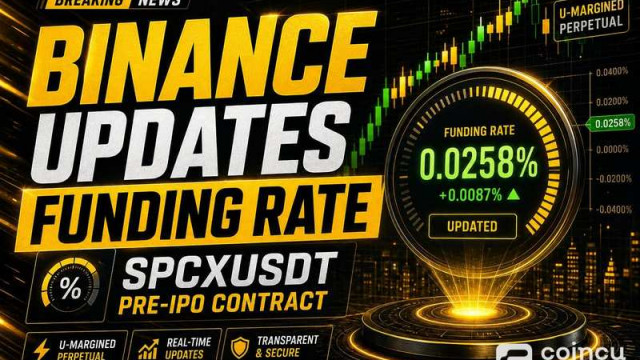
Binance has updated the funding rate on the SPCXUSDT U-margined Pre-IPO perpetual contract, adjusting the periodic cost of holding a position. The change applies to a derivative that tracks a token yet to complete a standard public listing. Traders can view the updated parameters on the SPCXUSDT trading page or through Binance’s futures API.
Funding rates are the market’s mechanism to keep a perpetual contract’s price tethered to its underlying reference price. When positive, longs pay shorts; when negative, the flow reverses. An adjustment by the exchange directly alters the carry cost for every open position.
Why Pre-IPO Perps Are a Different Animal Than Standard Futures
No Spot Market, No Anchor
Pre-IPO perpetual contracts differ from conventional futures because the underlying token lacks a liquid spot market. Price discovery happens almost entirely through the derivative itself, making the contract a vehicle for speculation on the listing outcome rather than a hedge. This absence of an established reference price can amplify volatility and widen the gap between the contract price and the eventual listing price.
Parameter Changes Signal Positioning Stress
Exchanges typically adjust funding rates or settlement intervals in response to elevated volatility or a significant long-short imbalance. Binance has a history of tweaking parameters on other Pre-IPO listings when market conditions shift. The update on SPCXUSDT suggests that positioning on the contract may have become one-sided or that volatility crossed a threshold.
Practical rule: A funding rate change on a Pre-IPO perp is not a routine maintenance event. It tells you that the exchange saw a risk signal worth acting on.
The Common Funding Rate Mistake That Bleeds Leverage
Many traders treat funding rates as minor fees, ignoring their compounding effect on leveraged positions. On a Pre-IPO contract where price discovery is thin, the funding rate can consume a meaningful portion of margin over days or weeks. The naive assumption is that the trade thesis (hoping the listing price will be above the contract price) will outrun the periodic payments. In practice, funding costs can force liquidations before the listing event arrives.
The recent $7.96 million ZEC withdrawal from a newly created Binance wallet illustrates the kind of large-scale activity that can occur around exchange-listed assets. While unrelated to SPCXUSDT, it shows that capital flows on Binance can shift quickly, and liquidity conditions for Pre-IPO contracts may tighten when large sums move.
A Better Framework: Treat the Funding Rate as a Carrying Cost
Calculate the Daily Cost First
Before opening or maintaining a position on SPCXUSDT, calculate the daily funding cost as a percentage of notional exposure. The funding rate is typically expressed as a percentage of position size, paid every eight hours. Multiply the rate by three to get the daily cost, then compare it to your expected holding period. If the cumulative cost exceeds your expected edge, the trade is negative expected value.
Watch Open Interest, Not Just Price
Open interest reveals whether money is entering or leaving the contract. A rising open interest after a funding rate adjustment suggests new positions are being added despite higher costs. Falling open interest signals that traders are closing positions to avoid the revised rate. A divergence between price action and open interest is often a precursor to a sharp reversal.
Correlate With Broader Flows
Pre-IPO contracts do not exist in isolation. Movements in Ethereum spot ETF flows and institutional positioning in products like Bitcoin ETFs influence overall derivatives sentiment. The recent eight-day outflow streak in Ethereum spot ETFs, with $28.14 million exiting on one day, suggests risk-off positioning in crypto derivatives. A similar sentiment drag may affect speculative instruments like SPCXUSDT.
Three Signals to Watch After the Parameter Change
-
The new funding rate direction and magnitude. A large positive rate (longs paying shorts) indicates sustained bullish bias. A negative rate (shorts paying longs) shows bearish pressure. Compare the new rate to the previous one to assess how much the exchange shifted the cost.
-
Change in long-short ratio on the contract. If the ratio remains heavily one-sided after a rate increase, positioning is stuck, and the risk of a squeeze or crash rises. Binance publishes this data for futures contracts.
-
Unusual price action near funding settlement times. Funding payments occur every eight hours. Spikes in trading volume or price changes just before settlement often indicate forced adjustments by leveraged traders.
What Confirms or Weakens the Setup
A confirmation signal: open interest stabilises or grows while funding rate stays moderate, and the contract price trades in a range rather than gapping. A weakening signal: open interest drops sharply, long-short ratio becomes extreme, or a large wallet moves funds off Binance, reducing liquidity on the order book.
Broader market conditions also matter. Read the analysis on S&P 500’s 41% concentration and how it mirrors crypto’s twin-token risk for context on how correlated risk builds across asset classes. For traders using brokers, see the best crypto brokers guide for platforms that support Pre-IPO instruments.
The Bottom Line for SPCXUSDT Holders
Binance’s funding rate update is a direct change to the economics of a speculative position. Ignoring it is the single fastest way to lose capital before the listing event even happens. Calculate the daily carry, monitor open interest and long-short ratios, and keep an eye on broader crypto flows. If the cost eats into your margin buffer faster than expected, the right move may be to step aside and wait for the next entry point.