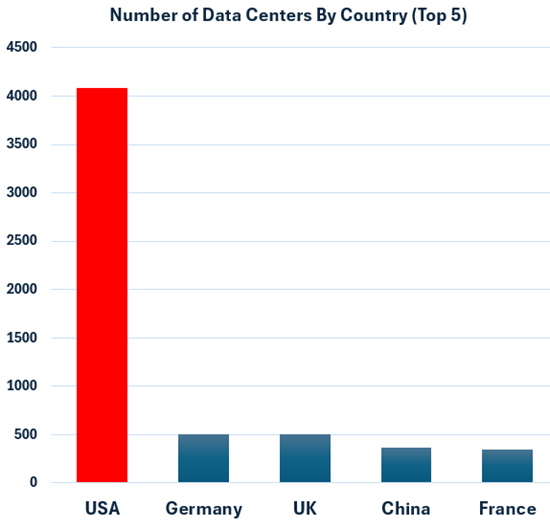
The comparison between AI data centers and 19th-century railroads is gaining traction in market commentary. Both require enormous upfront capital, both depend on a single transformative technology, and both promise to reshape the economy. The analogy breaks down in ways that matter for portfolio allocation.
The Capital Intensity Parallel
Railroads in the 1800s required massive land grants, steel, and labor. The first transcontinental line was built with government subsidies and speculative private capital. Many early railroads went bankrupt because overbuilding created excess capacity and pricing power collapsed. The survivors eventually formed a regulated oligopoly.
AI data centers today share the capital intensity. A single hyperscale facility can cost $1 billion or more. The largest operators – Microsoft, Amazon, Google, and Meta – are spending tens of billions annually. The parallel seems obvious: build first, figure out demand later. This naive reading misses structural differences.
Demand Structure and Switching Costs
The critical difference is demand structure. Railroads served a fixed set of goods: grain, coal, timber. Once the network was built, incremental traffic was limited by the economy's physical output. AI data centers serve a digital demand that scales differently. Each new generation of models – from GPT-3 to GPT-4 to whatever comes next – requires exponentially more compute. The demand function is not linear; it is super-exponential during training and inference scaling.
A second difference is switching costs. A railroad customer can choose any line that reaches the same destination. An AI developer using NVIDIA GPUs and a specific cloud provider faces high migration costs. The data center operator that locks in a customer with proprietary tooling and model weights has recurring revenue that railroads never had. The better market read focuses on defensibility rather than capex intensity.
Moat Structure Favors Incumbents
The leading cloud providers – Amazon Web Services, Microsoft Azure, Google Cloud – are building a defensible moat. They own the chips through custom designs, the networking through InfiniBand and proprietary interconnects, and the software stack through frameworks like PyTorch and TensorFlow. A railroad could not own the locomotive, the track, and the cargo. A cloud provider can own the entire stack.
Valuation reflects this. The hyperscalers trade at premium multiples because the market prices in durable competitive advantage. Railroad stocks trade at single-digit P/E ratios because the market knows pricing power is capped by regulation and competition.
Confirmation and Invalidation
What would confirm the railroad analogy? A wave of data center bankruptcies from overbuilding, falling utilization rates, and price wars among cloud providers. That is not happening. Utilization at the top three cloud providers remains above 70% for GPU instances. What would invalidate it? A shift to edge computing that reduces demand for centralized data centers or a breakthrough in model efficiency that cuts compute requirements by an order of magnitude. Neither is imminent.
The next catalyst is the NVIDIA earnings report. If data center revenue growth slows, the railroad analogy gains credibility. If growth accelerates, the comparison looks increasingly stale. For now, the data center buildout is a structural shift in computing that rewards the incumbents with the deepest pockets and the widest moats. Treat the railroad analogy as a warning, not as a blueprint.
For more context on the broader market environment, see our stock market analysis and the NVIDIA profile.