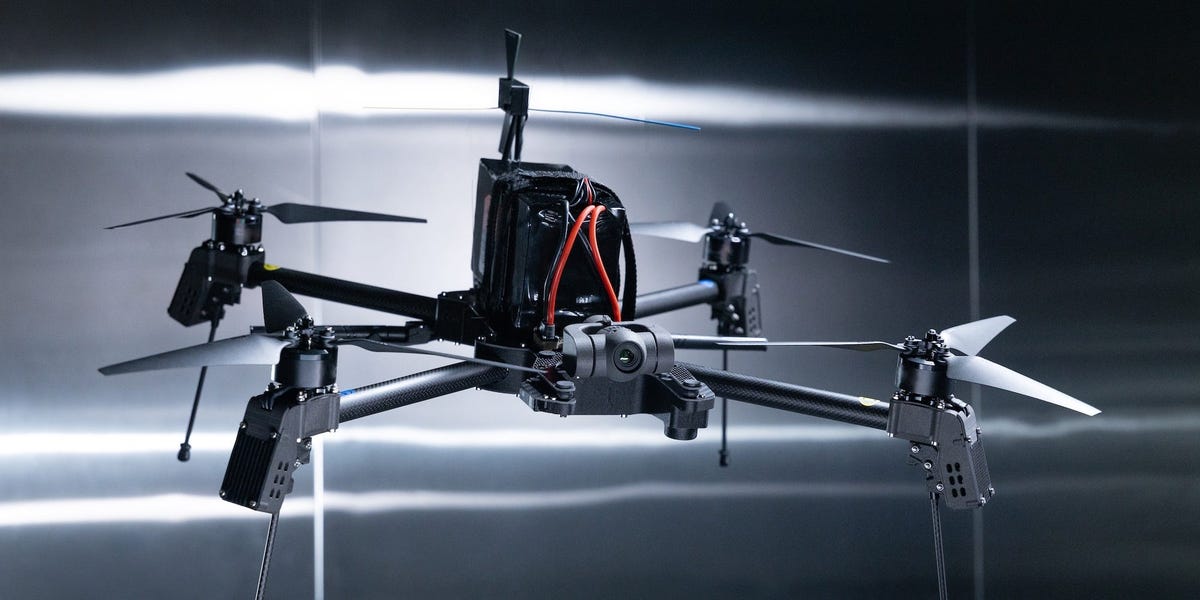
Vyriy Drone keeps some assembly lines manual so it can retool in hours, not weeks, as Russian jamming tactics shift. The trade-off: slower output for faster adaptation.
A Ukrainian drone manufacturer said relying too heavily on factory automation can become a liability in a war where battlefield conditions shift every few weeks.
Vyriy Drone, a company that builds first-person-view (FPV) drones for the Ukrainian military, keeps some assembly lines manual on purpose. The reason: when Russian electronic warfare tactics change, the drone's components and design often need to change with them within days.
"If you have a fully automated line, retooling takes weeks," a company representative told the source. "By the time the line is ready, the threat has moved on."
The trade-off is a deliberate choice between scale and speed. A fully automated factory can produce more units per shift. A manual or semi-manual line can switch to a different frequency, camera module, or flight controller in hours, not weeks.
Ukraine's drone sector has grown from small volunteer workshops to a formalized industry with state contracts. The government has pushed for higher production volumes as the war enters its third year. Vyriy's approach suggests that raw output numbers do not tell the full story.
A drone that cannot adapt to the enemy's next electronic warfare upgrade is a drone that becomes useless on arrival. Russian forces have repeatedly shifted jamming frequencies and spoofing techniques, forcing Ukrainian manufacturers to iterate on their hardware mid-production.
The company's stance mirrors a broader debate in defense manufacturing. Western defense contractors have spent decades optimizing for long production runs of standardized equipment. Ukraine's war demands the opposite: short runs, fast iteration, and the ability to scrap a design that worked last month.
Vyriy Drone did not disclose its current production rate or the share of manual vs. automated assembly. The company said it prioritizes "design flexibility" over "production efficiency" in the current phase of the war.
The manual approach carries its own costs. Human assembly is slower, more expensive per unit, and harder to scale when the military needs thousands of drones per month. The company acknowledged those limits. It argued that a drone that cannot adapt is not worth building at any volume.
The Ukrainian military's demand for FPV drones remains high. Both sides use them for reconnaissance, artillery spotting, and direct strikes. The technology cycle has accelerated to the point where a drone design that was effective in January may be countered by March.
Vyriy's bet is that the ability to pivot faster than the enemy can adapt is worth more than the ability to build more of the same thing. Whether that trade-off holds as the war grinds on will depend on how quickly Russian electronic warfare evolves and whether Ukraine's industrial base can keep up without full automation.
Prepared with AlphaScala research tooling and grounded in primary market data: live prices, fundamentals, SEC filings, hedge-fund holdings, and insider activity. Each story is checked against AlphaScala publishing rules before release. Educational coverage, not personalized advice.