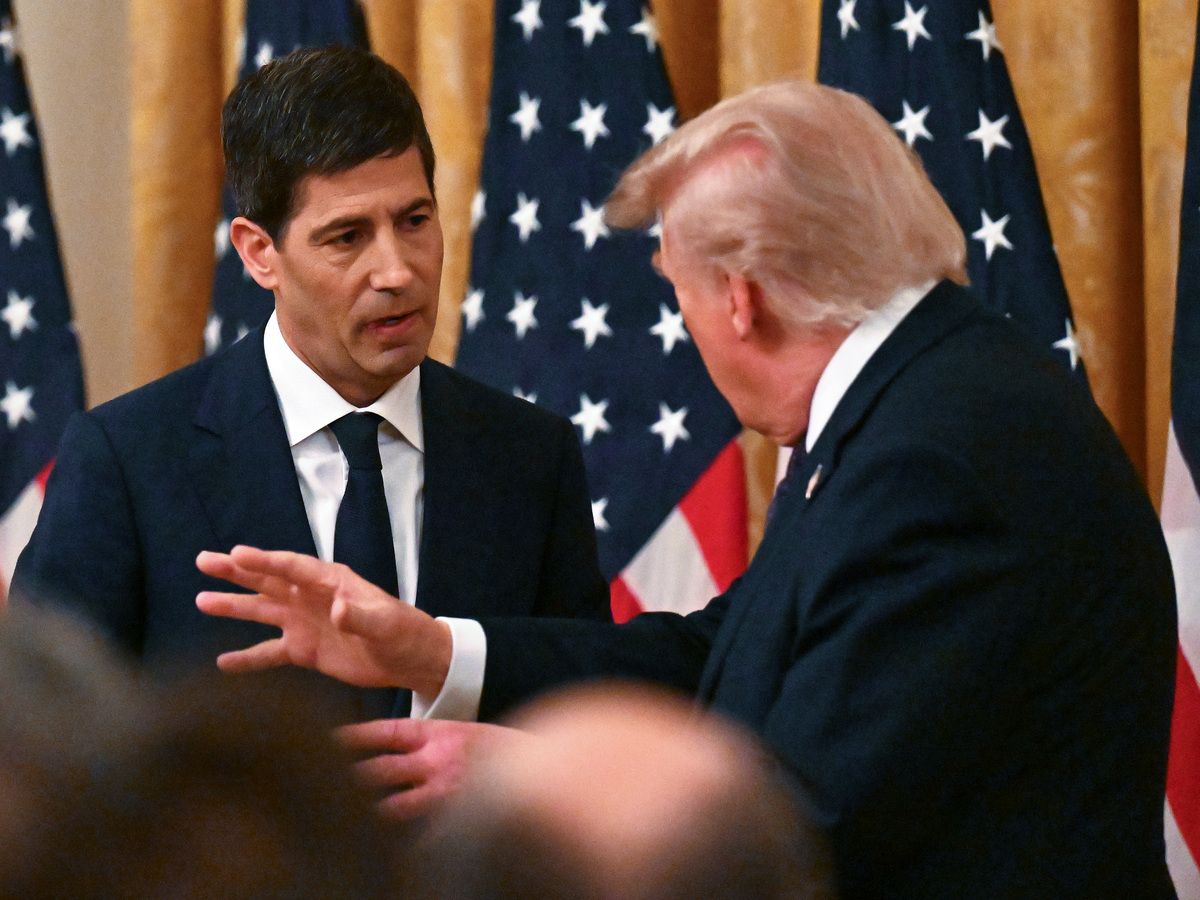
Kevin Warsh was sworn in as chair of the U.S. Federal Reserve on Friday. The market consensus pegged him as dovish, open to rate cuts. That thesis now collides with a 3.8% April inflation print, up from 3.3% a month earlier, driven by the war in Iran pushing oil prices higher. The Bank of Canada, which has already cut its key lending rate to 2.25%, will not follow any Warsh-led cuts. The transmission path runs through the rate gap, the Canadian dollar, and commodity exposure.
Warsh's Dovish Lean Hits Inflation Reality
Warsh has pointed to the potential disinflationary impact of artificial intelligence as a reason the Fed should be cautious about hiking. The administration of President Donald Trump pushed former Chair Jerome Powell to cut rates. Warsh is viewed as more sympathetic to that pressure. The April CPI reading changes the calculus.
Avery Shenfeld, managing director and chief economist at CIBC Capital Markets, offered a direct assessment:
Shenfeld's quote makes the mechanism explicit. A single dissenting vote does not move the FOMC median. That median currently expects no cuts until inflation recedes below 3%. The Fed's key lending rate target sits between 3.5% and 3.75%. A cut would require either a rapid drop in oil prices or a sharp economic slowdown that overwhelms inflation concerns. Neither condition holds today.
The April CPI Print and the Iran Oil Channel
The source text attributes the 3.8% inflation jump directly to the war in Iran lifting oil. For traders, this is supply-shock inflation – harder for any central bank to dismiss than a transitory demand spike. Central banks typically look through oil price moves if they expect reversal. Warsh's own framework, citing AI disinflation, may treat this as temporary. The committee is unlikely to gamble on that assumption while the conflict continues.
Why Warsh Would Vote Alone
A committee that sees war-driven inflation at 3.8% will not follow a lone dove. Shenfeld made clear that even if Warsh votes for a cut, he would be isolated. The FOMC operates on consensus. Markets must price the median view, not Warsh's view. The median view currently expects no cuts until inflation trends lower. The next CPI print and oil headlines will determine whether that median shifts.
The Canada-U.S. Rate Gap: Why BoC Won't Match
The Bank of Canada's key lending rate at 2.25% sits a full 125 to 150 basis points below the Fed's range. Governor Tiff Macklem's governing council has already cut more aggressively than the Fed in this cycle. Shenfeld explained why the BoC will not match any Fed cuts:
"Canada has already cut interest rates much more aggressively than the Federal Reserve in this cycle. So to some extent, if the Federal Reserve cut interest rates, they would just be taking a step to narrow a considerable interest rate gap with Canadian rates, which are now a fair bit lower."
The implication is a BoC hold even as the Fed moves. Canadian rates would remain relatively lower for longer. This changes the carry trade calculus: the loonie becomes more attractive on a relative basis if the Fed cuts while the BoC does not.
BoC's Domestic Weakness Constrains Further Easing
Canada's economy has shown more sensitivity to higher rates, partly due to household debt levels and a housing market that corrects faster. The BoC's earlier easing reflected that domestic weakness. A Fed cut would not change that domestic picture. The BoC has no reason to accelerate additional cuts just because the Fed moves. If anything, the stronger Canadian dollar that would result from a narrower rate gap could tighten financial conditions further, giving the BoC even less reason to act.
What a Weaker USD Means for CAD
Angelo Melino, economist and professor at the University of Toronto, said one impact of lower U.S. rates would be a stronger Canadian dollar relative to the greenback. The mechanism is straightforward: lower Fed rates reduce the yield advantage of holding USD assets, pushing capital toward currencies with higher short-term yields. The loonie currently offers a 125-basis-point pickup. Even after a hypothetical Fed cut of 25 or 50 basis points, the loonie would still yield more.
For traders, this creates a long CAD bias if the Fed cutting cycle begins. The risk is that the war in Iran also drives oil higher, which historically supports the loonie. Two forces – narrowing rate spreads and higher oil – could compound.
Transmission Through the Dollar and Risk Assets
The first-order move from any Warsh-led cut would be a weaker U.S. dollar across the board. The DXY index would likely fall as the rate advantage erodes. That has direct implications for commodities priced in dollars: gold typically rises, and crude oil may see a bid if the dollar weakens, though the war premium is already priced. For a deeper look at gold's current setup, see our gold profile.
For Canadian equities, the S&P/TSX Composite has a heavy weighting in energy and financials. A weaker CAD helps exporters. The BoC hold keeps a lid on domestic growth expectations. The net effect may be modestly positive.
Gold's Reaction Path
Gold has rallied on the war fear trade and on rate-cut expectations. A Warsh cut confirms the dovish bias. With inflation still elevated, real rates could remain negative, a bullish backdrop for gold. The macro transmission is clear: lower nominal rates plus sticky inflation equals lower real rates. Gold benefits.
Equity Index Read-Through
U.S. equities have priced a moderate amount of rate cuts for 2025. A Warsh-led cut could lift growth stocks and small caps that are sensitive to financing costs. If the cut is seen as forced by war-induced weakness, the equity reaction may be more mixed. The NASDAQ would be sensitive to the AI narrative Warsh has endorsed.
Next Decision Point: June FOMC and CPI Trajectory
The Fed's next scheduled meeting is in June. The BoC's next decision is also pending. For now, the market's focus remains on the war in Iran and the April CPI trajectory. If oil prices stabilize and inflation ticks lower, Warsh may gain the credibility to push for a cut. If not, the dovish chair will remain a lone voice.
Key takeaway for traders: The BoC's rate path is decoupled from the Fed's. Any USD weakness from a Warsh cut strengthens CAD, not the other way around. The 125-basis-point gap gives the loonie a buffer. Watch the next CPI print and oil headlines for confirmation.