Stocks● Neutral
VWAV's VARAN Prototype at Eurosatory: Passive Autonomy, No Orders Yet
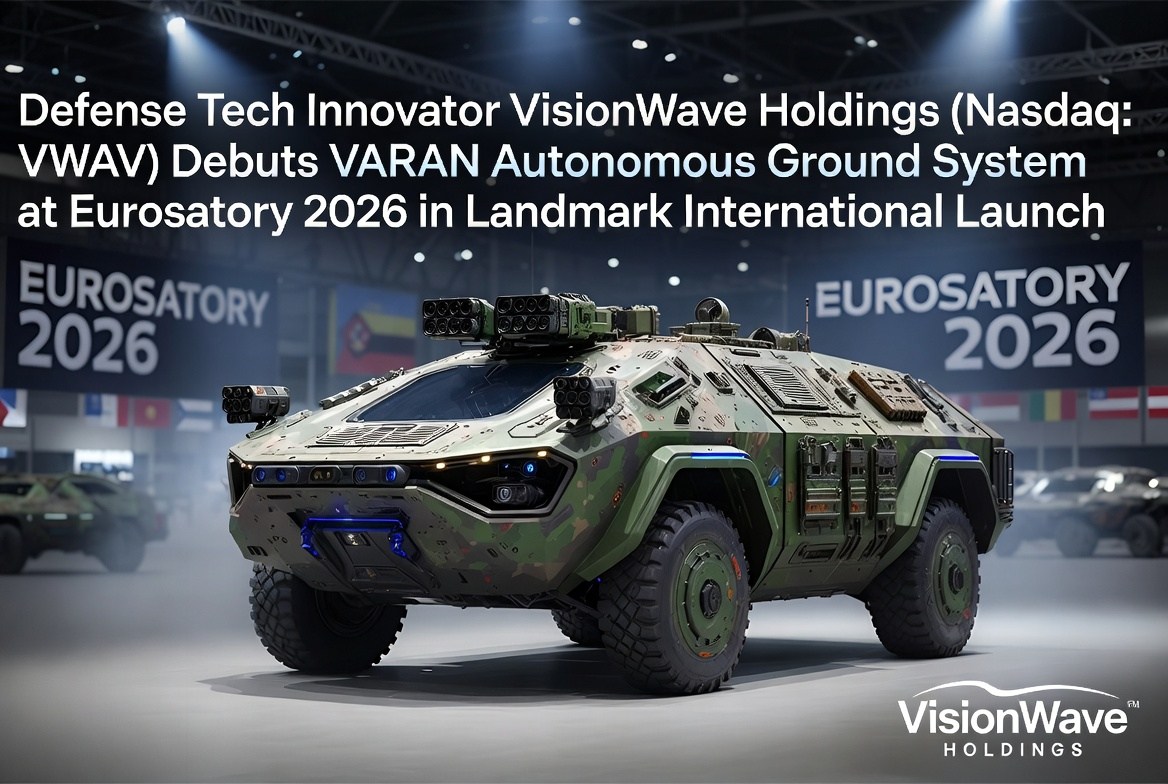
VisionWave showed VARAN at Eurosatory – a passive perception UGV for GPS-denied environments. The stock remains speculative until booth conversations turn into funded orders.
Continue with
VisionWave Holdings (VWAV) rolled a physical prototype of its VARAN autonomous ground vehicle onto the floor of Eurosatory 2026 in Paris on June 15. The vehicle is designed to operate without GPS, radar, or LiDAR. It relies on cameras and thermal imaging for passive 3D perception, a design intended to keep it functional in jammed or GPS-denied environments. Five board members and one advisory board member made the trip – the company's largest international delegation ever.
VARAN is a modular unmanned ground vehicle built from the ground up in the United Kingdom, according to the company. The height-adjustable chassis can shift stance automatically to clear terrain obstacles. Each wheel drives independently, allowing the vehicle to rotate in place. The company says a single chassis can be reconfigured in the field for eight mission roles – including ISTAR, counter-UAS, air defense, CASEVAC, logistics, route clearance, force protection, and electronic warfare support – without returning to a depot. Top speed is listed at 45 mph across open terrain, subject to ongoing testing.
The platform runs VisionWave's STRATUM AI management software, which includes the acquired qSpeed computational acceleration IP. That IP remains in proof-of-concept development. The vehicle also integrates stereo and thermal perception from Foresight Autonomous (FRSX), a sensor layer added through a recent all-stock deal. VisionWave has said the Foresight collaboration gives VARAN a proven automotive and defense sensing capability.
The exhibition is the first time VARAN has been shown to the international defense community as a physical product. CEO Douglas Davis called it “the moment VisionWave steps onto the world stage” in the company's press release. “We built this platform from the ground up, every system, every design decision, every line of code, and today we are showing it to the world for the first time.”