Vietnam's Crypto Pilot: Five Incumbents, $400M Capital Floor
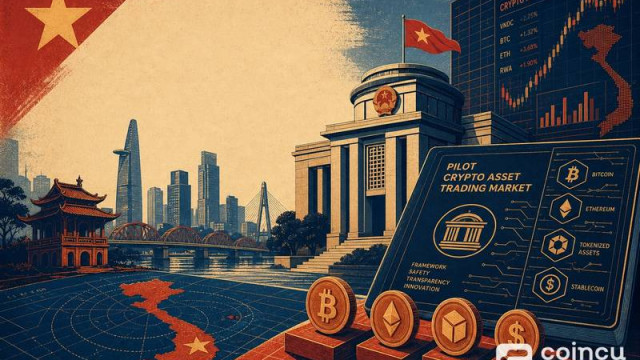
Five financial institutions clear screening for Vietnam's regulated crypto exchange pilot. A six-month enforcement grace period after licence issuance creates urgency for migration from offshore platforms.
Alpha Score of 40 reflects weak overall profile with moderate momentum, poor value, moderate quality, moderate sentiment.
Vietnam's Q2 2026 Crypto Exchange Pilot: Five Licensees and a Six-Month Enforcement Clock
Vietnam is moving from one of Southeast Asia's largest informal crypto economies to a licensed, domestic trading framework. Prime Minister Le Minh Hung, at the first session of the 16th National Assembly on April 9, 2026, directed the pilot launch of a regulated crypto and digital asset trading platform beginning in Q2 2026. The directive is a scheduling instruction. No exchange has begun operations.
The legal foundation was already laid by Resolution No. 05/2025/NQ-CP, effective September 9, 2025 and establishing a five-year pilot period. All crypto asset offerings, issuance, trading and settlement must be conducted in Vietnamese dong. Only Ministry of Finance-licensed organizations may provide market services.
The Five Shortlisted Entities
Vietnam began accepting licence applications on January 20, 2026. The Ministry of Finance received seven applications. Of those, five were judged valid and complete in the initial screening round.
According to a Reuters-linked CoinDesk report, affiliates of these entities cleared screening:
- Techcombank – a major Vietnamese joint-stock commercial bank
- VPBank – Vietnam Prosperity Bank, one of the country's largest private banks
- LPBank – Lien Viet Post Joint Stock Commercial Bank
- VIX Securities – a securities firm
- Sun Group – a conglomerate active in real estate, tourism and infrastructure
All five are established financial institutions or diversified conglomerates. No crypto-native startups are among the initial pool. That signals Hanoi wants incumbents to anchor the new market.
The $400 Million Capital Filter
Under Resolution No. 05/2025/NQ-CP, operators must hold at least VND 10,000 billion in charter capital – roughly $400 million at current exchange rates. The threshold limits participation to well-capitalised entities capable of meeting compliance and investor protection requirements.
The practical effect: smaller crypto-native firms cannot apply as independent exchanges. Their most viable path is as technology providers or service partners to licensed operators.
The $220 Billion Informal Flow Faces a Regulated Channel
Scale of Unregulated Volume
Chainalysis estimated that Vietnam recorded $220 billion to $230 billion in cryptocurrency transaction value between July 2024 and June 2025 – averaging more than $600 million per day. Nearly all of that volume flowed through offshore platforms such as Binance or OKX outside official channels.
Why a Ban Would Not Work
The scale alone makes a suppression strategy impractical. Vietnam's pilot acknowledges that structured absorption is more viable than attempting to shut down a $600 million/day flow.
The mechanism: channel that volume into a licensed, domestically regulated structure where authorities can monitor flows, collect taxes and enforce investor protection rules. The dong-denomination requirement means every trade sits inside the formal banking system from settlement onward.
The Enforcement Trigger: Six Months After the First Licence
How the Grace Period Works
A critical enforcement mechanism sits behind the licensing regime. Six months after the first licence is issued, domestic investors who trade on unlicensed platforms could face penalties or criminal prosecution. This is not simply an invitation to use local exchanges. It is a phased plan to cut off access to offshore venues.
What Changes for Vietnamese Investors
For investors currently on offshore exchanges, the pilot creates a path toward regulated access with clearer legal standing. The tradeoff is reduced choice. A pilot market with five licensed operators and mandatory dong settlement will offer fewer trading pairs and less liquidity than global platforms.
The enforcement timeline creates measurable pressure. Once the six-month grace period after the first licence expires, investors trading on unlicensed platforms risk legal consequences. Licensed platforms must be operational and liquid enough to absorb migrating volume. Investors must transition their activity before the deadline.
What Is Still Unknown Before Trading Starts
Eligible Assets
The resolution covers crypto assets broadly. It does not publish a list of permitted tokens. Whether Bitcoin, Ethereum and major stablecoins will trade from day one remains unclear. Individual token approval is possible. For more on the underlying assets, see the Bitcoin (BTC) profile and Ethereum (ETH) profile.
Custody and Settlement
All settlement must occur in Vietnamese dong. The resolution does not detail custody arrangements for the underlying digital assets. Whether operators must hold assets in domestic cold storage, use third-party custodians or meet specific reserve requirements has not been publicly specified.
Foreign Participation
The framework appears designed for domestic investors and licensed domestic operators. Whether foreign firms can apply for licences or foreign nationals can trade on licensed platforms is not addressed in the available documentation.
Exact Launch Date
The Q2 2026 target means the first platform could begin operating as early as this calendar quarter. The prime minister's directive is a scheduling goal, not a guaranteed date. Licensing review, technical readiness and compliance verification could push the actual go-live into Q3.
What Would Confirm or Break the Pilot Thesis
Confirmation Signals
- A platform actually goes live in Q2 or Q3 2026 with real order-book volume.
- Licensed exchanges begin offering BTC, ETH and USDT pairs from day one.
- The Ministry of Finance publishes a specific enforcement date after the first licence.
- Daily trading volume on licensed platforms reaches meaningful levels, indicating successful migration.
Breakdown Signals
- No platform launches by Q4 2026, suggesting licensing delays or regulatory backtracking.
- The asset list omits major tokens, limiting migration incentive.
- Offshore exchanges continue serving Vietnamese users without detectable enforcement action.
- The enforcement grace period is extended or never enforced.
Sector Read-Through: Vietnam as a Template for ASEAN
Vietnam's approach differs from jurisdictions that have attempted blanket bans on crypto, such as China's 2021 crackdown. By creating a regulated channel rather than prohibiting activity outright, the pilot acknowledges the scale of existing demand. The $600 million daily average suggests suppression would be impractical. Structured absorption is the more viable regulatory strategy.
Other ASEAN economies with large informal crypto flows – the Philippines, Thailand, Indonesia – face a similar question: how to integrate untracked capital flows into a regulated framework without killing the activity. Vietnam's five-year pilot with a high capital floor provides one model. If it succeeds in migrating volume from offshore exchanges, it could influence policy debates across the region.
For a broader view of how regulatory shifts affect crypto market analysis, the pilot's enforcement mechanism and capital requirements offer a concrete case study.
The pilot framework gives regulators room to suspend or adjust the rules if risks emerge during the five-year trial period. That flexibility makes it closer to a regulatory sandbox than full market liberalisation. The next six to twelve months will determine whether the blueprint can absorb $220 billion in annual volume without sparking new risks.
Drafted by a large language model from the source reporting linked above, then screened by automated publishing checks. It is not read by a journalist before publication. Some articles cite our Alpha Score. Verify prices and figures against the original source. Educational coverage, not personalized advice.