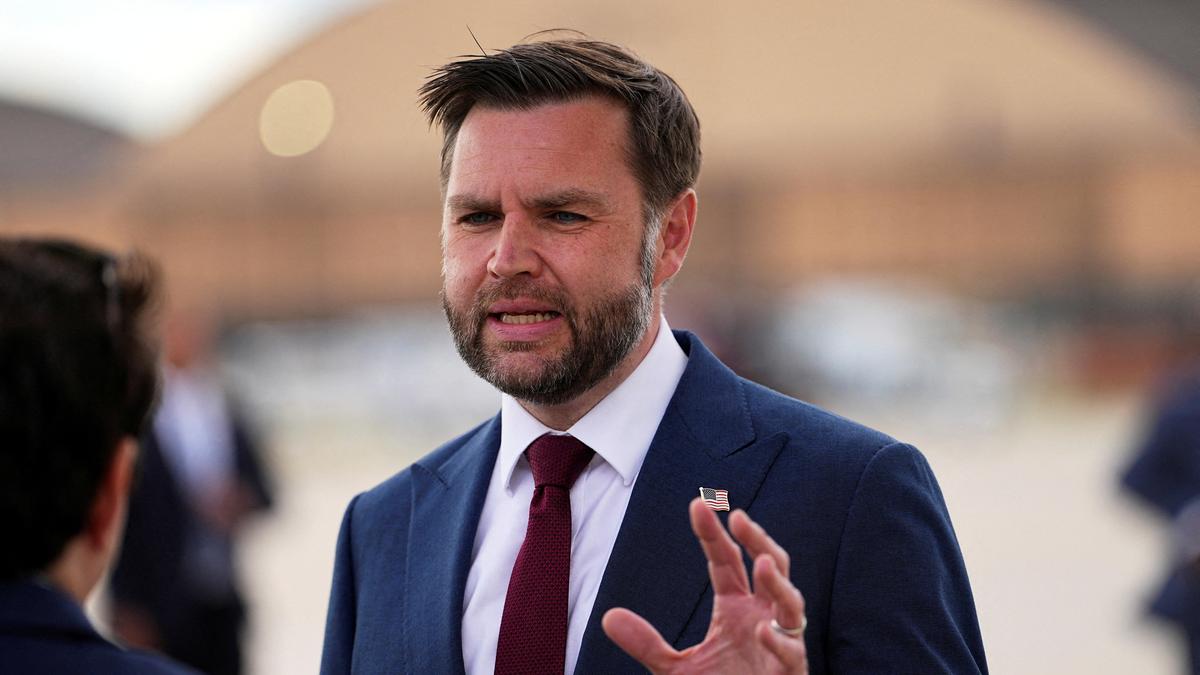
Vice President JD Vance will lead the American delegation to the in-person signing of the US-Iran peace framework agreement in Switzerland on Friday, President Donald Trump said.
Trump and Vance have both electronically signed the deal alongside Iran's lead negotiator Mohammad Bagher Ghalibaf, a senior US official told the New York Times. The memorandum of understanding's full text will be released "pretty soon... sometime after Friday," Trump said Monday in a media interaction in France.
Vance said on ABC News's Good Morning America that the digital signing happened Sunday. The deal was negotiated through mediators including Pakistan and Qatar. Pakistan Prime Minister Shehbaz Sharif said Monday his country would host Friday's signing ceremony in Switzerland.
The senior US official told NYT that the Strait of Hormuz will be fully open by Friday, with priority movement for heavy tankers to speed oil and gas flows. "It takes a little bit of time, because you know you have mines in the Straits," the official said. "But you will see a significant increase in traffic in the Strait of Hormuz actually starting already."
The official said the MOU ensures the Strait will be "toll-free for 60 days," with the expectation that language becomes part of the final agreement. The chokepoint between Iran and Oman carries a substantial share of global oil and LNG exports.
The event marks a major shift for global energy markets after months of disruption in the Strait. For shipping, the immediate effect is lower war risk premiums on vessels transiting the Gulf. For crude and LNG tanker operators, the priority lane for heavy tankers means faster turnaround on the world's most critical energy route.
The sector read-through is clearest for tanker owners exposed to Gulf routes. Frontline and Euronav, the two largest publicly traded crude tanker operators, both report significant revenue from Middle East loading. A faster reopening reduces congestion at Gulf terminals and cuts waiting time off Fujairah, where dozens of vessels have idled during the disruption. Lower congestion means lower spot rates in the near term as the backlog clears.
The bigger market signal may come on the insurance and finance side. War risk premiums on Gulf transits had pushed shipping costs higher for every barrel moving eastward. Those premiums will fall sharply once the mines are cleared, compressing total delivered costs for Asian buyers. That is a marginal negative for US and West African crude grades, which had gained a pricing advantage on the disruption spread.
Pakistan's role as mediator reinforces its strategic positioning in the region. Qatar's involvement, alongside its existing gas export relationships, means LNG flows from the North Field expansion face fewer logistical complications.
The NYT story quoted the senior US official saying traffic will not return to normal in two weeks but will see a significant increase over that timeframe. That timeline matters more than the ceremony itself. For traders tracking vessel positioning, the satellite data on Strait transits in the next 10 days will provide the first real confirmation of whether the timeline holds.
NYT stock page
stock market analysis