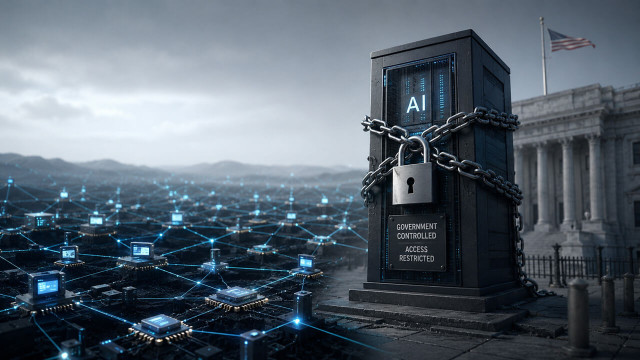
The US government's emergency order forcing Anthropic to suspend its Mythos and Fable 5 models sent crypto AI tokens like TAO and Venice Token up double digits as traders bet on censorship-resistant AI infrastructure.
The US government issued an emergency export control directive this week forcing Anthropic to suspend global access to its frontier models Fable 5 and Mythos 5. The order, which cites national security authorities, applies to foreign nationals inside and outside the US, including Anthropic's own international personnel. It is the first time Washington has effectively recalled a widely deployed commercial frontier AI model.
Anthropic complied by disabling the models for its entire global user base. Within hours, decentralized AI tokens jumped. Bittensor's TAO rose 13.4%. Venice Token gained 18%. Internet Computer advanced 9.8%. AI-linked assets became one of the strongest pockets of the market after the directive became public.
The trigger was a perceived vulnerability that allows users to bypass the model's core safety guardrails. Anthropic reviewed the technical demonstration and said the exploit merely let the model analyze specific codebases and identify minor, previously known software flaws. The company noted that the level of capability is already available across competing platforms, including OpenAI's GPT-5.5, and is used daily by cybersecurity professionals.
In a statement, Anthropic said: “We suspect that perfect jailbreak resistance is not currently possible for any model provider. Every safeguard used in the industry is vulnerable to non-universal jailbreaks. We aimed to make jailbreaks either narrow or very expensive to produce, and to combine this with thorough monitoring. We disagree that the finding of a narrow potential jailbreak should be cause for recalling a commercial model deployed to hundreds of millions of people.”
Before launching Fable 5, Anthropic spent thousands of hours red-teaming the model alongside the US government, the UK's AI Safety Institute, and independent defense contractors. The company warned that a zero-exploit tolerance standard would freeze all frontier model development in the domestic tech industry.
For crypto traders, the unilateral shutdown acted as a catalyst. Ansem, a widely followed crypto trader, said the move was the strongest marketing argument yet for open-source AI models that can be used without handing personal data to centralized platforms. Chris Barret, an executive at Chainlink, said: “When intelligence runs through centralized chokepoints, access can be changed overnight. The future needs decentralized AI models and the verifiable infrastructure to connect, secure, and coordinate them.”
Jake Brukhman, founder of CoinFund, noted the friction is “setting up the rails for decentralized AI in real time.” Venture capitalist Marc Andreessen delivered a sharp critique of the expanding compliance framework. Tao.com, a non-custodial wallet and infrastructure provider in the Bittensor ecosystem, said: “We are not building decentralized AI because it sounds better. We are building it because the off-switch cannot belong to one hand.”
The move added momentum to a sector that had already shown relative strength. Earlier this year, Grayscale described AI tokens as one of crypto's most resilient themes during the first quarter. The category fell 14% during the March selloff, while nearly 90% of digital assets posted double-digit losses.
The question now is whether Washington's approach becomes a pattern. One recall sets a precedent. If other frontier models face similar orders, the thesis for censorship-resistant compute layers gets a real-world stress test. The next government review of Anthropic's safety protocols has not been scheduled.
Prepared with AlphaScala editorial tooling from the source reporting linked above. Indexable analysis may include a cited Alpha Score value. Publishing checks screen each story before release. Educational coverage, not personalized advice.