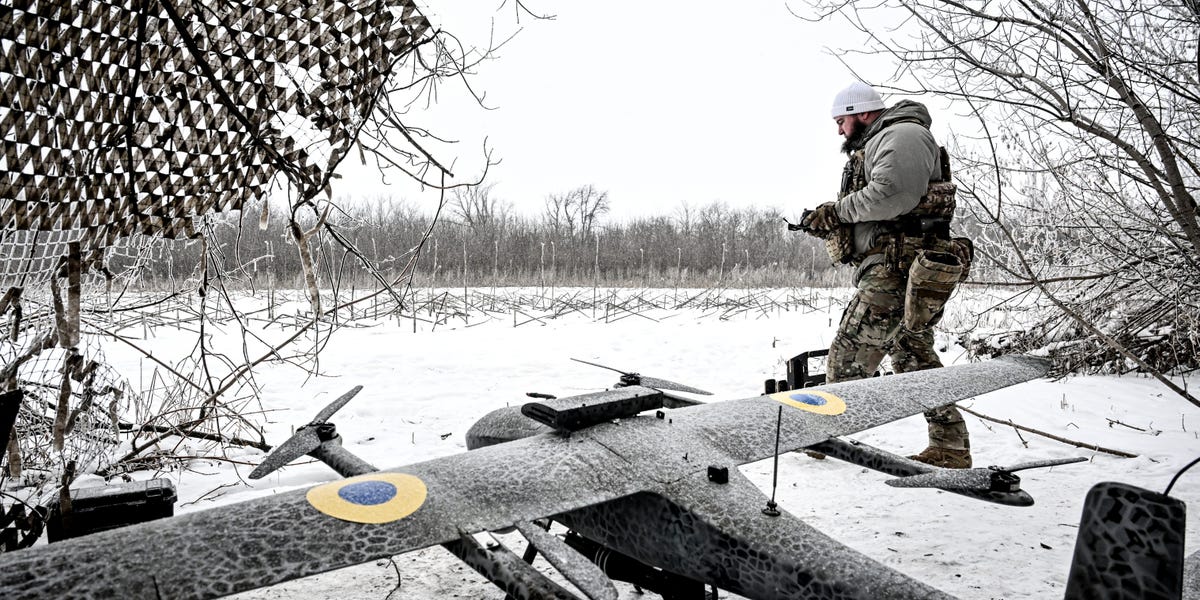
Three thousand feet above the fields of Zaporizhzhia, a recon drone watches over a deserted village. Its target: a trio of houses surrounded by trees, tucked in among the treeline. The houses are not military structures. They are Russian command posts, ammunition stores, and troop shelters – the kind of hardened, dispersed positions that HIMARS rockets, with their limited range and precision-guided warheads, struggled to engage effectively.
The new drones, which Ukraine has been developing and fielding in increasing numbers since late 2023, carry warheads comparable to a 155mm shell but can loiter for hours before striking. That loiter time changes the geometry of the fight. A HIMARS crew has minutes to acquire and engage a target before the rocket's flight time expires. A drone crew can wait until the target is fully occupied, then strike.
George Barros of the Institute for the Study of War (ISW) told Business Insider that the drone is "heralding a new phase of the war" for Ukraine. The assessment reflects a broader shift in how Kyiv is using its domestic drone industry to compensate for Western-supplied artillery and rocket shortages.
The drones are not a silver bullet. Russian electronic warfare has adapted, jamming drone frequencies and spoofing GPS signals. The strike in Zaporizhzhia – which destroyed the target houses and killed an estimated 15 Russian personnel – shows the capability is real.
For Ukraine, the math is straightforward. A single HIMARS rocket costs roughly $150,000. A comparable drone, built from commercial components, costs a fraction of that. The drone can be recovered and reused if the mission is aborted. The rocket cannot.
The shift changes the risk-reward calculation for Russian forward positions. A command post that was safe 40 kilometers behind the line because HIMARS could not reach it, or because the rocket's flight time gave warning, is now vulnerable to a drone that can orbit for hours and strike without warning.
Russian forces have responded by dispersing command elements and increasing electronic warfare coverage. Dispersion creates its own vulnerabilities: smaller, more mobile command posts are harder to protect with static air defenses, and the drones can hunt them one by one.
The ISW assessment is cautious about declaring a turning point. Barros noted that the drone campaign is still in its early stages and that Russia will adapt. The next test will come this summer, when both sides are expected to launch offensives. If Ukraine can sustain its drone production and keep Russian EW from fully neutralizing the advantage, the battlefield geometry will look very different than it did a year ago.