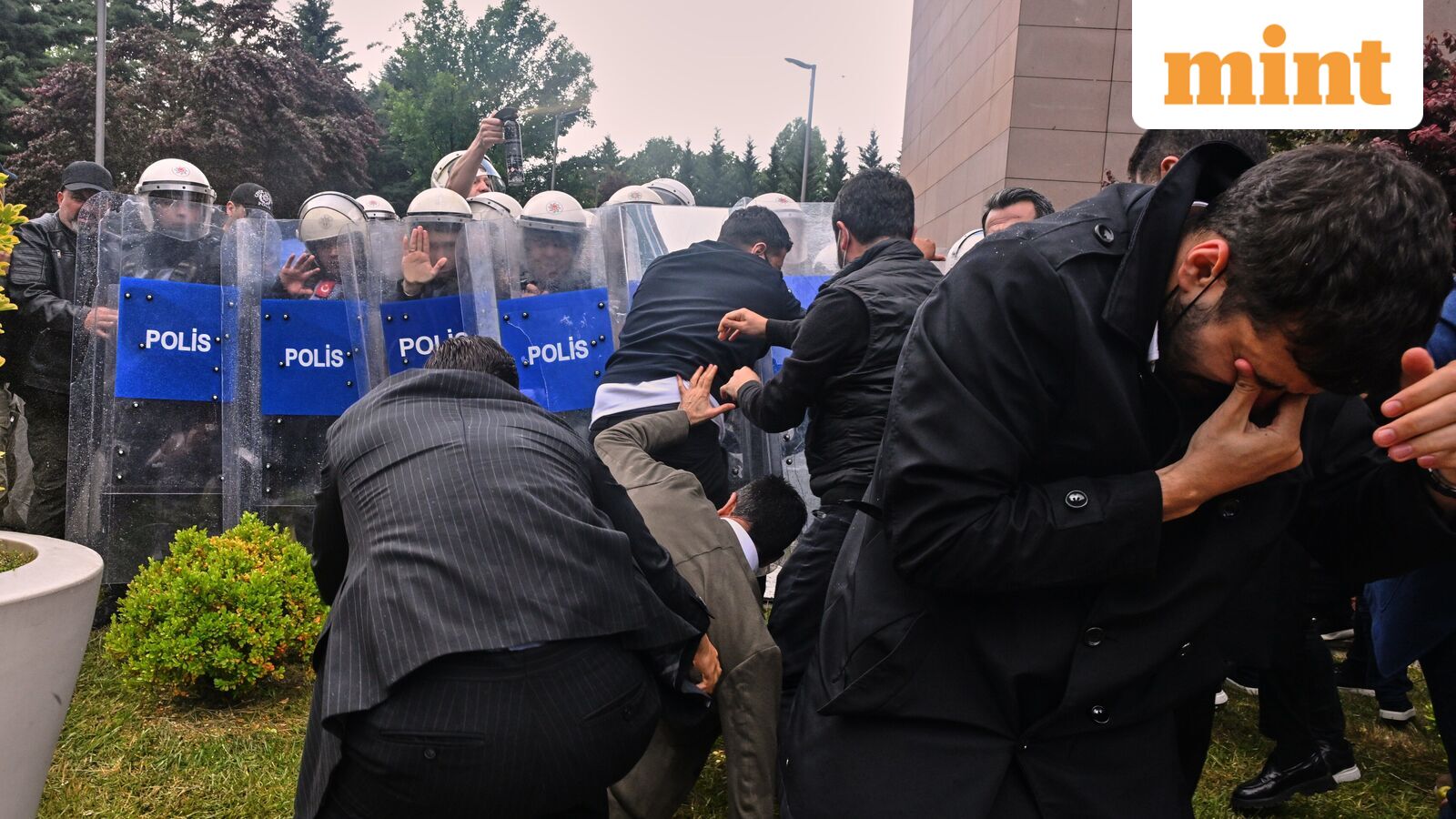
Turkish riot police on Sunday fired tear gas into the headquarters of the main opposition Republican People's Party (CHP) and forced entry to remove its ousted leadership, a direct escalation that began with a court ruling four days earlier. The event changes the risk calculus for Turkish assets, adding a layer of political uncertainty that could push the country toward an early election before 2028.
Court Ruling and Police Intervention at CHP Headquarters
A Turkish court on Thursday overturned the results of the CHP’s 2023 congress, removing Ozgur Ozel as party leader and reinstating former chairman Kemal Kilicdaroglu. The court cited alleged irregularities in the congress. On Sunday, the governor of Ankara ordered authorities to clear the party headquarters. Riot police breached a temporary barricade while people inside shouted slogans and hurled objects toward the entrance. Tear gas filled the building. No immediate reports of injuries emerged.
Ozel posted a video on X saying the party was “under attack.” After police intervention, he emerged to address supporters, who cheered and applauded. He declared the CHP would continue its struggle “on the streets and in the squares” and then led hundreds of supporters toward the Turkish parliament under heavy riot police presence.
Ozel Vows Legal Challenge While Calling for Fresh Congress
Ozel denounced the court decision as a “judicial coup” and vowed to challenge it through legal channels. He said he would continue staying at the CHP headquarters in Ankara “day and night.” On Saturday, he urged the party to convene a fresh congress at the earliest opportunity. Kilicdaroglu said such a meeting would take place at a “suitable” time. On the same day, CHP lawmakers elected Ozel as head of the party’s parliamentary group, underscoring continued support from the parliamentary wing.
Early Election Calculus: Erdogan’s Term Limits and the 2028 Schedule
Political analysts quoted in the source described the ruling as a crucial test of democracy in Turkey. The government has rejected accusations that the judiciary is being used against political opponents, insisting courts function independently. The sequence of events – a court removing an elected opposition leader, followed by police storming the party headquarters – raises questions about institutional checks and balances.
President Tayyip Erdogan, who has led Turkey since 2003, faces term limits that currently restrict him from seeking another term after 2028. Analysts noted that the latest court ruling could increase the likelihood of an early election. Erdogan is 72, and an early vote would allow him to potentially seek another term if the legal framework is adjusted. The next general election is currently scheduled for 2028.
The CHP’s electoral strength was demonstrated in 2019 when it won control of several key cities, including Istanbul, where Ekrem Imamoglu emerged as a widely popular leader capable of defeating Erdogan. The Sunday confrontation may further energize the opposition base.
Turkish Asset Risk: Lira, Bonds, and Capital Flows
Political turmoil in Turkey historically translates into a higher risk premium on lira-denominated assets and Turkish sovereign bonds. Foreign investors have reduced exposure to Turkish markets since the 2018 currency crisis, the CHP confrontation adds a fresh catalyst for capital outflows. The key question is whether the government can contain the fallout without a broader institutional crisis.
What Confirms the Risk Thesis
If the legal challenge by Ozel is rejected and the police action leads to sustained protests, Turkish financial markets will likely price in a higher probability of an early election. A snap vote would create uncertainty over policy continuity, particularly regarding monetary policy. The Turkish lira has already depreciated significantly in recent years, and further political instability could accelerate the trend.
What Would Weaken the Setup
A quick resolution of the CHP leadership dispute through an orderly fresh congress would reduce the political risk premium. If the court ruling is reversed on appeal or if Kilicdaroglu agrees to a new congress without confrontation, the immediate threat to stability subsides. Additionally, if the government demonstrates that the police action was limited and not part of a broader crackdown, investor anxiety may ease.
Catalyst Watch: Confirmation and Weakening Factors
Ozel’s legal appeal is the first catalyst to watch. A swift rejection would signal that the judiciary is aligned with the government, deepening the political crisis. The timing of a potential CHP congress is also critical – if Kilicdaroglu delays, the opposition remains fractured. Meanwhile, 13 people were detained on Saturday in connection with a probe into the 2019 CHP congress, accused of violations of political party laws, bribery, and laundering criminally obtained assets. Further arrests could escalate tensions.
Risk to watch: If the court ruling is upheld and Ozel's legal appeal fails, the probability of an early election rises sharply, pressuring the lira and Turkish bond yields.
Practical Framework for Monitoring
- Track the Turkish lira’s spot rate against the dollar. A break through key support levels would indicate rising risk aversion.
- Watch the yield spread between Turkish 10-year bonds and U.S. Treasuries. Widening spreads signal a loss of confidence.
- Monitor protests in Istanbul and Ankara. If turnout exceeds previous opposition rallies, the political risk premium will increase.
Bottom line for traders: The Turkish political landscape has shifted from a stable pre-schedule election path to a volatile near-term outlook. The CHP headquarters storming is not a one-off event – it is the visible result of a court intervention that challenges the opposition’s internal governance. Until the legal and political questions are resolved, Turkish assets carry an elevated risk of further depreciation. For broader stock market analysis context, similar political risk episodes in emerging markets have historically led to capital flight and currency weakness. The next concrete marker is the court’s decision on Ozel’s appeal.