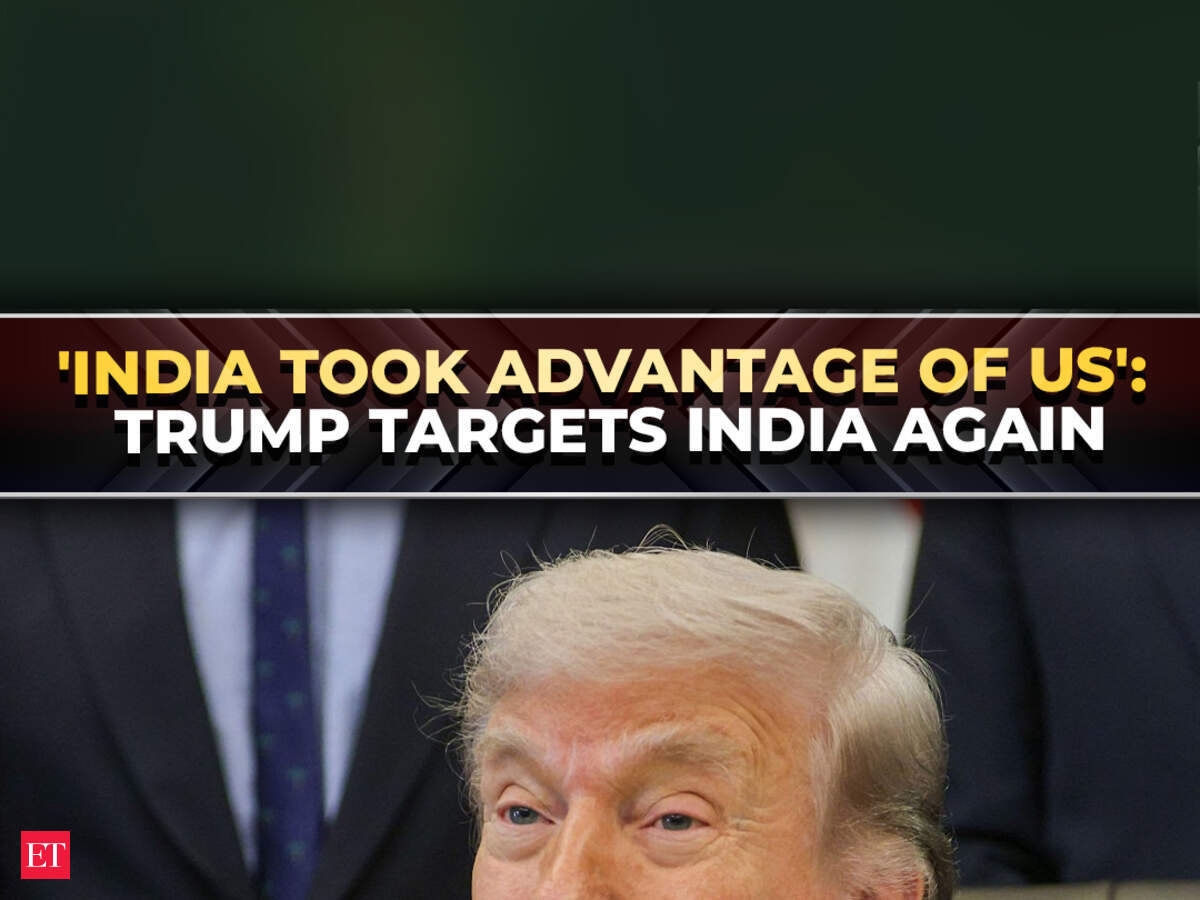
Former President Donald Trump accused India of having exploited the United States for years, injecting fresh uncertainty into bilateral trade negotiations just as a deal was nearing finalization. The comment, reported by the Economic Times, places a spotlight on the unresolved tariff and market-access issues that have defined US-India trade relations. For traders, the statement is a concrete risk event–not just political rhetoric–because it signals that the US side may demand structural concessions rather than incremental adjustments.
The simple read is that Trump's charge complicates the path to a deal, increasing the probability of higher tariffs on Indian exports. The better market read requires understanding the specific sectors, the tariff mechanisms in play, and the positioning that would amplify or cushion the blow.
The Trade Leverage Mechanism
Trump's statement suggests that the US negotiating team will take a harder line, potentially demanding reciprocal tariff reductions, greater market access for US agricultural and manufacturing goods, and limits on Indian digital services taxes. The mechanism works through two channels: direct tariff costs and investor sentiment re-rating.
How Tariffs Flow to Corporate P&Ls
Indian exporters to the US pay tariffs at customs. If the US raises duties on Indian goods, the cost can be passed to US consumers (reducing demand), absorbed by Indian producers (squeezing margins), or mitigated by currency depreciation. Each sector has different pass-through capacity.
Sentiment Re-Rating and Multiple Contraction
Even without new tariffs, the uncertainty of a trade dispute pushes equity risk premiums higher. Indian stocks trading at elevated price-to-earnings multiples–particularly in IT services, pharmaceuticals, and textiles–become vulnerable to multiple compression. A 5% tariff on a sector with 20% profit margins could wipe out 25% of net income if the tax cannot be passed through.
Sectors Most Exposed to US Trade Measures
The following sectors have the highest direct revenue exposure to the US market and the thinnest margin buffers.
IT Services: The Hidden Risk
Indian IT services companies like Tata Consultancy Services, Infosys, and HCL Technologies generate a substantial portion of revenue from US clients. While tariffs on services are rare, Trump has previously floated the idea of taxing cross-border digital services. A trade dispute could tighten H-1B visa approvals, increasing staffing costs for US operations.
Pharmaceuticals: Generic Drug Pricing Under Pressure
Indian generic drug makers–Sun Pharma, Dr. Reddy's, Cipla–face a different risk. The US is their largest export market. Trump's charge could be a prelude to executive action on drug pricing, which would directly impact margins. Tariffs on drug imports, while less common, have been threatened in previous trade disputes.
Textiles: Direct Tariff Hit
Textile exporters have the least pricing power. A 10% tariff on Indian garments would likely be absorbed by Indian manufacturers, crushing margins. This sector already faces competition from Bangladesh and Vietnam.
Timeline: What the Trade Deal Finalization Means
The quote comes ahead of a planned trade deal finalization. The precise date is not given, the negotiation window is narrow. A deal would likely include:
- Reduced US tariffs on Indian steel and aluminum (Section 232)
- Indian tariff cuts on US almonds, apples, and auto parts
- Resolution of digital services tax disputes
Trump's charge suggests the US side may demand more, delaying or scuttling the deal.
What Would Confirm a Worse Scenario
- Official US trade representative statements echoing Trump's accusation
- Announcement of new tariff actions against India (e.g., reinstating GSP revocation or adding new duties)
- Indian government retaliatory tariff threats on US goods
What Would Reduce Risk
- A deal signed within the current framework, even if modified
- Indian concessions that satisfy US demands without triggering a domestic political backlash
- US administration distancing itself from the campaign-style rhetoric
Affected Assets Beyond Indian Stocks
The trade risk is not contained to Indian equities. Exchange-traded funds tracking Indian markets–the iShares MSCI India ETF (INDA) and WisdomTree India Earnings Fund (EPI)–would see direct downside. US companies with significant India revenue, such as Coca-Cola, PepsiCo, and Mastercard, face their own tariff and regulatory risk if India retaliates.
Currency and Bond Markets
The Indian rupee tends to weaken during trade tensions as foreign portfolio investors reduce exposure. A 5% rupee depreciation against the dollar would offset some tariff impact for exporters, would hurt importers and increase inflation. Indian government bond yields could rise if foreign selling pressures build.
Positioning: How to Prepare for Trade-Driven Volatility
For active traders, the event introduces a catalyst that can break range-bound markets. Here is a practical framework:
- Identify high-beta names in exposed sectors. They will overshoot to the downside on bad headlines.
- Set volatility triggers. A 2% one-day drop in the Nifty IT index following a trade announcement could signal a deeper rotation out of India into other emerging markets.
- Watch the INR/USD pair. A break above 84 would indicate sustained foreign outflows.
What the AlphaScala Proprietary Data Tells Us
AMC Entertainment Holdings (Alpha Score 27/100, Weak) is not directly tied to US-India trade. Its low score reflects the broader risk environment for companies with high leverage and discretionary exposure. The same principles apply to Indian stocks with weak balance sheets: they will be first to sell off if trade uncertainty rises. See the AMC stock page for context on how weak scores correlate with tariff sensitivity.
Next Decision Point for Traders
The next concrete marker is any official statement from the US Trade Representative or the Indian Ministry of Commerce. If the charge remains a campaign-style remark without policy follow-through, the risk premium will fade. If it becomes the administration's position, expect a repricing across Indian equities and the rupee.
For a broader analysis of how trade wars affect portfolio construction, see our stock market analysis guide. Traders adjusting their watchlist may also consult our ranking of the best stock brokers for international exposure.
The asymmetry of outcomes favors a cautious allocation: reduce exposure to tariff-sensitive sectors and set stop-losses wider to accommodate volatility. If the deal gets done, the selloff could be a buying opportunity. If it collapses, the drawdown will be sharper than consensus expects.