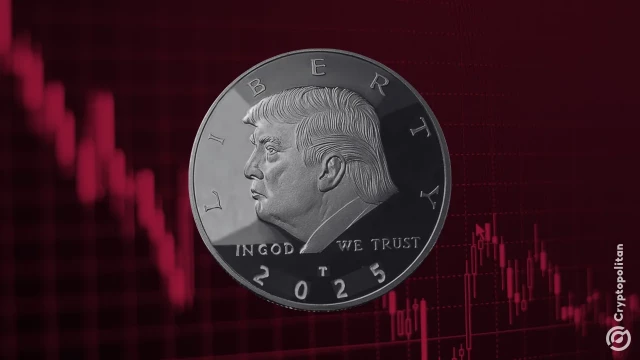
President Donald Trump earned $636 million from the Official Trump (TRUMP) memecoin. The people who bought it lost $3.81 billion through the end of June, according to blockchain analytics firm Nansen and Trump's 2025 financial disclosure.
Nansen counted 988,905 wallets that booked losses. The firm's tally, first reported by The New York Times, includes both realized losses and paper losses still sitting in unsold wallets. Roughly two in three wallets that ever bought TRUMP are underwater. Fewer than 500,000 wallets booked about $4 billion in profit. Nansen said those gains went to early buyers and automated traders who bought before the run-up and sold into the crowd that followed.
The token itself tells the story. TRUMP changed hands near $1.76 on Friday, about 97% below the $75.35 peak it hit on January 19, 2025, the day before Trump's second inauguration, per CoinMarketCap data. He had launched the coin three days earlier and promoted it on Truth Social.
Retail buyers needed the price to climb. Trump did not. The memecoin earned money from trading activity itself, so he gained revenue whether the token rose or fell. That structure is the difference between the two numbers.
His financial disclosure fills in the rest. The filing reported at least $1.4 billion in crypto-related income for the year, more than half of the $2.2 billion Trump reported overall. According to Cryptopolitan, the $1.4 billion in crypto earnings comprises $635 million in memecoin royalties, $527 million from token sales by World Liberty Financial, and approximately $263 million from stakes in related companies.
World Liberty Financial buyers have fared poorly too. Nansen found that 85% of the 26,663 WLFI wallets it tracked incurred losses of approximately $83 million, offset by roughly $23 million in profits. The company cautioned that the actual damage is likely larger, as many exchange trades cannot be traced on-chain. WLFI traded near $0.056 on CoinMarketCap, down about 88% from its September 2025 high.
Not every buyer remained quiet. Nicholas Pinto told The New York Times he put around $500,000 into TRUMP after backing Trump in the 2024 election and figures he is down about half. He called the project "almost a legal scam."
Asked about the income in a CNBC interview, Trump said he did not know his crypto ventures had earned at least $1.4 billion, that he could find out the exact figure if he wanted to, and that there was nothing wrong with making money from digital assets. He added that he had no intention of pulling his family out of the business. White House spokeswoman Anna Kelly told The New York Times that Trump had turned the United States into the "crypto capital of the world" and acted in the country's interest.
The Ethics Bill That Could Block Future Memecoin Presidents
The numbers arrived as lawmakers put finishing touches on a crypto market structure bill. Democrats are putting up a fight. Senator Kirsten Gillibrand renewed her calls for ethical guardrails that will prevent the president, members of Congress, and their families from profiting off digital assets.
"We cannot allow members of Congress, senior administration officials, presidents, or vice presidents to get rich off these industries because of their insider status," she said in May at the Consensus Miami conference.
Gillibrand also co-sponsors the End Crypto Corruption Act, a separate bill from Senator Jeff Merkley with 19 Democratic co-sponsors. It would stop senior officials and their families from issuing or endorsing tokens, memecoins, NFTs, and stablecoins.
Senators Elizabeth Warren, Ruben Gallego, and Angela Alsobrooks have made similar arguments. Gallego wrote on X that "Trump is using the presidency to profit off the American people."
Republicans want to move quickly. South Carolina Senator and Banking Committee Chairman Tim Scott has called for a full Senate vote this month, just before the August recess. The committee voted 15-9 on a substitute amendment. Gallego and Alsobrooks voted to move the bill out of committee but would not guarantee a floor vote if ethical concerns were not addressed.
If senators can agree on ethical provisions while settling anti-money-laundering and DeFi oversight questions before the recess, the bill has a strong chance of passing. The NOBLE Endorsement Gives CLARITY Act a Lift Before Senate Recess covers similar dynamics in the broader market structure debate.
The TRUMP memecoin case is a concrete example of why those ethical provisions matter. The revenue model separated the creator's incentives from the buyers'. For anyone tracking crypto market analysis, the question is whether the next memecoin president will face the same rules.